
The Impact of AI in Garment Design: Reducing Lead Times by 40%
Introduction
The garment manufacturing industry, traditionally reliant on manual processes and extensive sampling, is undergoing a profound transformation with the integration of Artificial Intelligence (AI). From conceptualization to production, AI is revolutionizing every stage of the design and development lifecycle, most notably in its ability to drastically reduce lead times. For B2B manufacturers like Yingzhuo, leveraging AI in garment design is becoming a critical competitive advantage, enabling faster market response and enhanced customization for global brands.
AI-Powered Design and Trend Forecasting
AI’s initial impact is often seen in its analytical capabilities:
•Trend Prediction: AI algorithms can analyze vast amounts of data from social media, fashion blogs, sales figures, and runway shows to predict upcoming trends with remarkable accuracy. This allows designers to create collections that are highly likely to succeed.
•Generative Design: AI can generate novel design variations based on specified parameters (e.g., fabric type, silhouette, target demographic), providing designers with a wealth of creative options and accelerating the initial sketching phase.
Digital Prototyping and 3D Visualization
Perhaps the most significant contribution of AI to reducing lead times comes from digital prototyping:
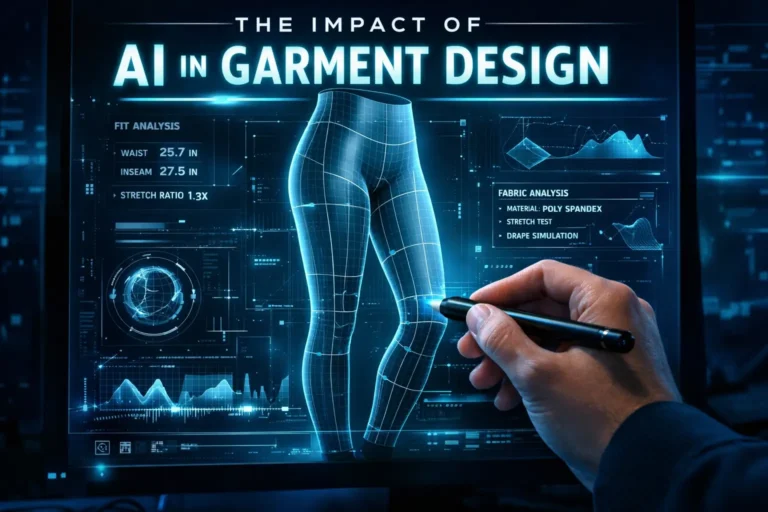
•Virtual Samples: Instead of producing multiple physical samples, AI-powered 3D design software allows for realistic virtual prototypes. These digital samples can be rendered with accurate fabric drapes, textures, and fits, eliminating the need for costly and time-consuming physical iterations.
•Instant Feedback: Brands can review and approve designs virtually, making real-time adjustments and significantly shortening the approval cycle. This alone can cut weeks off the traditional development timeline.
•Pattern Optimization: AI can analyze 3D designs and automatically generate optimized 2D patterns, minimizing fabric waste and ensuring precise fit, which directly translates to faster production setup.
AI in Pattern Making and Grading
Traditional pattern making and grading are labor-intensive and prone to human error. AI streamlines these processes:
•Automated Pattern Generation: AI can convert 3D designs into precise 2D patterns, accounting for fabric stretch and garment construction.
•Intelligent Grading: AI algorithms can accurately grade patterns across multiple sizes, ensuring consistent fit and reducing the need for manual adjustments.
•Fabric Utilization: AI can optimize fabric layout for cutting, minimizing waste and maximizing material efficiency, which is crucial for sustainable manufacturing.
The Impact on Lead Times and Cost Efficiency
The cumulative effect of AI integration across these stages is a dramatic reduction in lead times, often by 40% or more.
•Faster Time-to-Market: Brands can bring new collections to market much quicker, capitalizing on fleeting trends.
•Reduced Sampling Costs: Eliminating multiple physical samples saves significant material, labor, and shipping costs.
•Improved Accuracy: AI minimizes errors in design and pattern making, leading to fewer production delays and rework.
Conclusion
AI is no longer a futuristic concept but a present-day reality transforming garment manufacturing. For B2B partners, collaborating with manufacturers who have embraced AI in design and development, such as Yingzhuo, means gaining a crucial competitive edge. It promises not only faster lead times and cost efficiencies but also a more innovative, sustainable, and responsive supply chain, essential for success in the dynamic global activewear market.