Rash Guard Manufacturing: UPF Ratings, Fabrics and Fit Explained for Brands

Walk into an REI in Denver or a Decathlon in Manchester and the sun-protection rack now takes up more floor space than the fashion swimwear beside it. Twenty years ago the rash guard was surf-shop equipment, sold next to board wax. Today dermatologists recommend sun-protective clothing by name, and parents buy kids rash guard sets before a first swim lesson. The category has kept growing through retail cycles that flattened ordinary swimwear, and it rewards brands that treat it as technical apparel rather than a beach novelty.

This guide is for founders, product developers and sourcing buyers who are planning a rash guard or swim shirt line. It walks through the decisions that determine whether a product earns its hangtag claims, from category definition through UPF ratings, fabric behavior and the fit choices that define a range. It closes with a lower-risk launch path and the questions brands ask us most often.

What Separates a Rash Guard from a Swim Shirt

The two labels get mixed constantly, sometimes by factories, so a clean definition protects you at the briefing stage. A rash guard is a fitted athletic top, originally built for surfers to stop board rash and wetsuit chafe. It sits close to the body because it has to work under a wetsuit and against a waxed deck, and a true surf rash guard adds flatlock seams plus a small connector loop at the hem that ties into boardshorts, so the top stays put in the water.

A swim shirt is the relaxed cousin. It is cut like a t-shirt, worn loose for casual sun coverage at the pool or the lake, and it trades hydrodynamics for comfort. Many swim shirts carry no tested UPF rating at all. That gap is your opportunity, because shoppers increasingly read hangtags, and a tested UPF 50 rash guard gives them a concrete reason to pay more for yours.

Search data shows how wide the demand runs. Queries like rash guard women, men’s rash guard and rash guard for swimming are three different buyers with three different fit expectations, and your range plan should treat them as separate products, not one pattern graded up and down. The same goes for retail channels. Surf shops want credibility, department stores want family coverage, and swim schools want durability.

UPF Ratings: Where the Number Comes From

UPF stands for Ultraviolet Protection Factor, and the math behind it is refreshingly simple. A fabric rated UPF 50 lets one fiftieth of the sun’s UV radiation through, which means it blocks roughly 98 percent. Ratings above 50 get labeled 50+, because finer distinctions stop meaning much on skin.

The rating is not self-declared. Brands typically send fabric to a third-party lab that tests to a recognized standard, most often AATCC 183 in the United States or AS/NZS 4399, the Australian and New Zealand method that much of the surf industry cites. Keep the report on file for every colorway you sell, because retail buyers and marketplaces increasingly ask to see it, and different colors of the same fabric can rate differently.
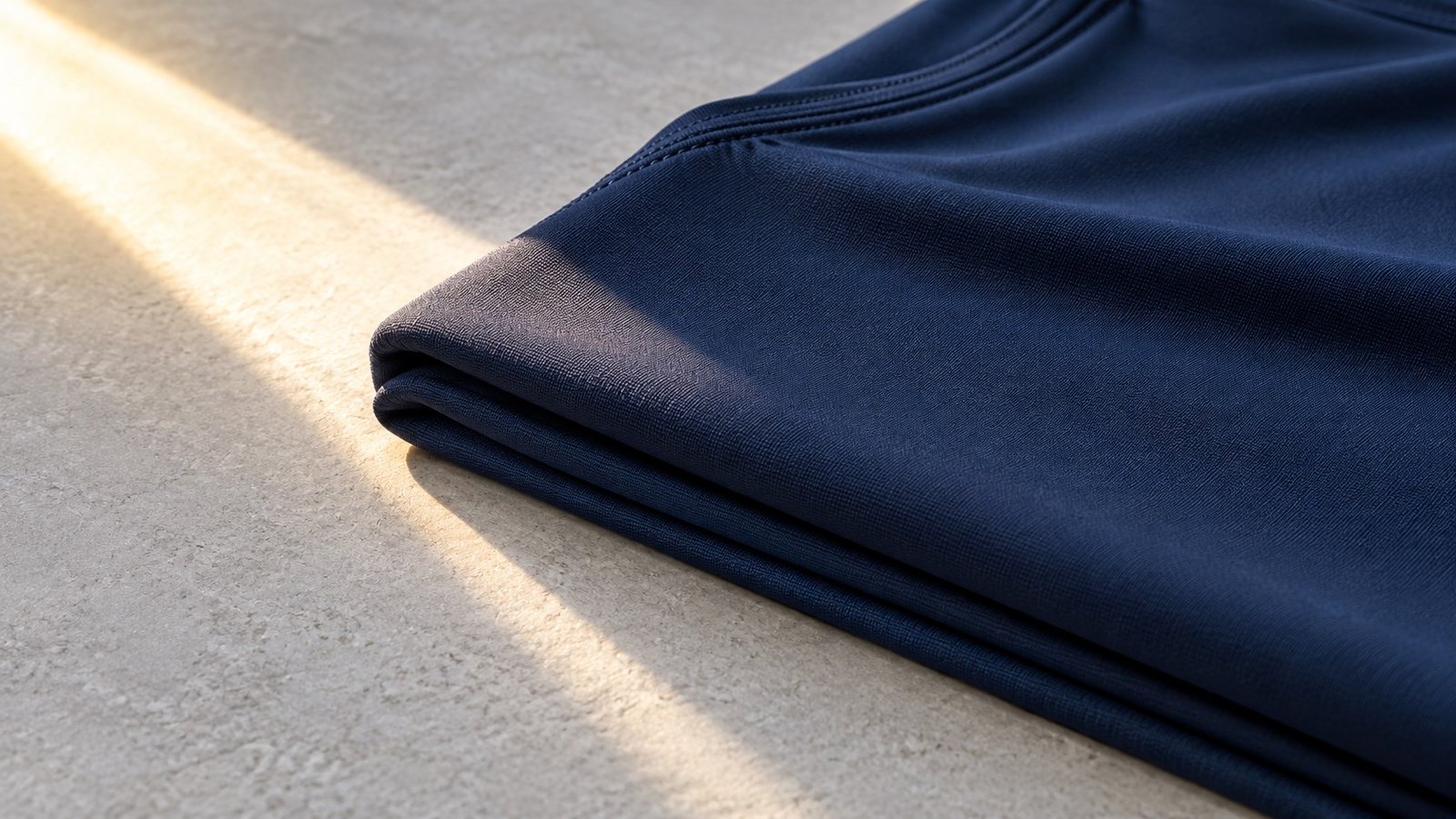
Rash guard fabric with a UPF 50+ rating shielding skin from ultraviolet rays
UPF 50+ fabric transmits about one fiftieth of incident UV. Ask whether the lab result also covers the fabric stretched and wet.

Fabric decisions set the rating long before any lab gets involved. Tighter knits leave smaller gaps for light to pass through, so knit density matters more than almost anything else. Weight helps too, and most rash guard fabrics run from about 180 to 220 gsm for exactly this reason. Color works in your favor as it deepens. Darker and more saturated dyes absorb more UV, which is why the same quality in black usually out-protects it in white.

The factor brands forget is stretch. When a snug garment extends over a shoulder or a flexed back, the knit opens and protection drops. A fabric that tests 50+ flat on the table can rate meaningfully lower on a moving body. Ask your factory for the rating at realistic stretch, wet and dry, and grade your fit so the garment sits snug rather than strained.

Fabric Choices for a Rash Guard Line

Nylon-spandex, usually around an 80/20 blend, gives the softest hand feel and the matte look that premium surf brands favor, which makes it the default base for a quick dry rash guard with lifestyle or surf positioning. Its weakness is pool water. Nylon loses stretch and color faster under chlorine, so a nylon top worn in a chlorinated pool three times a week will age within a season.

Polyester-spandex costs a little less, takes sublimation prints beautifully and shrugs off chlorine far better than nylon. If your line is print-heavy or priced for volume retail, polyester is usually the right base, and its slightly slicker hand feel is one some buyers prefer anyway. For swim schools, clubs and lap-swimming ranges, go a step further and spec chlorine-resistant PBT. It trades a little softness for shape and color that survive hundreds of pool hours, which is why training gear relies on it so heavily.

Whichever fiber you choose, hold the line on genuine four-way stretch and test recovery, the snap-back that keeps elbows and cuffs from bagging out. A fabric can stretch wonderfully and still fail your customer by staying stretched. If you want hands on swatches before deciding, our Zhongshan factory pulls rash guard qualities from a fabric library of more than 5,000 options, including recycled alternatives, and swatches of all three routes above go out with every development brief.
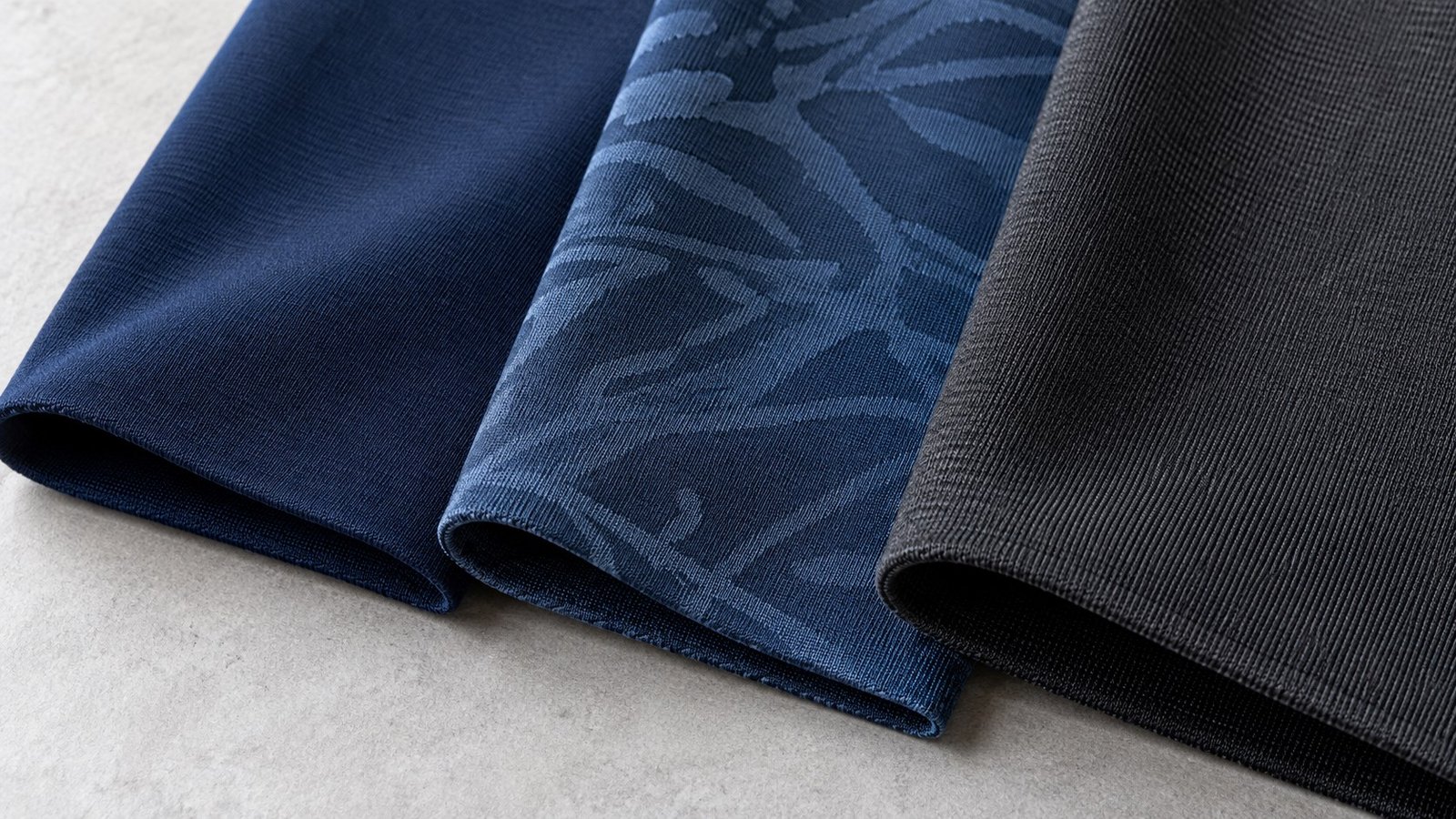
Close-up of quick dry rash guard fabric swatches in nylon-spandex, polyester-spandex and chlorine-resistant PBT
Nylon-spandex for softness, polyester-spandex for prints and chlorine resistance, PBT for heavy pool use.

Fit, Sleeves and Seams That Define the Range

Sleeve length is your first segmentation call. A long sleeve rash guard maximizes coverage and carries the strongest sun-protection story, while short sleeves sell into warm water and high-mobility sports. Many brands launch both on the same body pattern, which keeps pattern costs contained while doubling the range they can present to buyers.

Closures widen the audience further. A zip up rash guard serves older customers, anyone who dreads pulling a tight wet top overhead, and parents dressing squirming kids. Specify a zip garage at the collar so the pull never touches skin, plus a backing placket so water does not flush through the teeth. A hooded rash guard answers the surf, paddle and open-water crowd, where scalp and neck burn fastest. Keep the hood light and close-fitting so it stays put in wind and water.

Fit intent shifts by customer. A men’s rash guard usually runs straighter through the torso with room in the shoulders, while women’s styles shape at the waist and need real attention to bust fit. Kids rash guard patterns call for easier entry, higher necklines and generous armholes, because a parent, not the child, decides whether the shirt goes back on after lunch.

Seams decide whether any of this gets worn. Flatlock stitching lies flat against the skin instead of ridging the way an overlock seam does, and on a garment worn wet against moving skin, that is the difference between all-day comfort and a rash of the wrong kind. Raglan sleeves clear seam bulk off the shoulder for paddling. A specialist swimwear factory reaches for these answers without being asked, which is one quiet way to tell one from a generalist.
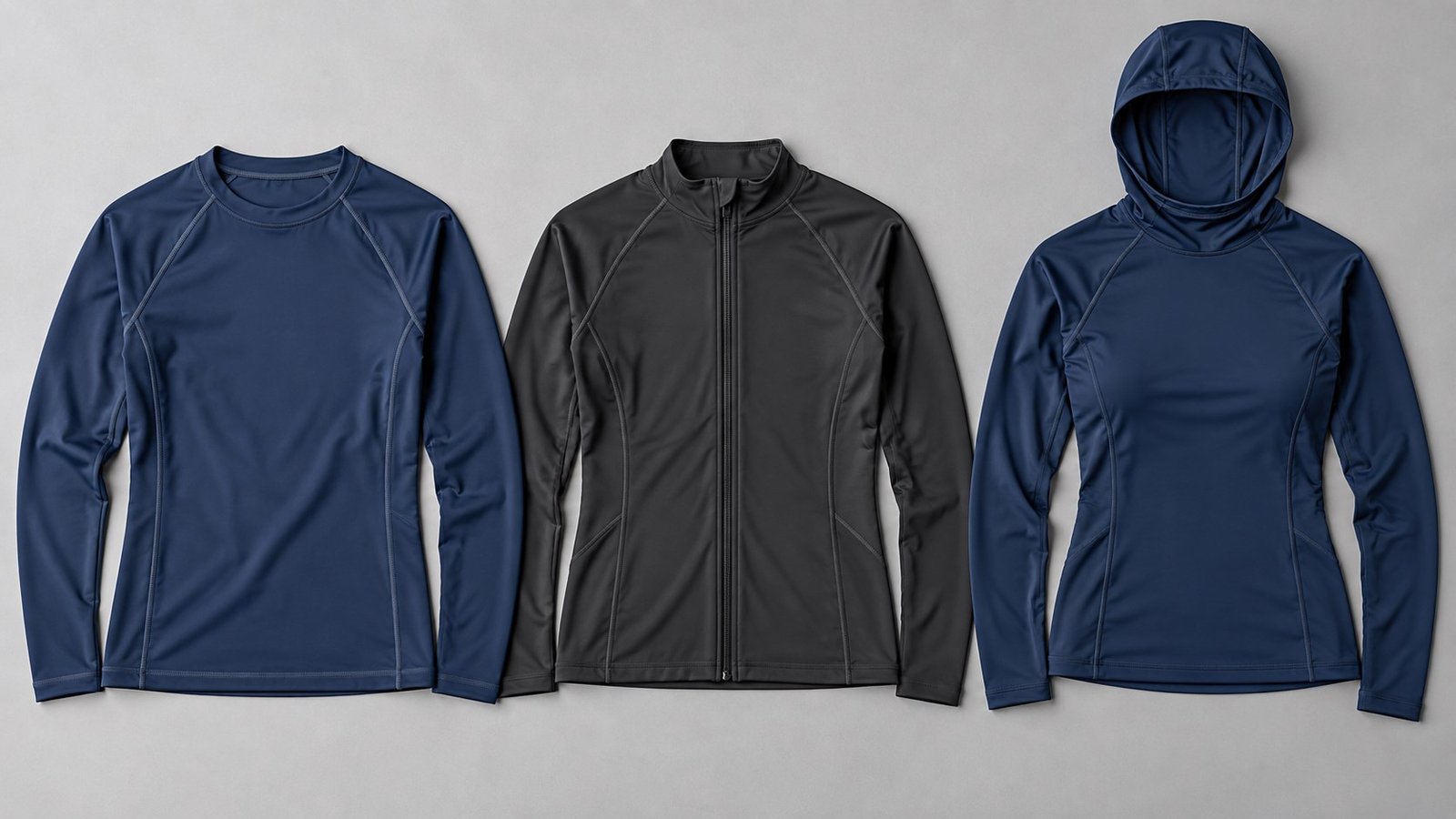
Flat lay of long sleeve, zip up and hooded rash guard styles showing the fit range
Long sleeve, zip-up and hooded variants can share one base pattern, keeping development cost down while widening the range.

A Lower-Risk Way to Launch Your Rash Guard Line

The most common first-order mistake is developing a fully custom range before anyone knows what sells. The safer path starts from proven, in-production blocks. At Enjoy Apparel, an OEM and ODM swimwear factory in Zhongshan, China, we keep more than 1,000 ready styles across swimwear and sun protection, and many brands launch their first rash guard range by putting their own colors, prints and logos on those blocks before committing to original patterns.

From there, development follows the sell-through. Styles that move get refined fits, exclusive prints and eventually fully custom patterns, which an exclusive design agreement can protect. Styles that stall cost you a test order rather than a season of development budget. Either way, the money goes into information you can act on.

If a rash guard line sits on your roadmap, send the sketch or the mood board to our team over WhatsApp, +852 9641 7199. You will hear back with fabric options, a shortlist from the ready range and an honest read on where to start.

Frequently Asked Questions

What is the difference between a rash guard and a swim shirt?

A rash guard is a close-fitting athletic top built for in-water sport, usually with flatlock seams and a tested UPF rating. A swim shirt is a looser, t-shirt-cut garment for casual sun coverage. They overlap at the casual end, but the fit, the seams and often the fabric weight make them genuinely different products, and your tech pack should say which one you are building.

What UPF rating should my line target?

UPF 50+ is the rating customers recognize and the one most retailers treat as the credible floor for a sun-protection claim. Lower ratings exist, but they are difficult to market when the hangtag beside yours says 50+. Set the fabric spec so the garment still earns 50+ stretched and wet, not just flat and dry on a lab bench.

What is your MOQ for rash guards?

Our floor is 100 pieces per style on a custom rash guard order, with the exact figure shaped by your fabric and color choices. Sampling runs 14–21 days once fabric, colors and artwork are locked. Launching on a ready style with your own colors and branding is the fastest route to that first order.

Can you add our logo to rash guards?

Yes, and rash guards take decoration well. Heat transfer logos are the category standard because they sit flat and stretch with the fabric. Silk screen suits bold chest and back prints, while silicone, reflective and embroidered marks fit premium or surf-positioned lines. Share your artwork and we will recommend the method that survives the water your customers swim in.
EU Green Claims Rules and Your Swimwear Brand: What You Can and Cannot Say

The email usually lands on a Tuesday morning. A swimwear brand selling into Europe opens a message from a marketplace compliance team, or from a consumer protection authority, asking for the evidence behind a phrase like “sustainable swimwear for women” on one of its collection pages. The hangtags are printed, the leaf icon was expensive, and the fabric choices genuinely are better than average. None of that answers the question.

Since September 27, 2026, that question has legal teeth across the EU. The Empowering Consumers for the Green Transition Directive, formally Directive (EU) 2024/825, now treats unsubstantiated environmental claims as unfair commercial practices in every member state. This guide is for swimwear and activewear brands selling into Europe. It covers what changed, which words are now risky, how recycled fabric claims survive scrutiny, and what your factory should be handing you.

What Actually Changed in September 2026

The directive was adopted in February 2024, member states had until March 2026 to write it into national law, and it has applied across the EU since September 27, 2026. It amends the Unfair Commercial Practices Directive, which governs how any business may market to consumers, and adds new entries to the blacklist of practices banned in all circumstances, with no need to prove consumer harm in each case.

For apparel brands, three additions matter most. Generic environmental claims such as “eco-friendly,” “green,” or “sustainable” are banned unless the product can show recognized excellent environmental performance, a bar set at roughly EU Ecolabel level. Product-level “carbon neutral” claims built on offsetting are banned outright. And sustainability labels invented by the brand itself, without independent third-party certification behind them, are gone too. The same directive also adds pre-purchase information duties on durability and repair, plus a harmonized guarantee notice, though those bite harder on hard goods than on swimwear.

Scope reaches beyond Europe. The rules attach to commercial practices aimed at EU consumers, not to where a company is registered, so a brand in Austin or Sydney shipping orders to France or listing on an EU marketplace is inside them. Penalties are set by each member state, and for widespread infringements they can reach at least 4 percent of the trader’s turnover in the countries concerned.

The separate Green Claims Directive tells a different story. That proposal was meant to define exactly how claims must be substantiated and verified, but it was paused in June 2025, when the European Commission announced its intention to withdraw the file and the final negotiation round was cancelled. As of this writing it remains unadopted, with no application date and an undecided future. The uncertainty changes nothing about the rules above, which are already binding law.

The Words That Put You at Risk

“Generic” is the legal core of the ban. A claim counts as generic when it is not tied to a specific, verifiable aspect of the product in clear and prominent terms wherever the claim appears. “Sustainable swimwear” on a product page promises everything and specifies nothing, which is exactly the pattern regulators are now empowered to challenge.

The Commission’s own guidance lists “environmentally friendly,” “eco-friendly,” “green,” and “nature’s friend” as examples of generic wording, and a headline like “eco-friendly swimwear” falls in the same bucket. Industry lawyers add “conscious,” “planet-friendly,” “responsible,” and “kind to the ocean” to the risk list.

Collection names count as well. A line marketed as your conscious or earth collection functions as a claim about every product inside it, even if the product pages themselves are carefully worded. Imagery can count as a claim too, since a leaf icon or a green-tinted logo beside a product name reads as an environmental statement whether or not any words accompany it.

Specific, measurable statements are the safe ground. “Made with 78 percent recycled nylon” is a composition claim. It can be true or false, it can be checked, and the directive leaves room for it as long as the evidence holds. The same logic applies in reverse to words like “recyclable” or “biodegradable,” which now need real-world qualification rather than wishful labeling.

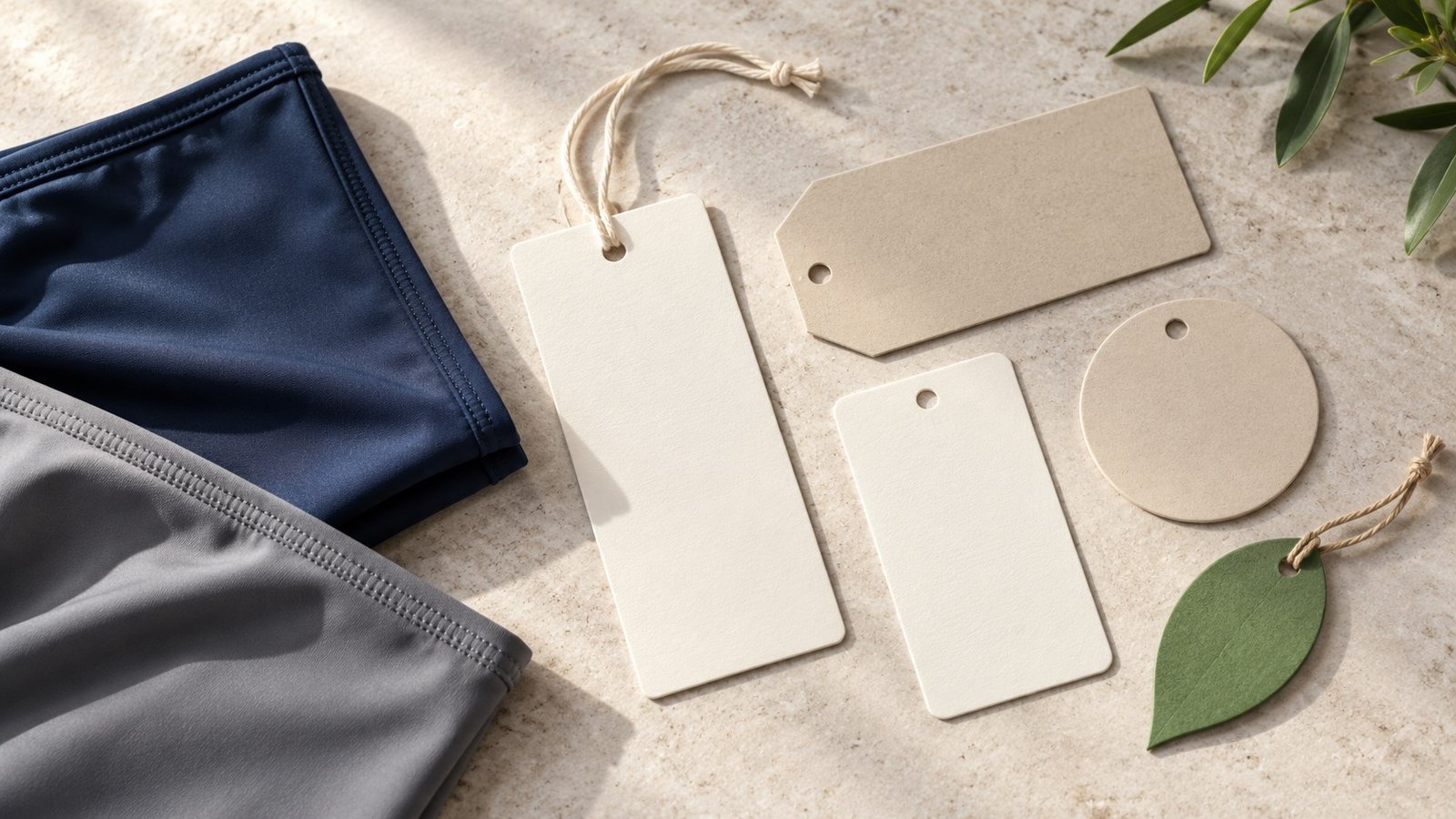
Close-up of blank swimwear hangtags and fabric swatches laid out for review under the EU green claims rules
Hangtag wording is marketing copy in the legal sense, and it now carries the same evidentiary burden as any ad.

Recycled Fabric Swimwear Claims Under the New Rules

Swimwear marketing leans hard on recycled synthetics, and for good reason. Regenerated nylon spun from recovered fishing nets and industrial waste, and recycled polyester made from PET bottles, are real inputs with traceable supply chains. That traceability is precisely what makes recycled fabric swimwear claims defensible under the new rules, provided the paperwork chain is complete from yarn to finished garment.

Precision is what separates a claim from a violation. “Made with recycled materials” without numbers is now a liability. A defensible version states the recycled content percentage of the fabric, names which components it covers, and references the standard behind it. The main fabric of a bikini might carry the recycled content while the lining, straps, and trims do not, and the copy should say so.

For most swimwear supply chains, that standard is the Global Recycled Standard. GRS certifies products with recycled content from 20 percent upward, and the certificate states the exact percentage, so a fabric certified at 50 percent recycled content cannot be marketed as fully recycled.

The chain of custody runs on two documents. Scope certificates are held by each certified handler in the chain, and transaction certificates are issued for each shipment lot. The transaction certificate is the piece of paper that ties your marketing sentence to a physical batch of fabric, which is why brands should see it before they write the copy, not after a regulator calls.

Consistency across channels is the trap most brands fall into. A product page can be fully compliant while an Instagram ad shouting “100 percent sustainable bathing suits” creates the violation. Hangtags, product pages, marketplace listings, paid ads, and influencer briefs all need to carry the same claim in the same qualified form, because regulators read them as one body of marketing.

Brands still choosing materials will find recycled nylon and recycled polyester options alongside conventional swim knits in our fabric library, which is where most of these conversations with clients begin.

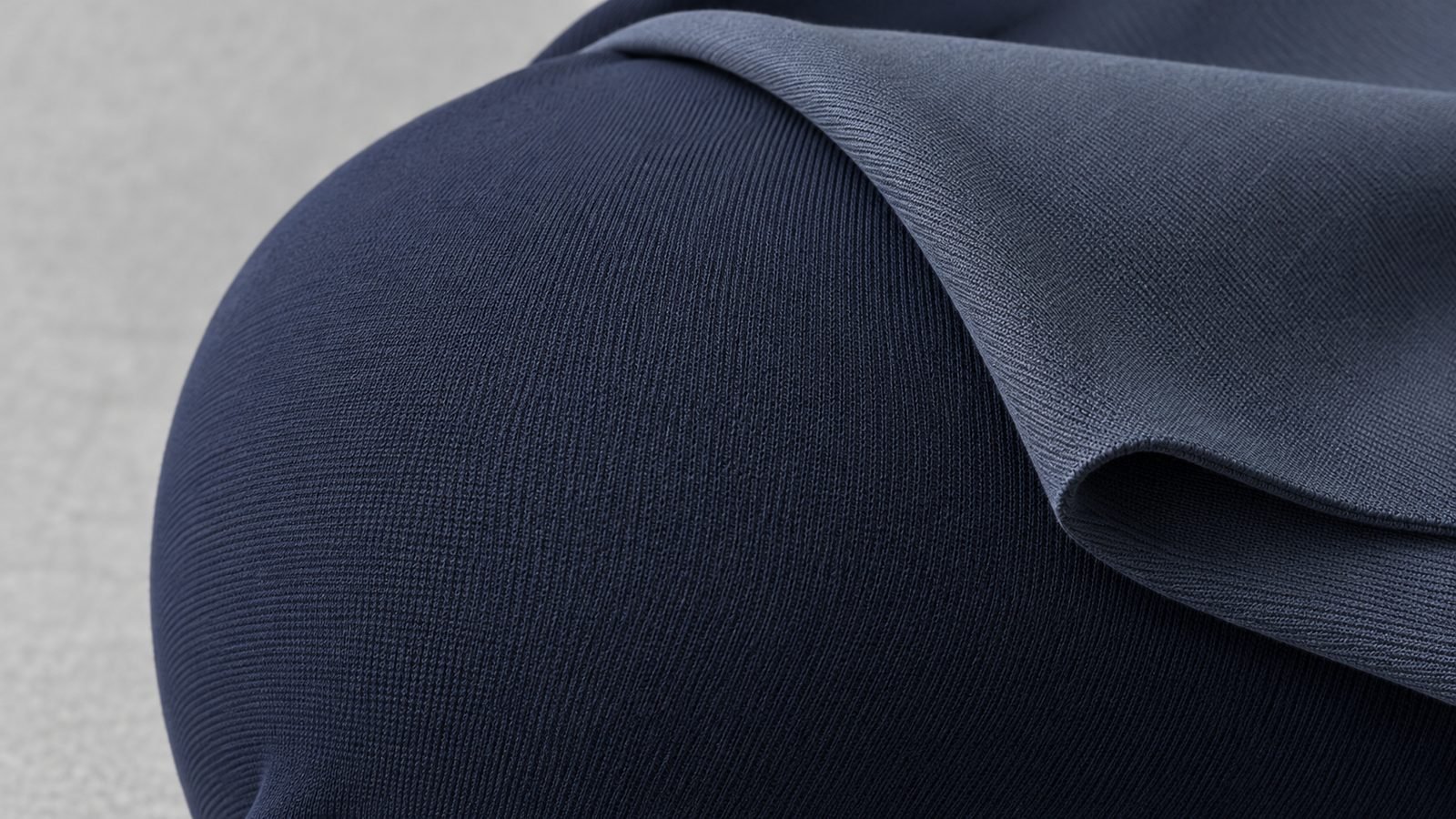
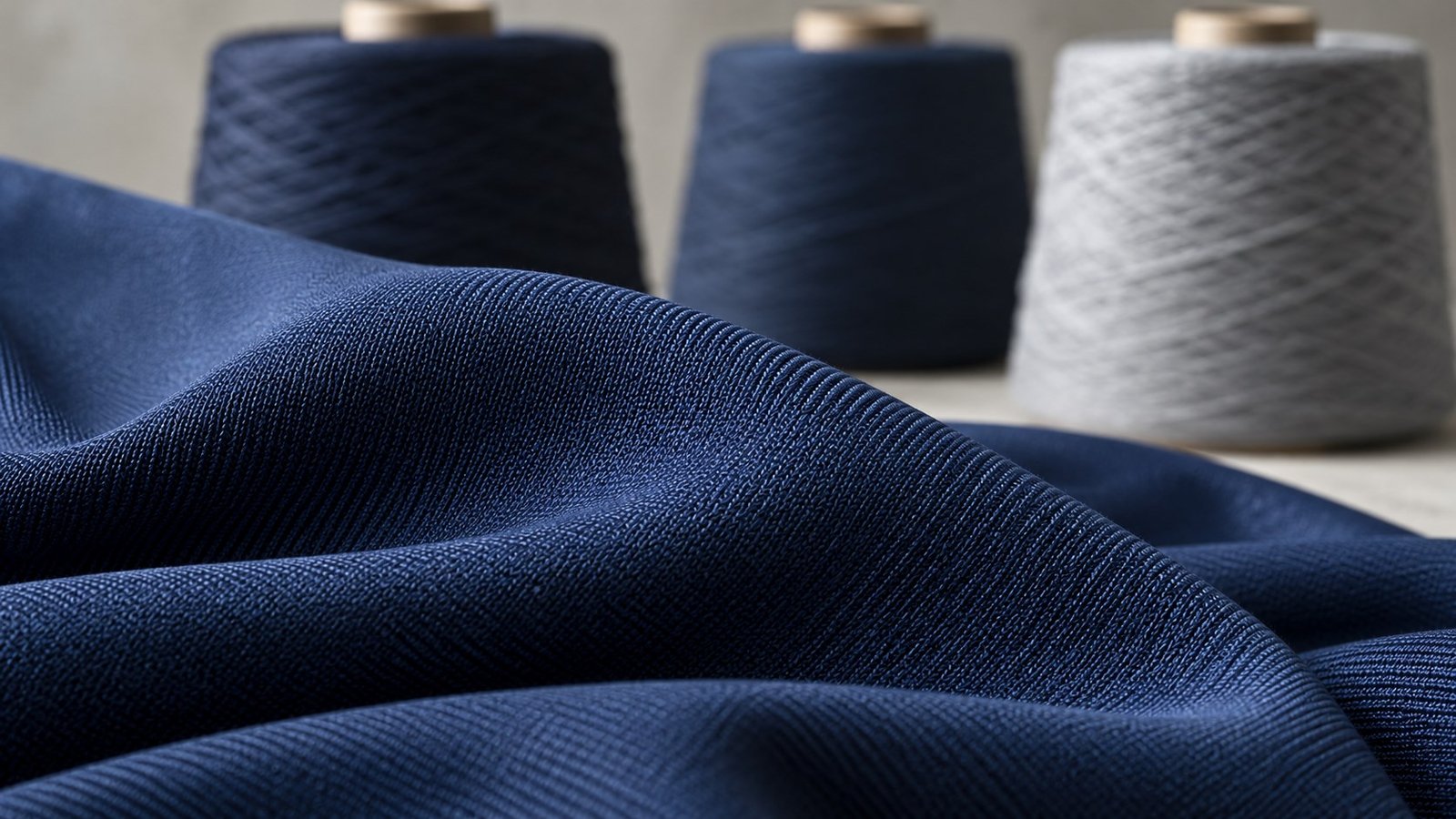
Close-up texture of recycled nylon swimwear fabric in deep blue with yarn cones in the background
Recycled nylon and polyester dominate EU-facing sustainable swimwear lines, and every percentage in the copy must match a certificate.

The Paperwork Your Supplier Should Hand You

Environmental claims live or die on supplier documentation, which makes your factory part of your compliance setup whether it wants to be or not. A serious supplier should be able to produce the mill’s composition specification for each fabric, the fabric supplier’s GRS scope certificate, and the transaction certificates for the lots that went into your production run. If any of those documents does not exist for a fabric you are already marketing, closing that gap is your job before it becomes a regulator’s.

Fabric certification has a second layer worth understanding. OEKO-TEX® STANDARD 100 certified fabrics have been tested for harmful substances, which supports careful “tested for harmful substances” language. It is not an environmental virtue claim, and it does not prove recycled content, but it keeps the safety side of your copy honest while GRS documents the material side.

At Enjoy Apparel, lot-level paperwork travels with the goods as standard practice. When a client builds a recycled-content collection with us, the GRS transaction certificates and mill specifications for the fabrics used are compiled into the shipment file, and the same discipline runs through our OEM/ODM services from development through bulk production. Your marketing team ends up holding evidence rather than promises.

What to Do Before Your Next EU Season

Compliance here is mostly boring, methodical work, and it is cheaper than a forced rebrand. Before your next collection ships to Europe, work through the following.

  • Audit every environmental claim across your website, packaging, and ad library, and flag each undefined green word for rewriting or removal.
  • Replace generic claims with specific composition statements that name the fiber, the percentage, and the certifying standard.
  • Check that every percentage you publish matches the figure on the relevant certificate exactly, including which components it covers.
  • Align hangtags, product pages, marketplace listings, and influencer briefs so the same qualified claim appears everywhere.
  • Collect supplier documentation before bulk production starts, not after the first complaint.
  • Remove offset-based “carbon neutral” product claims from all EU-facing materials.
  • Keep one evidence file per style so any claim can be substantiated within days, not months.
Desk scene with blank compliance documents and recycled fabric swatches prepared for an EU green claims review
Certificates, swatches, and a per-style evidence file are the working materials of EU green claims compliance.

If your next collection uses recycled fabrics and you want the documentation to arrive with the goods, email admin@zsenjoyco.com with the claims you plan to make, or talk them through with our team on WhatsApp, +852 9641 7199. Ten minutes before production beats rewriting a season of marketing afterward.

Frequently Asked Questions

Does this apply to brands based outside the EU?

Yes. The rules follow the consumer rather than the company’s headquarters. Any trader directing commercial practices at EU consumers falls inside the framework, which includes US, UK, and Australian brands shipping orders to EU customers or listing on EU marketplaces.

Can I still say my swimwear is made with recycled fabric?

Yes, as long as it is framed as a specific claim. State the recycled content percentage, name which component it applies to, and hold the certification chain, typically GRS or RCS, that ties the fabric lot to your production run. Unquantified “recycled” language is where brands get into trouble.

Is the word “sustainable” banned completely?

For most apparel marketing, treat it as banned. A generic claim like “sustainable swimwear” is only permissible where the product demonstrates recognized excellent environmental performance, a threshold roughly at EU Ecolabel level that few garments meet. Replace it with specific, provable statements about materials and processes.

What documents should I ask my swimwear supplier for?

Ask for the mill’s composition specification for each fabric, the fabric supplier’s GRS scope certificate, the transaction certificate covering each fabric lot in your order, and test reports behind any safety or performance language. Request them before bulk production and keep a file per style.

What a Swimwear Factory Visit Tells You That a Hundred Emails Never Will

The drive in from the highway runs past fabric markets and dye houses, and then through the gate of our building in Shaxi Town, Zhongshan. You sign in at the front desk, finally shake hands with the merchandiser you have been emailing for months, and five minutes later you are standing in the sample room, coffee going lukewarm in your hand, because there is too much to look at.

This guide is for brand owners and buyers deciding whether a factory visit is worth the flight, and for anyone who wants to know what to look at once they arrive. It draws on how we host visitors at Enjoy Apparel, a swimwear and activewear OEM/ODM manufacturer founded in 2014, and on what experienced buyers tell us they check first.

Most visits follow the same arc. An hour in the sample room, a walk through cutting, sewing, and packing, and a long conversation at the meeting table with styles spread out between you. By the time you leave, the question in your head has usually shifted from “can they make this” to “how soon can we start.”

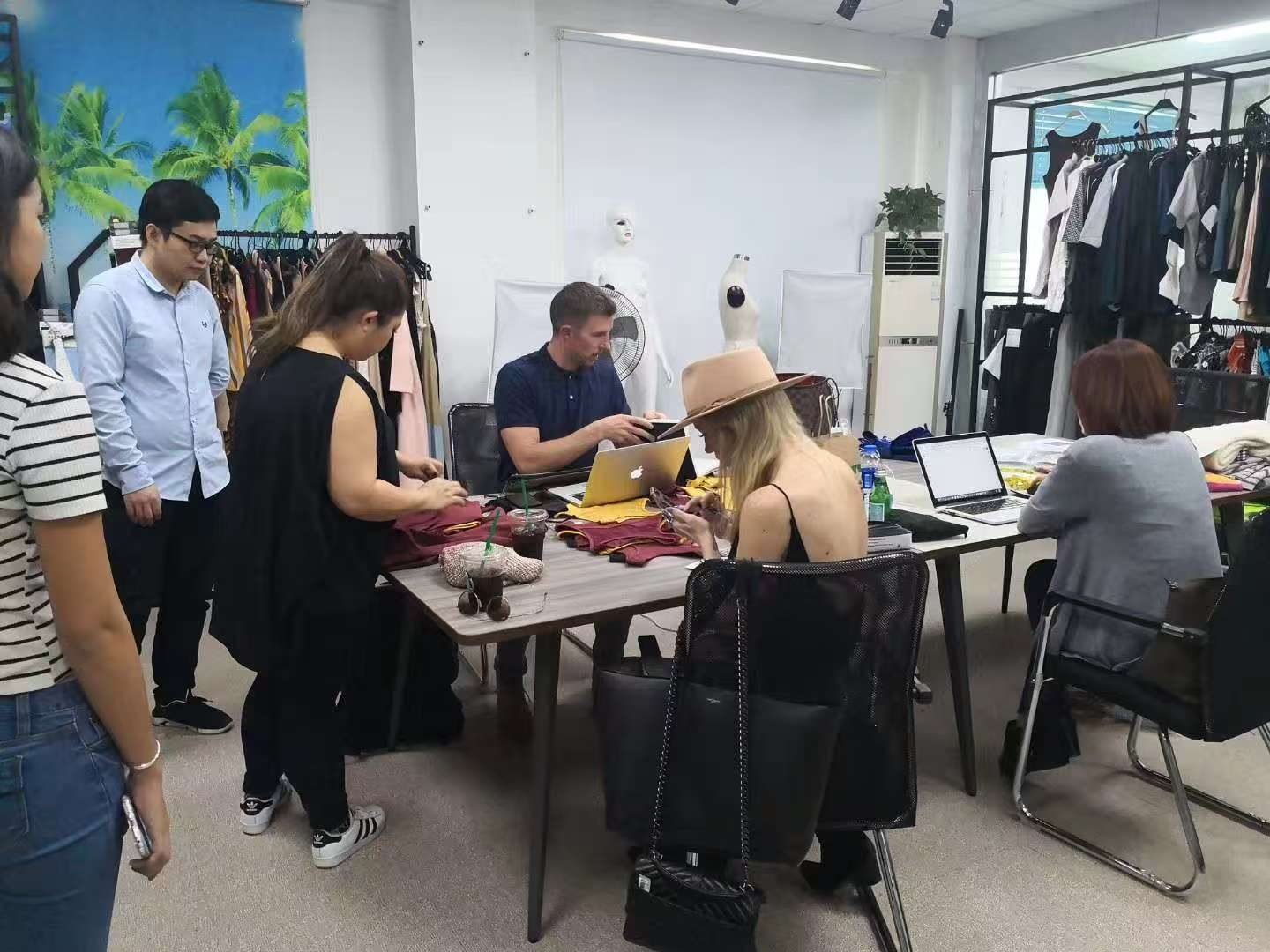
Overseas clients reviewing fabric swatches and samples with the Enjoy Apparel merchandising team
Clients reviewing fabric swatches and sample styles with our merchandising team during a visit.

The Signals That Never Make It Into an Email

A polished email takes twenty minutes to write. A production floor takes years to build, and it is very hard to stage one for a single Tuesday morning. The gap between presentation and reality is exactly what a visit closes.

None of this makes emails useless. Messages are good for specs, prices, and confirmations, anything that belongs in writing. What they cannot carry is texture, how a workplace feels, how people treat the product in their hands, whether the operation has depth behind the person writing to you.

You learn more from watching a sewer’s hands for ten seconds than from a month of messages. Does she handle each piece as if it matters, smoothing seams as she sews? Are the cutting tables clean, with markers and fabric organized, or is the floor a landscape of offcuts? Small habits on the line become small defects in your cartons, or the absence of them.

Breadth is another signal. A factory with a thin, dated sample room usually runs a thin, dated development pipeline. And notice how the merchandiser handles an unexpected question face to face, because that is the same person who will answer your messages while your bulk order is running.

Start in the Sample Room

Every serious visit we host begins in the same place. Our sample room holds more than 1,000 ready styles developed for OEM clients, from bikinis and one-pieces to handmade crochet swimwear, rash guards, modest swimwear, and yoga sets, backed by a fabric library of over 5,000 options. The numbers matter less than what your hands do there.

Pick up any suit and turn it inside out. Check whether the coverstitch lies flat, whether the elastic is fully enclosed, whether the lining sits cleanly against the shell. Stretch the fabric and watch how it recovers. A factory that trusts its own construction will hand you the garment and let you look for as long as you like.

The fabric side of the room earns its own hour. Swatches are organized so you can compare weights and hand feel side by side, from quick-dry nylon-spandex to chlorine-resistant PBT and recycled options. Bring a fabric you already love, and the team can usually point you to the closest match, or to something you end up liking more.

This room is also where vague ideas turn concrete. Buyers regularly arrive with a mood board and leave with three physical styles pinned to a fabric card, because touching the actual rib or crinkle settles debates that screenshots cannot.

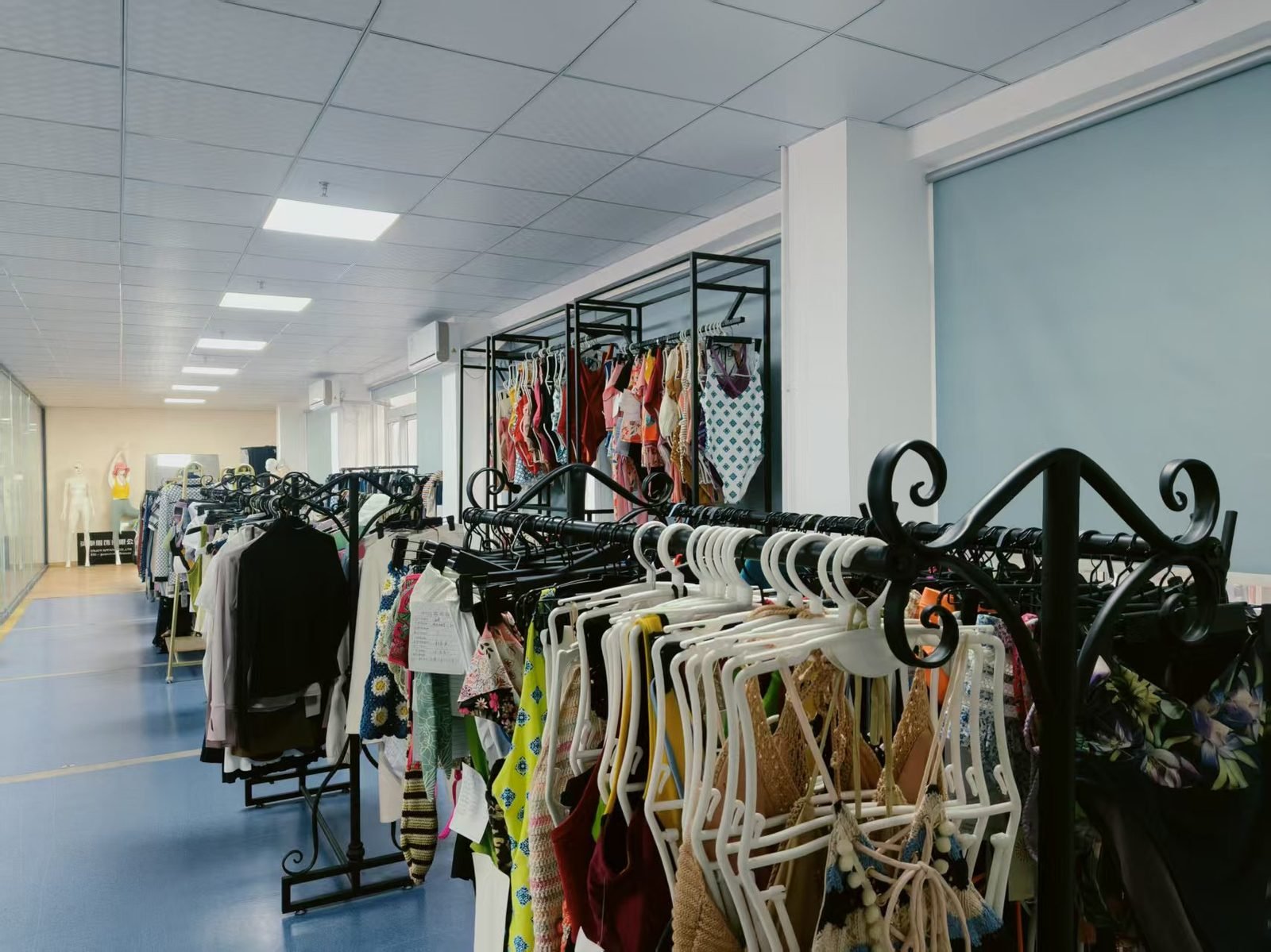
Sample room corridor with racks of swimwear styles produced for OEM clients
Racks of swimwear styles developed for OEM clients line the sample room corridor.

On the Floor, Watch the Work in Progress

Samples are curated. Work in progress is not. Ask to see a style that is currently in bulk production rather than the finished pieces set aside for guests, then pull a garment at random and compare it with the one beside it. Stitch density, seam alignment, and elastic tension should look boringly consistent from piece to piece.

Look at what happens between machines. Where do rejected pieces go, and who decides they are rejected? Is there an inspection point along the line, or does checking only happen at the end? The answers tell you whether quality is built in or inspected in, and only the first of those survives a busy season.

The cutting room deserves a slow pass too. Fabric should be inspected before it is spread, and cut panels should be bundled and labeled so pieces from the same roll stay together. Disorder at the cutting table becomes shade variation and twisted seams at retail.

For brands selling into markets that ask about social compliance, the walk is also where paperwork becomes a place. Enjoy Apparel is a BSCI-audited factory, and we share certification and audit details when we talk, but seeing the floor yourself shows you what the audit actually describes.

The People You Will Actually Work With

A swimwear order succeeds or fails in communication long before it reaches a machine. During a visit you meet the pattern maker who will interpret your fit comments and the merchandiser who will carry your order from sampling through shipment, so treat the day as a working session, not a tour.

Describe a fit problem you had with a previous supplier and watch how the pattern maker responds. A good one asks two or three sharp questions back, about your size chart, your target market, and your customer’s body. That exchange is the job interview no video call fully replaces.

If you are developing original designs, put time with the design team on the agenda. ODM projects, from silhouette proposals to Pantone color development, move faster face to face, and thirty minutes at their table can replace two weeks of annotated screenshots.

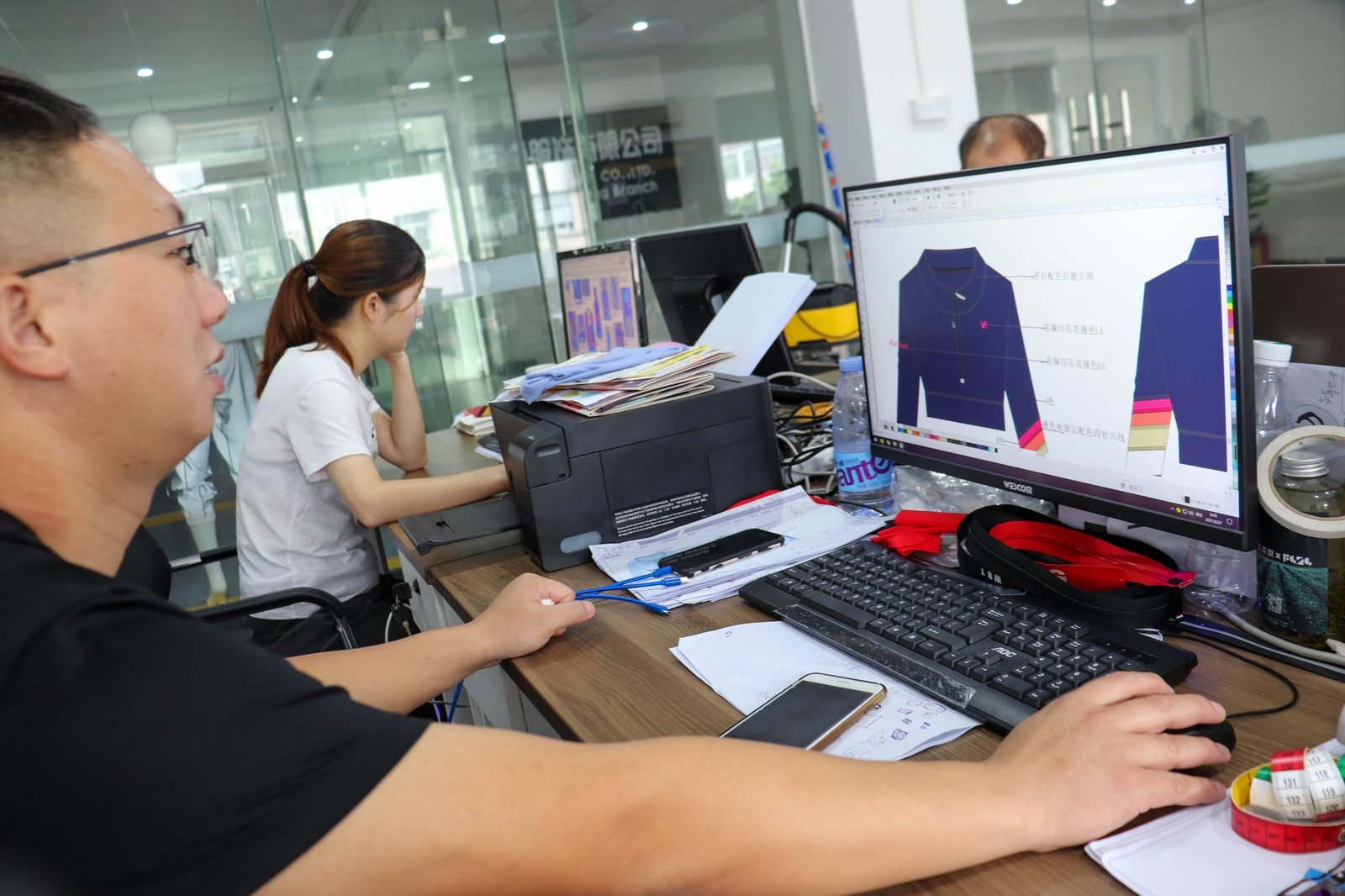
Design and merchandising team working on garment designs at the Enjoy Apparel office
The design and merchandising team at work in our Zhongshan office.

Responsiveness matters as much as skill. If messages sit unanswered during the week of your visit, when the factory knows you are watching, expect the same silence once your deposit clears.

If You Cannot Get on a Plane

Clients from Europe and the US visit us through the year, and we believe the trip pays for itself, but distance, budgets, and calendars are real. A scheduled video audit is the honest second option, and it works when you run it like a visit rather than a sales call.

European clients visiting the Enjoy Apparel office in Zhongshan, China
A client group from Europe visiting our office in Shaxi Town, Zhongshan.

Scheduling is easier than most buyers expect. An evening call in Europe or a morning call in North America lands inside our workday, which means a merchandiser can walk the floor live while the lines are running, not after hours in an empty building.

Ask for a live walk-through that follows the same route you would take in person: sample room, cutting, sewing lines, in-line inspection, packing. Have the host zoom in on stitching, pull random pieces from the line, and answer questions without a script. A factory with nothing to hide will not mind letting you drive.

Preparation decides how much an hour gets you, in person or on camera. Arrive with the following and the conversation moves from introductions to feasibility:

  • Your tech pack, or at minimum reference samples of the styles you want to produce.
  • A target price range per style, so fabric and construction options can be matched against it.
  • Rough quantities per style and color, even if they are only planning numbers.
  • Fabric preferences, including composition, weight, hand feel, and any performance needs like UPF 50+ or chlorine resistance.
  • Your size range and target market, since grading differs between US, EU, and AU customers.
  • Branding details, from logo method to labels, hangtags, and packaging.

If you want the full picture of how an order moves from tech pack to shipment before you arrive, our custom process page lays out each step. And if the trip becomes possible later, the video call simply turns into the rehearsal.

The Door Is Open

A hundred emails can tell you what a factory wants you to know. An afternoon on the floor tells you what you need to know. If you are weighing a swimwear or activewear program and want to meet the people behind your production line, come see the building, or let us walk you through it on camera first.

The Enjoy Apparel team on a company trip, the people behind your production line
The Enjoy Apparel team on a company trip.

Drop us a line at admin@zsenjoyco.com or reach us on WhatsApp (+852 9641 7199), and we will fix a time, at our front desk in Shaxi or on a video call, whichever gets you answers sooner.

Frequently Asked Questions

Do I need an appointment to visit the factory?

Please book ahead rather than dropping in. Scheduling means your merchandiser and a pattern maker are free, and that samples relevant to your category are pulled and waiting. The fastest way to set a date is through our contact page.

Can I do a video tour instead of flying to China?

Yes. We run live video walk-throughs of the sample room and production floor on scheduled calls, and you can ask us to zoom in on stitching, pull pieces from the line, or linger wherever your questions are.

What should I prepare before visiting?

At minimum, a tech pack or reference samples, a target price range, and rough quantities. The checklist above covers the rest, and the same preparation works for a video audit.

Where is Enjoy Apparel located?

Our factory and office are in Shaxi Town, Zhongshan, Guangdong, part of China’s knit garment manufacturing belt. Guangzhou and Shenzhen are within easy reach, so many visitors combine the trip with the region’s trade shows.

Modest Swimwear Manufacturing: Coverage, Fabrics and Construction Standards for Brands

Modest swimwear has moved from a niche request to one of the fastest-growing corners of the global swim market. Brands serving customers from Dubai to London to Southeast Asia are launching full-coverage lines, and many of them discover the same problem the hard way. Most swimwear factories built their pattern rooms around bikinis and brief one-pieces.

A modest line is as much an engineering brief as a design brief, and the factories that understand this deliver a very different product from the ones that simply “add sleeves.” This guide is written for brand founders, product developers and wholesale buyers planning a modest line. It walks through the three things you need to specify before you ask any manufacturer for a quote (coverage, fabric, and construction), plus the market details that separate a line that sells from a line that gets returned.

What “Modest” Means in Product Terms

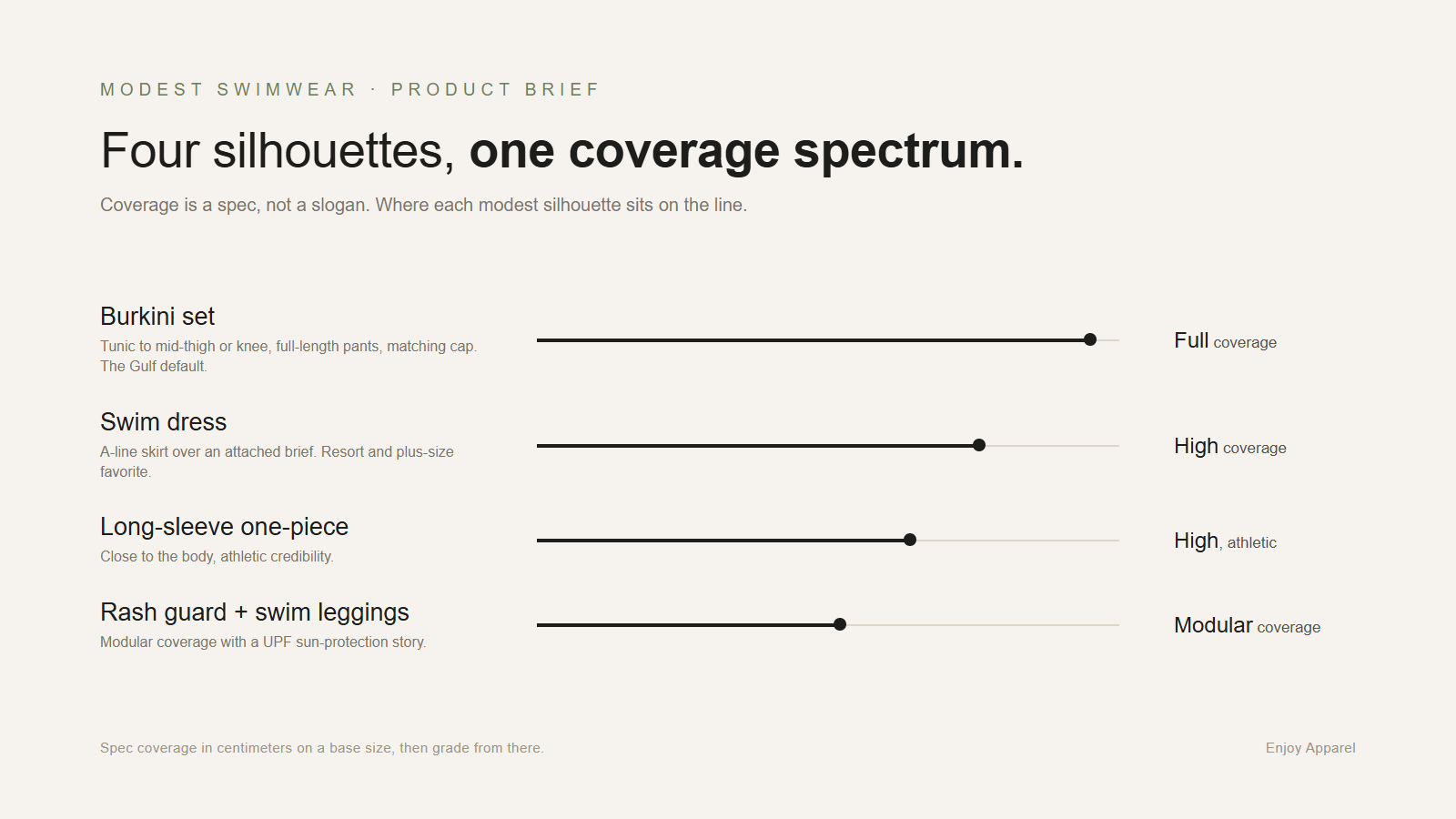
“Modest” is a marketing word. Your tech pack needs measurements. The burkini set, a tunic over swim pants often with a matching cap, sits at one end of the spectrum with a high crew or mock neckline, full-length sleeves, a tunic cut to mid-thigh or knee, and full-length pants. It is the silhouette Gulf customers ask for most. The swim dress softens the same idea into an A-line skirt over an attached brief, which is why it performs so well with resort customers and plus-size ranges.

The long-sleeve one-piece keeps coverage high while staying close to the body, and it has become the default for buyers who want modest styling with real athletic credibility. A rash guard paired with swim leggings turns coverage into a mix-and-match program, with the bonus of a sun-protection story.

Whichever silhouette you choose, settle two decisions before you talk to a factory. Fit intent comes first. Modest does not mean loose everywhere, and a relaxed tunic over fitted pants behaves very differently in the water than a compression-fit one-piece. Then express coverage in centimeters on a base size and grade from there, because “long enough” means something different to every pattern maker who reads it.

Coverage spectrum of four modest swimwear silhouettes, from the burkini set to a rash guard and swim leggings
Four modest silhouettes sit on one coverage spectrum. Whichever you choose, express coverage in centimeters on a base size, then grade from there.

Fabric Requirements: Opacity Comes First

Ask any swimwear technician where modest lines fail, and the answer comes back the same every time. Transparency. A fabric that looks perfectly opaque on the table can turn see-through in the water, because wet fabric stretches tighter against the body and light colors lose opacity when saturated. Fabric selection for modest swimwear therefore starts with opacity, not hand feel.

The working spec we recommend is a main body fabric in the 200–220 gsm range, noticeably heavier than the 180–190 gsm common in fashion swimwear, knitted from roughly 80/20 nylon-spandex with genuine four-way stretch. The extra weight buys both opacity and the more structured drape that flatters relaxed silhouettes.

Close-up of dense matte four-way-stretch swimwear fabric showing its knit texture and opacity
Dense, matte four-way-stretch fabric provides the opacity, recovery and structured drape a modest swimwear line needs.

Finish matters too. A matte surface reads more covered than a shiny one, which tends to highlight every contour. And for light colorways, a double-layer front panel and a lined gusset solve opacity more cheaply than upgrading the whole garment to a heavier quality.

Where your customer swims decides two more choices. In Gulf markets, hotel and community pools are a major use case, and standard spandex degrades fast in chlorinated water. A chlorine-resistant polyester/PBT blend is the right answer there. And since modest swimwear covers more skin by design, a UPF 50+ rated fabric lets you turn coverage into a functional sun-protection feature rather than an apology.

Stretch is only half the story. Recovery, the fabric’s ability to snap back, is what keeps knees and elbows from bagging after the first swim. A modest silhouette with bagged knees loses exactly the clean line the customer bought it for. Test both, and test after washing, not just off the roll.

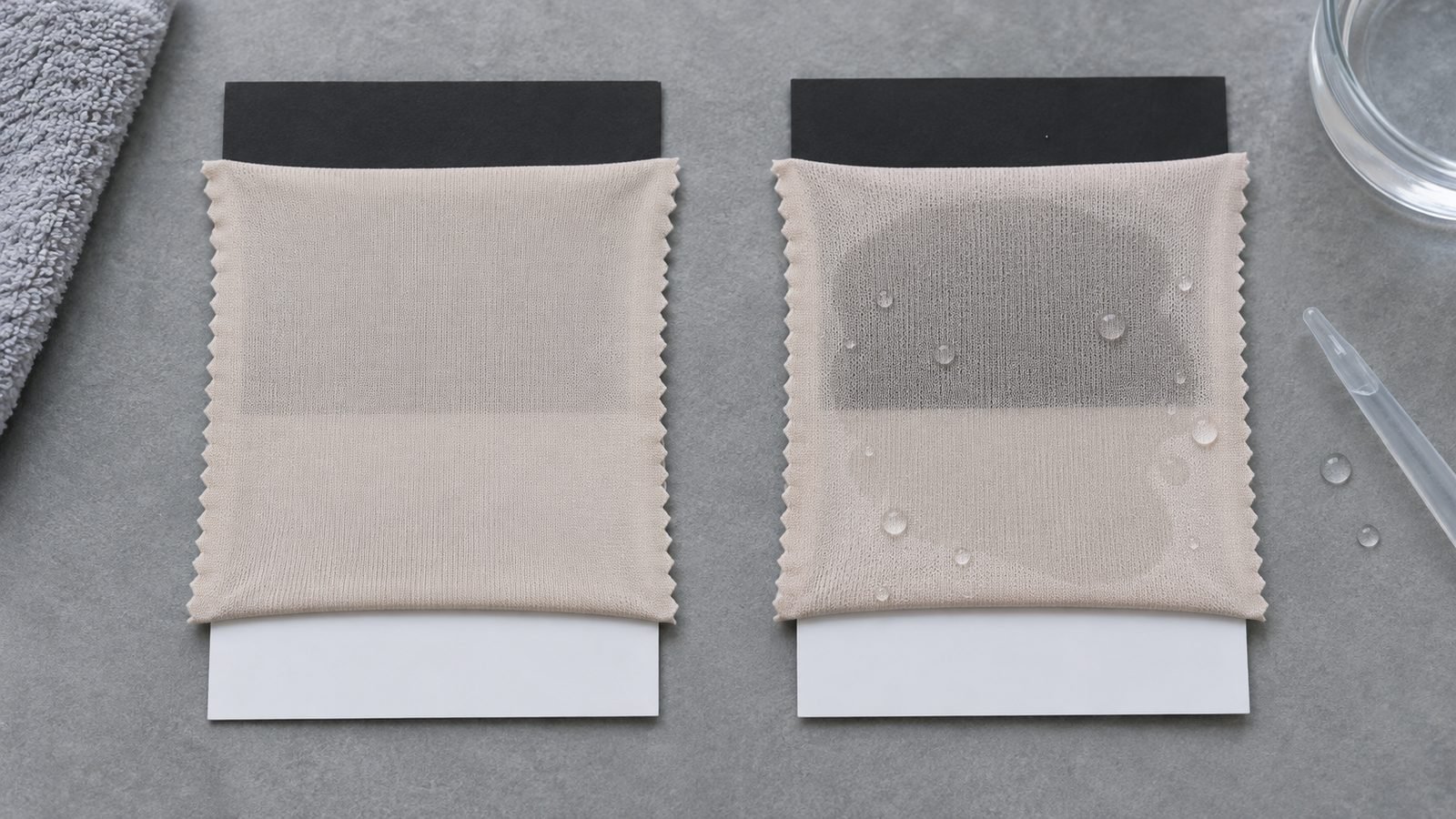
Dry and wet swimwear fabric swatches stretched over black-and-white contrast cards for opacity testing
The test your factory should run on every light colorway: stretch the fabric 30–40% over a black-and-white contrast card, evaluate it dry, then soak it and evaluate again. If it fails wet, it fails, period.

Construction Details That Make or Break the Line

Modest swimwear lives or dies on details that barely matter in a bikini. More fabric means more seam contact with skin, so flatlock seams, which lie flat instead of ridging, are the difference between a garment worn for laps and one worn once and returned.

Ride-up is the other classic failure. A tunic that floats upward or leggings that slide down defeat the entire product, which is why experienced factories build silicone gripper elastic into hems and a drawcord into the waist of swim pants.

Bust support needs a modesty-first answer too, usually removable cups or a shelf bra with an opaque lining. If the style closes with a front zip, specify a modesty panel behind it and a zip garage at the collar so nothing pinches or gapes.

Then there is the hijab question. Attached hood, detachable cap, or no headpiece at all? Detachable caps with a simple snap system give your customer flexibility and give you simpler inventory. Either way, the cap should be cut from the lightest, fastest-drying fabric in the set, because a heavy wet hood is miserable.

Finally, remember water weight. A knee-length tunic carries real weight when the wearer climbs out of the pool. Whether the hem snaps back or stretches out forever is decided by your fabric recovery and hem construction, not by luck.

Sizing and Fit for Modest Lines

Relaxed-fit swimwear grades differently from compression swimwear. If your factory grades a modest tunic the way they grade a bikini, the largest sizes will pull at the bust while the smallest swim in fabric. Ask for a dedicated grading rule for relaxed styles, and confirm which market’s size chart you are building to. Gulf, US and EU expectations are not the same, and modest swimwear has heavy overlap with plus-size demand.

Then insist on a wet fit check. A modest style that fits beautifully on the table can lift, pull or balloon in the water, and that is exactly the moment your customer will judge it.

Middle East Market Notes

For brands targeting the Gulf and the wider Middle East, the product is only half the brief. Prints and motifs deserve a cultural review before sampling, because what reads as abstract in one market can read very differently in another. Presentation should match the positioning of the product, down to photography styling, packaging and even hangtag imagery. Arabic care labels are a small cost and a meaningful signal of seriousness.

And plan your calendar backwards from the region’s selling season. Resort retail in the Gulf runs on a different rhythm than the Western summer, and sampling slots fill up fast ahead of it.

The Mistakes That Sink Modest Lines

The failures we see most are rarely exotic. The first is briefing coverage and nothing else. “Long sleeves, long legs” is a silhouette, not a product, and brands that skip the fabric and construction spec end up approving a sample that photographs well and fails in the pool. The second is approving opacity on a dry swatch, still the single most expensive mistake in this category. Bulk fabric that fails the wet test is not a defect you can negotiate away; it is a container of unsellable inventory.

Right behind those come choosing stretch without recovery, then a presentation that contradicts the product, and finally treating the cultural review of prints as optional until the first complaints arrive. None of these require genius to avoid. They require a checklist and a factory that has made the mistakes before you.

How We Build Modest Lines at Enjoy Apparel

Modest swimwear is one of the programs we run for Middle East buyers at Enjoy Apparel, our swimwear and activewear factory in Zhongshan, China. Because coverage and opacity are the hard parts, we start modest projects from the fabric side. Our fabric library of 5,000+ qualities includes 200–220 gsm four-way-stretch options, chlorine-resistant PBT, UPF-rated and recycled alternatives, and OEKO-TEX® STANDARD 100 certified fabrics are available on request, which matters for brands selling into Europe and the Gulf.

Our pattern team develops custom coverage patterns, from tunics to detachable caps to swim leggings, as a standard ODM service. Development minimums start at 100 pieces per style, with samples in your hands in 14–21 days and bulk production from around a month, depending on style.

If you are planning a modest line, send us your coverage spec or even a reference garment, and we will come back with a fabric recommendation and a development plan. The fastest way to start is a WhatsApp message to +852 9641 7199. If you prefer email, write to admin@zsenjoyco.com.

Frequently Asked Questions

What is the MOQ for a custom modest swimwear line?

Our minimum is 100 pieces per style, with the exact requirement depending on fabric and color choices. Starting from in-stock fabrics keeps minimums at their lowest; custom-dyed colors and specialty fabrics raise them.

Can you develop custom coverage patterns, such as a knee-length tunic with an attached hood?

Yes. Custom coverage patterns are a standard part of our ODM service. You can supply a tech pack, a reference garment, or even a sketch, and our pattern team converts it into production-ready patterns. Exclusive design agreements are available to protect your styles.

Which fabrics do you recommend for modest swimwear?

For most styles, a 200–220 gsm nylon-spandex with four-way stretch and strong recovery, in a matte finish. For pool-heavy use, a chlorine-resistant polyester/PBT blend. For sun-protection positioning, UPF 50+ rated fabric. We confirm the final quality against your price point and use case before sampling.

How long do sampling and production take?

Samples take 14–21 days after fabric, trims and artwork are confirmed. Bulk production takes at least one month, scheduled by style complexity and order quantity.

Custom Swimwear MOQ, Explained by Fabric: In-Stock vs Custom-Dyed vs Recycled

Three factories quote your first swimwear collection. One says 100 pieces per style, one says 300, one says a thousand. None of them is lying, and none of them is really answering your question. The number was set long before your order reached anyone’s cutting table, by fabric mills and dye houses upstream. Once you understand where it comes from, you can engineer it down, and the single biggest lever you control is fabric.

This guide breaks MOQ down by the three fabric routes every swimwear brand can choose from. In-stock fabric, custom-dyed fabric, and recycled or specialty fabric each carry their own minimums, timelines and trade-offs. Knowing them before you request a quote will save you weeks of back-and-forth, and very probably a development budget spent on the wrong route.

Where MOQ Actually Comes From

Start at the mill. Knitted swim fabric is produced in runs, and every run has a minimum expressed in kilograms or meters, per quality and per color. Your factory’s cutting floor then converts that fabric into pieces, which is why “our MOQ is 300” is usually just the mill’s minimum wearing a different unit.

Color adds the second layer. Custom shades are dyed in vats, every vat has a minimum load, and dyeing less than that minimum still costs the full vat. That is why the moment you insist on your exact Pantone, the per-style minimum climbs.

The third layer is quieter. Custom woven labels, branded elastics and molded cups all arrive with their own supplier minimums, and cutting efficiency (how many garments fit into one fabric marker) decides how much of the cloth you paid for actually becomes product. Every MOQ answer you will ever receive is some combination of these three constraints. Change the fabric route, and the answer changes with it.

In-Stock Fabric: The 100-Piece Path

In-stock (or “stock-supported”) fabric is material the factory already buys in volume for its running programs, usually proven nylon-spandex and polyester-spandex qualities in a standing color card. Because that fabric is already on the shelf or one reorder away, the mill and dye minimums are absorbed across many clients, and genuinely low minimums become possible. At Enjoy Apparel, this route draws on a library of 5,000+ fabrics, most of them with standing color cards ready to cut.

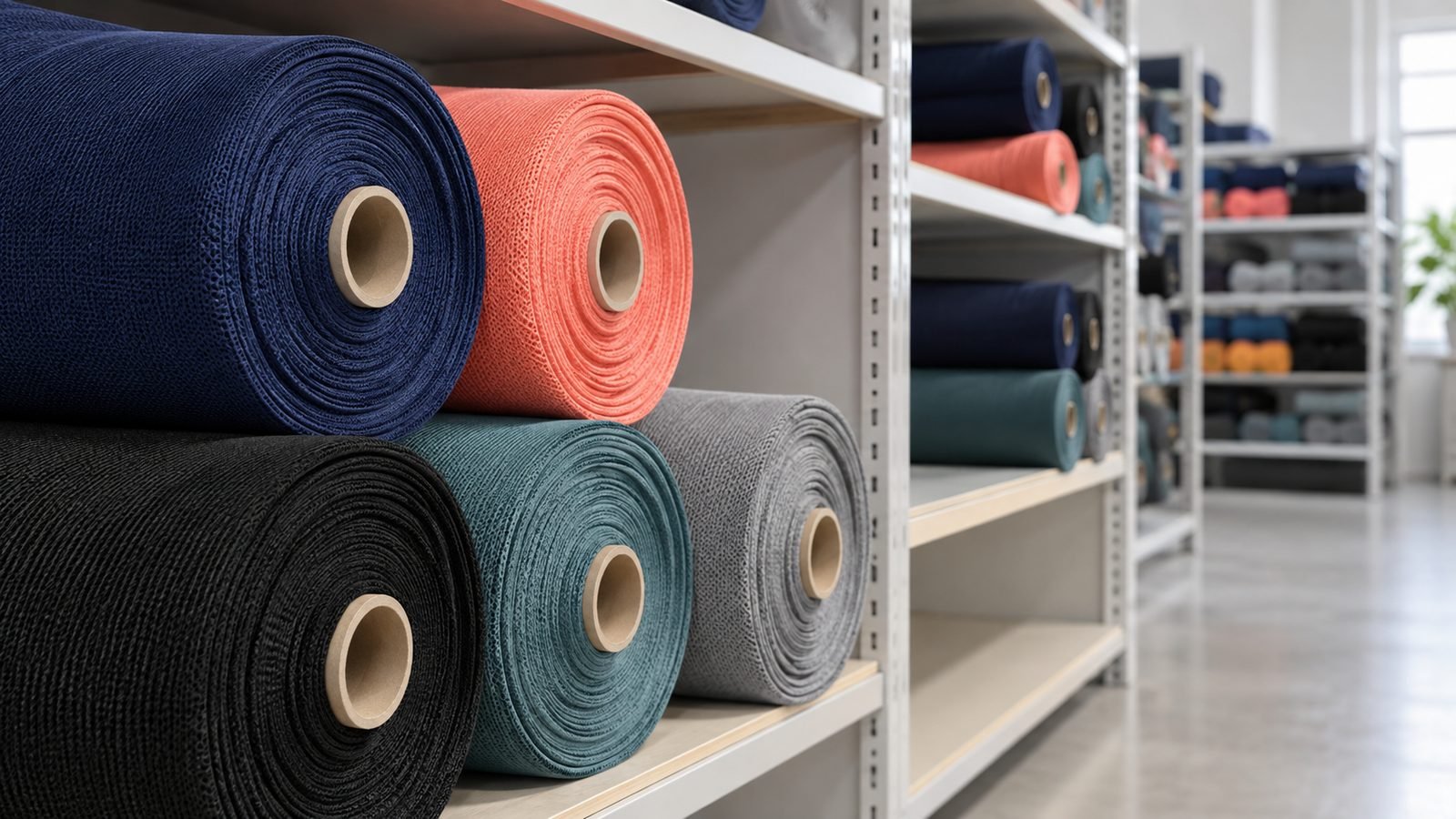
Organized rolls of swimwear fabric in storage, illustrating how stock-supported materials help keep minimum order quantities low
Stock-supported qualities spread mill and dye minimums across multiple programs, making smaller first orders practical.

This is also the route behind our standard minimum. One hundred pieces per style, samples in 14–21 days, bulk production from around one month depending on the style. For a first collection, that means you can test three or four styles without committing your entire budget to inventory. When one of them sells, a reorder moves quickly, because the fabric pipeline already exists.

The trade-offs are real and worth weighing honestly. Your color choice is finite, since you pick from the stock card, and if your brand identity hangs on one exact Pantone, stock fabric may only get you close. You also share that palette with other brands, so your differentiation has to come from design, prints and trims rather than an exclusive base shade. For startups still validating a market, neither trade-off matters much. Speed and survivable risk matter, and this route offers both.

Custom-Dyed: Pantone Matching and Its MOQ Ladder

Custom dyeing gives you exact brand colors, and it rewrites the MOQ math completely. The process runs through lab dips, meaning small swatches dyed to match your Pantone reference, typically over two or three rounds of adjustment before approval. Custom-dyed projects therefore sit at the longer end of the normal 14–21 day sampling window. Build that into your calendar before you promise anyone a launch date.

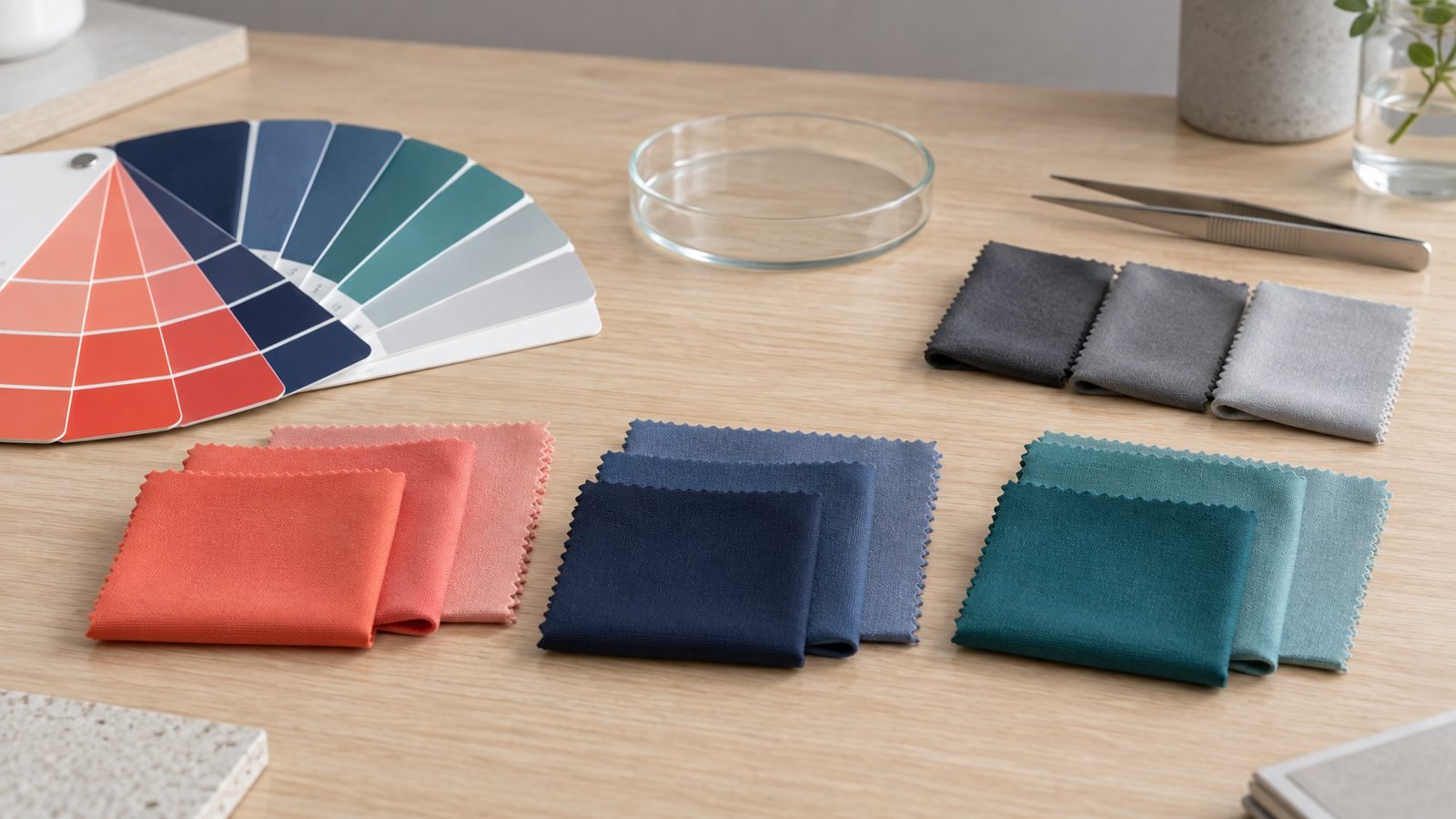
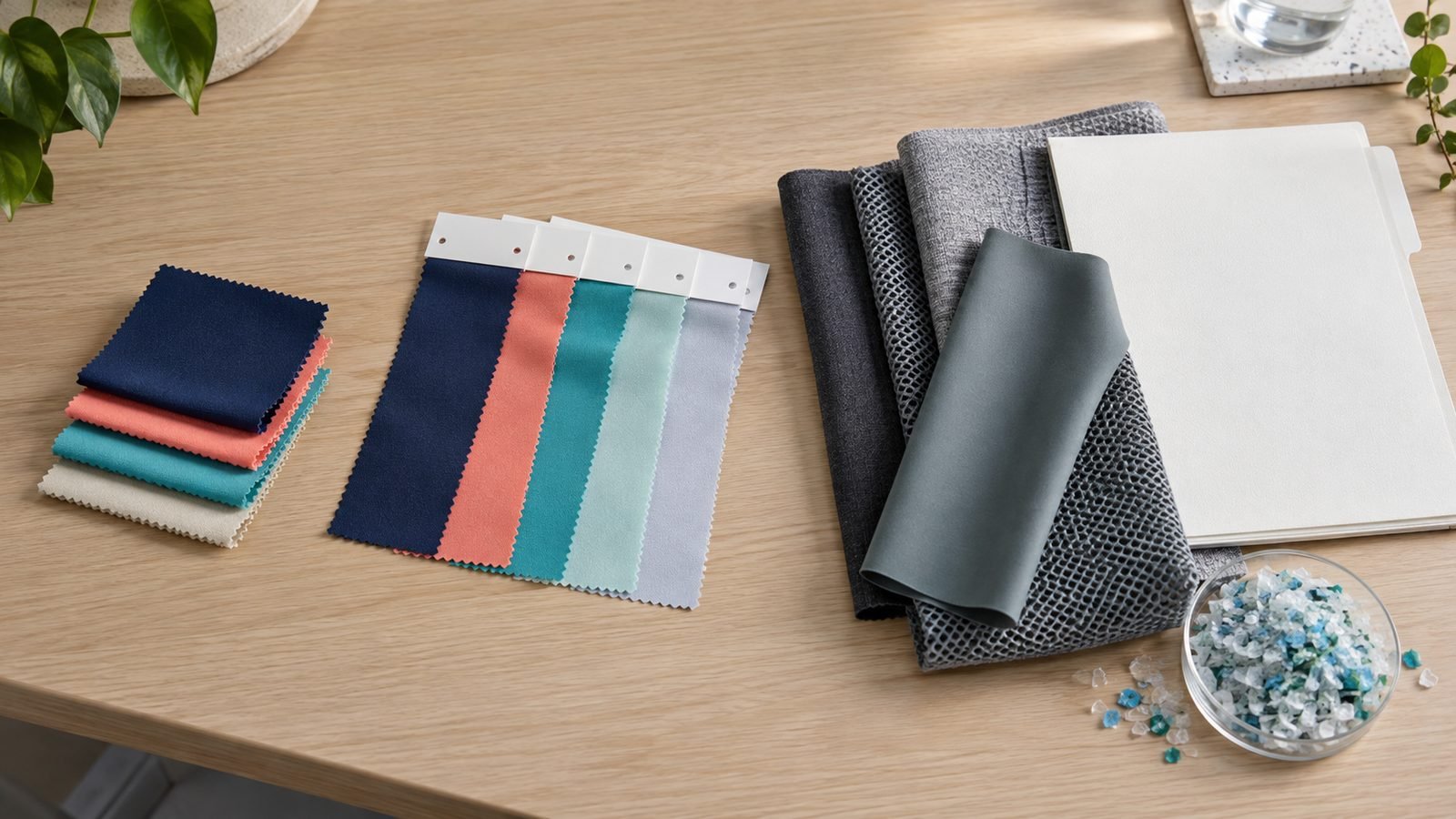
Grouped swimwear fabric lab-dip swatches in coral, navy and teal for custom color matching
Each custom color moves through lab-dip comparisons and approval rounds before bulk dyeing begins.

The ladder appears at bulk dyeing, because the vat minimum applies per color, not per style. Three custom colorways can mean three separate vat minimums even on the same fabric quality. And since the minimum is set in fabric weight, it can translate into several hundred pieces per color, depending on how much cloth each garment consumes.

Colorfastness and shade tolerance are the details worth insisting on here. Chlorinated pool water, salt water and sun cream are hostile environments for dyes, so specify testing to chlorine and seawater before bulk. A beautiful custom coral that bleeds after two pool sessions is a returns problem, not a brand asset. And agree on a lot-to-lot shade tolerance before you need it, especially if you plan reorders across a long season. “The same red” from two different dye lots is a negotiation unless you define it in advance.

Custom dyeing is the right route when color is core to your positioning and your volume per color can carry the vat minimum. Until then, it is a tax on being early.

Recycled and Specialty Fabrics: Higher Minimums, Real Differentiation

Recycled nylon and polyester swim qualities, including regenerated-nylon types and GRS-certified options, follow the same logic with one addition. Mill minimums run higher, because these fabrics are produced in smaller, more controlled batches. The same applies to specialty constructions like chlorine-resistant PBT.

Plan for minimums above your stock-fabric program. The standard workaround is combining several styles into one fabric quality so they meet the minimum together, and you should budget for a fabric premium per meter. What you get in return is a sustainability story that European buyers increasingly require rather than merely prefer.

The paperwork deserves a warning of its own. If you intend to print “recycled” on a hangtag, the claim needs a chain of custody. For GRS-certified fabric, ask for the transaction certificate that ties your fabric lot to the standard, and check what documentation your factory itself can show.

For reference, our own factory holds a BSCI audit and ISO 9001 certification, and we can supply OEKO-TEX® STANDARD 100 fabric documentation with orders on request. Without that paper trail, a sustainability claim is decoration, and decoration is getting riskier every year as the EU tightens enforcement of green claims.

Three swimwear fabric development routes progressing from ready-stock swatches to custom color dips and recycled specialty materials
Moving from stock-supported fabric to custom color and recycled specialty materials adds sourcing steps, documentation and minimum-volume pressure.

Your First Order: Structure and Negotiation

Whatever route you choose, treat the first order as an experiment rather than a bet. In practice that means fewer styles in more colors. Two or three strong silhouettes in several colorways teach you which shapes sell, and color variety costs far less than style variety. Weight your size curve toward the middle and keep the tails shallow; your sell-through data will correct the curve on reorder.

Plan the reorder before you place the first order. A factory working from in-stock fabric can turn one around meaningfully faster than one starting from raw material. And keep one style deliberately simple, a clean single-fabric design that serves as your operational baseline while you experiment with more complex pieces.

As for negotiation, MOQ is negotiable, but rarely in the way buyers first try. Asking “can you do fifty?” is a request for the factory to lose money, and factories hear it every week. What actually moves the number is arriving with a credible plan. A target market, a launch date, a reorder intention. Factories flex for growth stories, not for small numbers.

This is also how most private label swimwear programs begin in practice. A small, well-planned first run on a proven pattern, with the brand’s own labels and packaging doing the differentiating.

Offering to absorb constraints works the same way. Stock colors instead of custom shades, an off-peak production slot, simpler trims. Every constraint you take on is minimum the factory can give back, and combining several styles into one shared fabric buy remains the single most effective lever of all. A deposit behind your commitment changes the risk calculation faster than any email.

Be suspicious, though, of any supplier who agrees to a number below a plausible cost floor. The difference will surface somewhere, usually in fabric substitutions, line priority or QC attention.

How We Handle Low-MOQ Programs at Enjoy Apparel

Enjoy Apparel is a swimwear and activewear OEM/ODM factory in Zhongshan, China, and low-MOQ development is one of the programs our clients use most. Alongside the fabric library, our ready-style catalog of 1,000+ proven base patterns lets new brands start from tested fits instead of a blank page. Tell us your budget and your timeline, and we will tell you plainly which fabric route fits, before you spend anything on development.

Bring us your collection plan. WhatsApp +852 9641 7199 or email admin@zsenjoyco.com, and you will get a route recommendation, not just a quote.

Frequently Asked Questions

Is MOQ calculated per style, per color, or per size?

Per style is the base unit; ours is 100 pieces. Custom-dyed colors add a per-color minimum from the dye house on top, while sizes within a style can usually be mixed freely along your size curve.

Can I mix different styles to reach the MOQ?

Mixing styles does not lower the per-style minimum, because each style carries its own pattern, marker and sewing-line setup. What mixing can do, at the fabric level, is let several styles in the same quality and color share one fabric minimum. That combination is one of the first things we help clients engineer.

How much do samples cost?

Sample cost depends on style complexity, fabric route and whether custom dyeing or new trims are involved. We quote sampling individually after reviewing your design, and we will always tell you which choices are driving the sample price.

Do reorders carry the same MOQ?

For in-stock fabric routes, reorders typically run at the same low minimum on a faster timeline, because patterns and markers already exist. Custom-dyed reorders depend on whether your color can be re-dyed within tolerance, another reason to agree lot-to-lot tolerance up front.

Tariffs and Swimwear Sourcing in 2026: A Practical Guide for US Brands

If you source swimwear from China and sell into the United States, September 2026 has given you plenty to worry about. A sanctions bill passed by the US House this month would authorize tariffs of up to 100% on imports from China and India, according to industry press reports. Days earlier, former senior US trade officials publicly questioned the legal basis of the Section 301 tariffs already in place. And the FABRIC Act, aimed at reshoring garment production, was reintroduced in Congress.

We are a China-based swimwear manufacturer, and we follow these headlines more closely than most. After more than a decade of watching US trade policy swing, our honest advice is the opposite of panic. The worst sourcing decisions are made in the two weeks after a scary headline.

This guide walks through what is actually happening, how tariffs really hit your cost structure, why “just move to another country” is harder in swimwear than in almost any other category, and the calm moves that protect your margins. Written from the factory side of the table, it is the same briefing we give our own US clients.

Note: policy details below are current as of mid-September 2026 and sourced from trade press reporting. Verify the status of any bill or tariff rate with primary sources before making decisions. We list them at the end.

What Is Actually Happening (as of September 2026)

Strip away the headlines and three things are true at once. First, new tariff authority targeting China is advancing through Congress, though a House-passed bill is not law until the Senate acts and the President signs. Many bills die somewhere along that road. Second, the legality of the existing Section 301 tariffs is being openly challenged by former trade officials, which means some current tariffs could theoretically be struck down as easily as new ones could be added.

Third, trade fragmentation more broadly is accelerating, and brands are being pushed to document their supply chains in more detail, across more jurisdictions, every year. The practical takeaway is neither “tariffs are coming” nor “tariffs are going.” Volatility itself has become a permanent line item in your sourcing strategy, and the brands that win are the ones structured to absorb swings in either direction.

How Tariffs Actually Hit Your Landed Cost

Tariffs rarely hurt the way people imagine. The pain is in the compounding. Your landed cost builds in layers. The FOB price you negotiated, then international freight and insurance, then the customs duty itself, then the quiet small print. Merchandise processing fees, harbor maintenance fees and brokerage charges are each small alone and meaningful together, especially on smaller shipments.

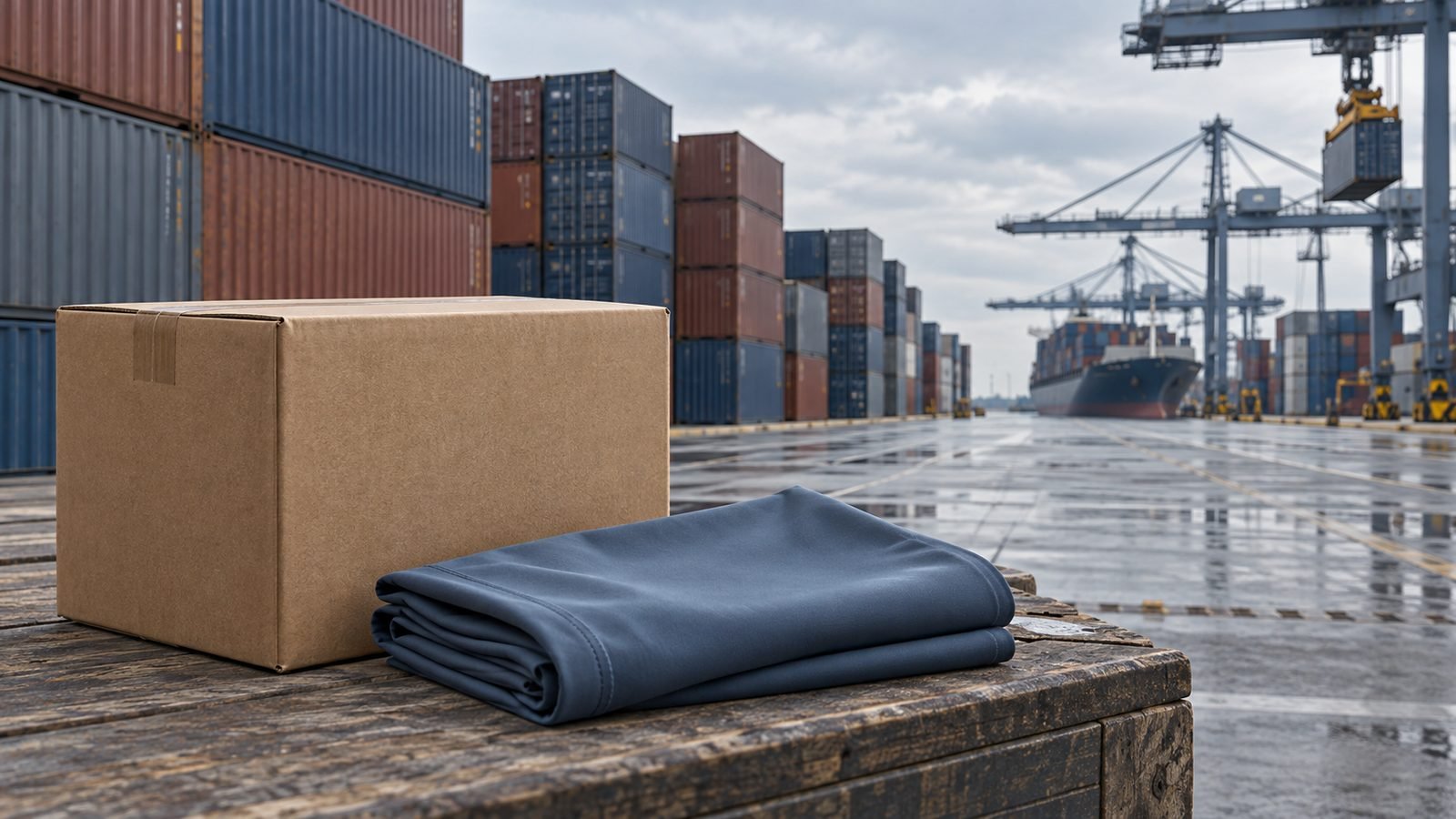
Plain shipping carton and folded swimwear fabric at an anonymous container port, illustrating freight and customs costs in swimwear sourcing
FOB price is only the starting point: freight, insurance, customs duty and handling determine the true landed cost.

How duty is calculated, and how your product is classified, decide what you actually pay. Duty applies to customs value, generally the FOB price rather than your retail price, but your margin multiple then amplifies that increase all the way up to the shelf. A modest rise in first cost can force a much larger retail pricing decision.

Classification matters just as much. Knitted synthetic swimwear, woven cover-ups and rash guards can fall under different HS codes with different duty rates, which means a wrong classification either costs you money quietly or triggers a compliance review loudly. If you do not know your landed cost per style to the cent today, fixing that comes before any tariff scenario planning.

Calculator, blank shipping documents and increasing cost stacks illustrating landed cost planning for imported swimwear
Separate product cost, freight, duty and handling into visible line items so policy changes adjust one layer instead of breaking the whole pricing model.

Why “Just Move Production” Is Harder in Swimwear

Every tariff cycle produces the same advice. Move sewing to Vietnam, Bangladesh, Turkey, anywhere else. In basic knitwear that can work. Swimwear is different, for structural reasons most commentators miss.

Start with fabric. Swimwear is not sewn from commodity jersey. It depends on high-stretch nylon-spandex and polyester-spandex knits, chlorine-resistant, UPF-rated, recycled, produced by a concentrated set of mills. China holds the deepest and most complete supply base for these qualities. Many garment factories in Southeast Asia import their swim fabric from China, so moving the sewing often does not move the supply chain at all. It just adds freight and lead time on top of the same fabric.

The trims are equally specialized. Molded cups, underwires, chlorine-proof elastics and rust-proof hardware come from the same regional ecosystem. Then there is requalification. A new factory means new patterns, new samples, new fit approvals, new colorfastness and compliance testing. Budget a full development cycle, months rather than weeks, before a replacement factory ships a single sellable unit. And when an entire industry reroutes at once, alternative factories fill up and their prices rise to meet the moment.

Generic logistics warehouse with fabric rolls, cartons and pallets illustrating the complexity of relocating a swimwear supply chain
Moving sewing does not automatically move the fabric, trims and development ecosystem behind a swimwear program.

None of this means diversification is wrong. It means a panicked, unexplored move usually costs more than the tariff it was meant to escape.

Seven Questions to Ask Your Manufacturer Right Now

If you do nothing else this week, have this conversation with your supplier:

  1. Where does our fabric actually come from, with origin documentation per quality, not a verbal answer?
  2. Can you support our customs paperwork accurately, from certificates of origin to packing declarations? (Knitted synthetic swimwear is commonly classified in the 6112.31/6112.41 family, but confirm your exact codes with your broker.)
  3. What are our Incoterms, really? Under FOB you control freight and see every cost layer; under DDP the factory bundles everything, which is convenient until you need to know what a tariff just changed.
  4. How would a tariff change flow through our pricing, passed through, shared, or absorbed, and documented how?
  5. What is our realistic Plan B? A serious answer covers fabric sourcing, requalification timeline and cost, not just “we also work with factories in X.”
  6. Can we dual-quote our best-selling styles at two origins before we need the second option?
  7. What are you seeing from your other US clients? A factory serving the American market is a free early-warning system.

Planning for Three Futures at Once

Development for next season starts now, which means your 2027 costing has to survive several policy outcomes. If new tariffs raise your landed cost, the disciplined response is to adjust the duty line item and renegotiate quote validity windows, while resisting the urge to switch factories mid-season. Switching costs will exceed the tariff on a first order.

If the status quo holds, you get more of the same volatility, and the right posture is keeping dual quotes for your crown-jewel styles and your origin documentation current. If existing tariffs are struck down, your first cost drops, possibly retroactively. Treat that as margin buffer, not as a reason to cut retail prices you will struggle to raise again.

Cost documentation and source tracking make every one of these futures easier. Build duty into your pricing as a visible line item, so that when it moves you adjust a number instead of rebuilding your entire pricing architecture. And track primary sources rather than commentary. The USTR publishes the tariff actions, US Customs publishes the entry rules, and your customs broker translates both into your specific codes.

How We Work with US Brands

Enjoy Apparel is a Zhongshan-based OEM/ODM manufacturer of swimwear and activewear, and our US clients range from first-collection startups to established sellers. What they come for is transparent costing. Fabric origin documentation on request, accurate customs paperwork, clear FOB terms, and minimums low enough (from 100 pieces per style) to test styles and routes before committing real volume. When costs move, you see exactly where.

If tariff headlines have you re-evaluating your supply chain, start with a conversation, not a relocation. Our team answers on WhatsApp (+852 9641 7199) and by email (admin@zsenjoyco.com).

Frequently Asked Questions

Who actually pays the tariff, the factory or the brand?

Legally, the importer of record pays US customs duties at entry. Under FOB terms, that is you or your US entity. Factories cannot “absorb” a US tariff, though suppliers and buyers sometimes renegotiate pricing to share the pain. Be skeptical of any party who tells you otherwise.

Is DDP shipping safer in a volatile tariff environment?

DDP moves customs responsibility to the shipper and makes your cost predictable upfront, but you trade away visibility and control. In volatile times, seeing your cost layers under FOB usually beats hiding them. If you use DDP, work only with partners you trust deeply.

Will moving production out of China eliminate tariffs?

Only if the country of origin genuinely changes. In swimwear, fabric, trims and development often remain tied to the Chinese supply base even when sewing moves. Rules of origin are technical; get a customs broker’s opinion before counting on any savings.

Where can I check the current status of tariffs myself?

The Office of the US Trade Representative (ustr.gov) for tariff actions, US Customs and Border Protection (cbp.gov) for entry rules and duty rates, and your licensed customs broker for your specific HS codes. Verify anything you read, including this article, against those sources before acting.

Inside a Swimwear Factory: How Your Order Moves From Fabric Roll to Packed Carton

The light panel hums on, and the first roll of the morning goes up on the inspection machine. A worker feeds the fabric over the glowing surface and watches it travel past, face up, then face down. By the time that same fabric leaves the building it will be folded, bagged and sealed into cartons. This article walks the route in between, station by station, with photos from the floor of Enjoy Apparel, an OEM/ODM producer of swimwear and activewear based in Zhongshan, China.

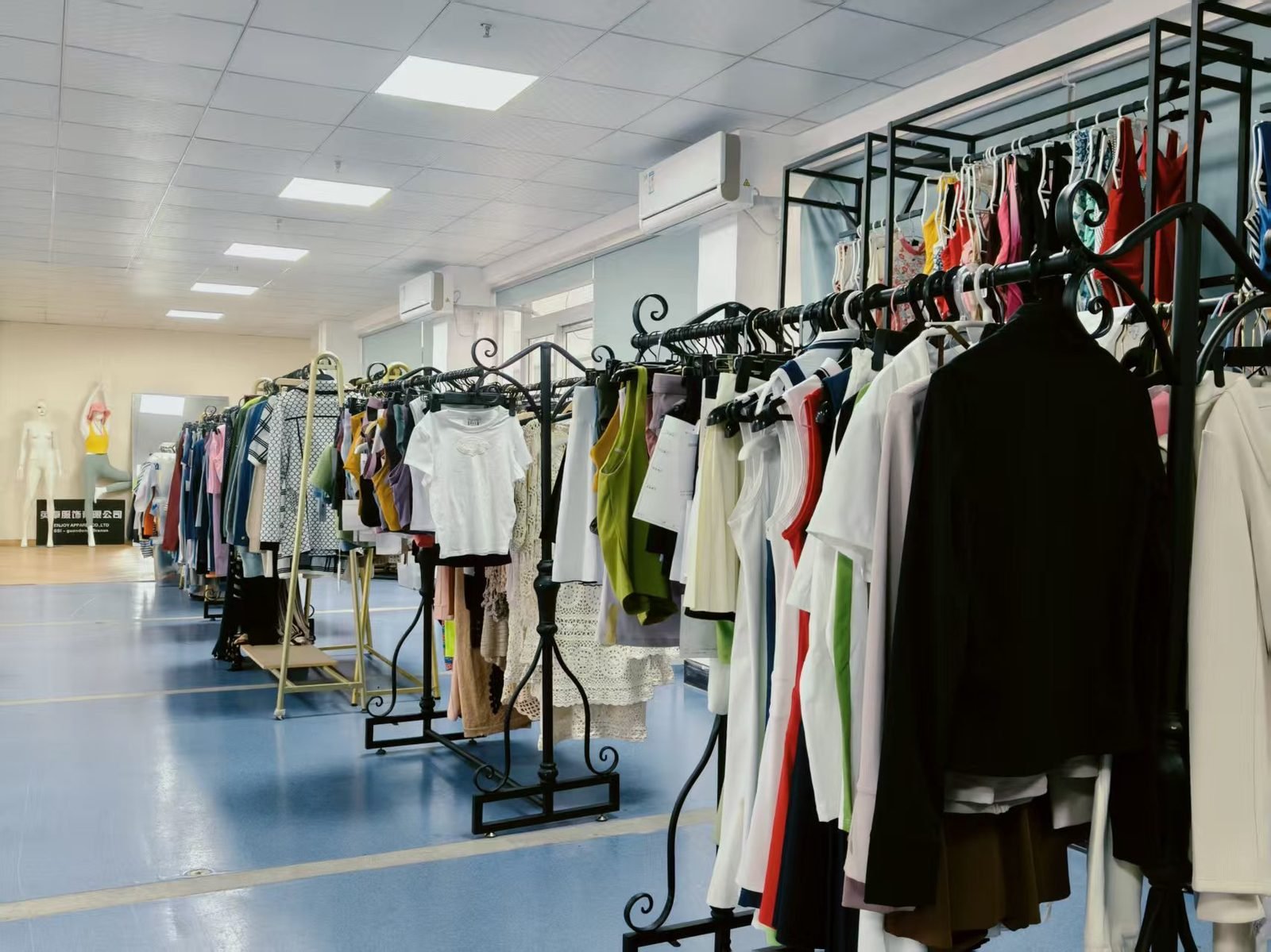
Swimwear and activewear samples on display racks in Enjoy Apparel's sample showroom
Factory visits usually begin in the sample showroom, where racks of ready styles give buyers a starting point for their own collections.

If you are vetting swimwear suppliers in China and wondering what really happens to your order after the deposit clears, this is the tour we would give you in person. The paperwork side of the same journey, from tech pack to freight booking, lives on our custom process page. Here we stay on the floor.

Fabric Inspection Comes Before Anything Gets Cut

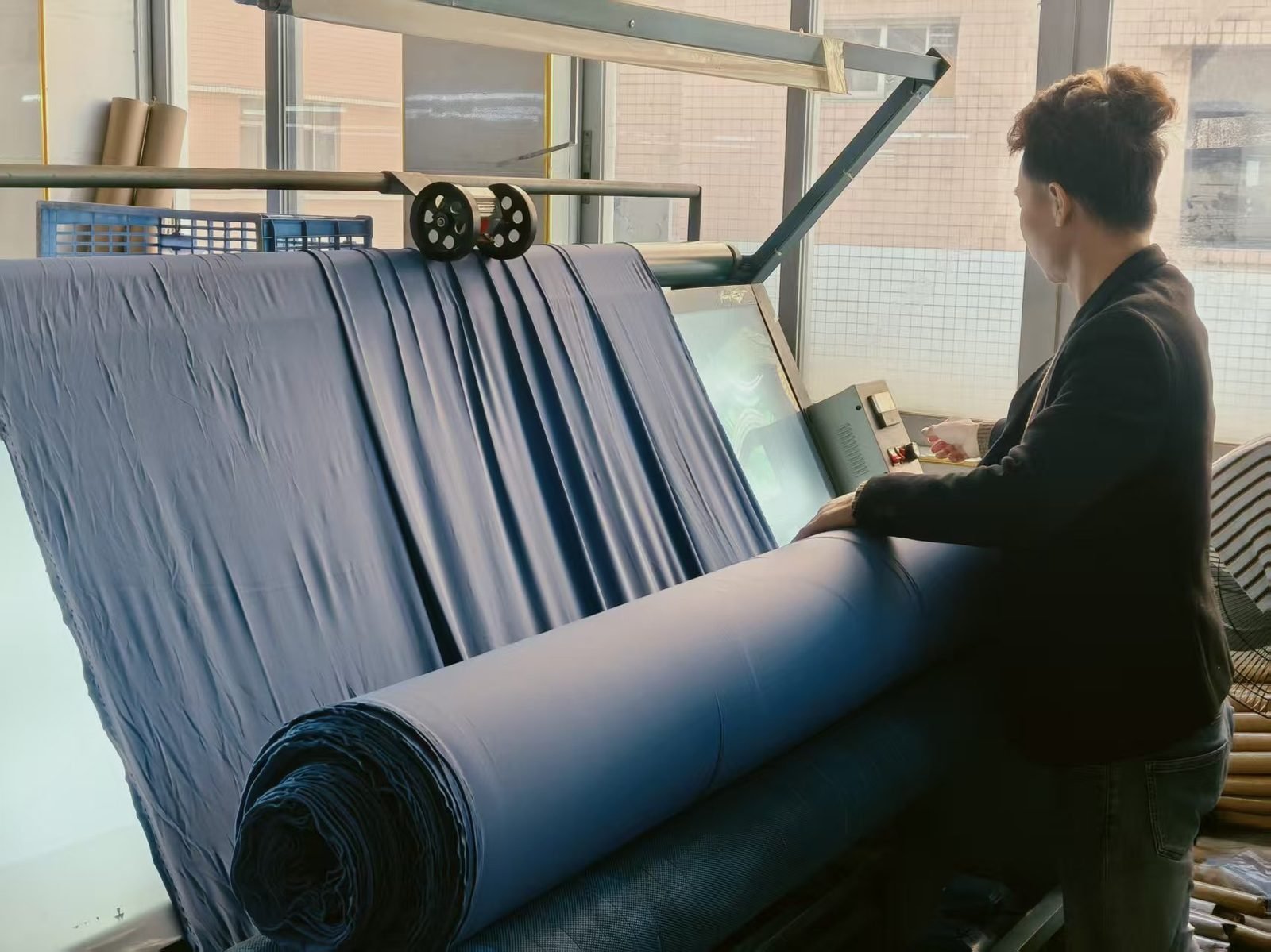
Every roll that enters the factory is checked before it earns a place on the cutting table. The roll mounts onto an inspection machine, and the fabric travels slowly across a backlit panel while an inspector watches both faces. On swimwear knits, the usual suspects are pinholes, snags, oil spots, dye streaks and shading differences between the center of the roll and its edges.

Worker inspecting a roll of blue swimwear fabric on a fabric inspection machine before cutting
A roll of blue swimwear knit running across the light panel during incoming fabric inspection.

Strictness here is economics, not perfectionism. Fabric is the biggest material cost in a swimsuit, and a defective meter found after cutting cannot be returned to the mill. A flaw discovered at the sewing line has already absorbed cutting labor. Found at packing, it has absorbed everything. The cheapest place to catch bad fabric is before a single layer is spread.

Rolls are also measured for usable width and weighed against the specification, and stretch fabric gets time to relax off the roll so it measures honestly. Material that falls short goes back to the supplier, or the bad section is marked so the cutting layout can route around it.

Marker Making, Spreading and the Band Knife

Cutting starts on a computer, not a blade. The pattern pieces for every size in your order are arranged into a marker, a cutting layout that squeezes the most garments out of each meter of cloth. Marker efficiency decides how much of the fabric you paid for becomes swimwear rather than bin filler, and on knits it also fixes the direction of stretch in every finished piece.

The fabric is then spread into a stack of layers aligned to the marker’s length. Stretch fabric has to be spread relaxed, with no tension on the roll. A layer pulled tight across the table springs back after the cut, and every piece taken from it finishes small, which is one of the quiet ways a size chart stops meaning anything.

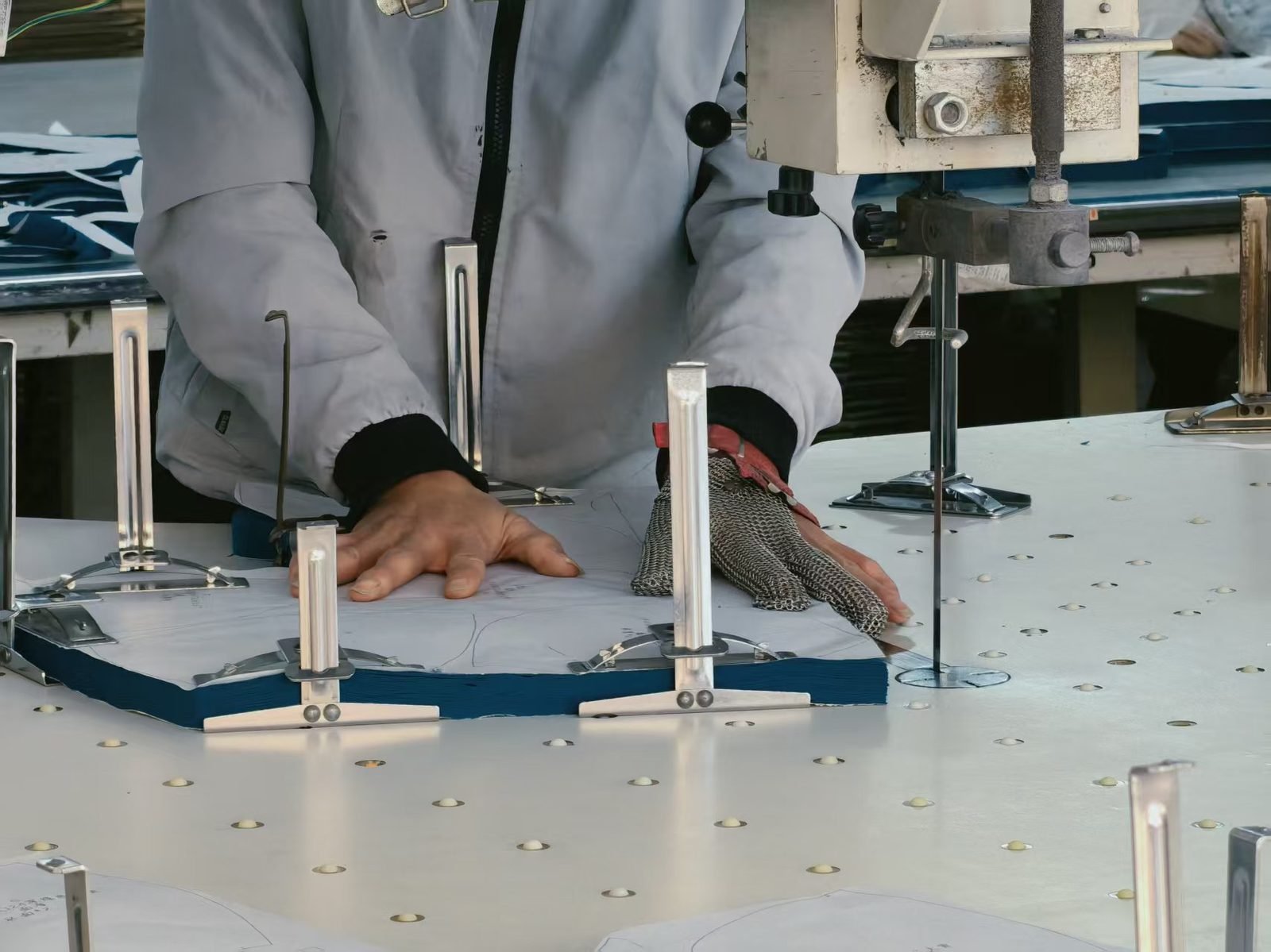
The stack is cut as a single block on a band knife machine, its continuous vertical blade following the marker lines through every ply at once. Drift of a few millimeters at the top of the stack becomes a real size inconsistency at the bottom, so the operator works slowly around curves, and notches are cut so the sewing line can match panels later. Cut pieces are bundled by size and counted, and the line receives complete kits.

Cutting stacked swimwear fabric layers with a band knife cutting machine
A band knife cutting through stacked fabric plies along the marker lines.

Sewing Stretch Fabric Without Fighting It

Ask sewing veterans what is hard about swimwear and the answer is the fabric itself. A nylon-spandex knit stretches in every direction, and the seam has to stretch just as far without popping a stitch. Pull the fabric as it feeds and the seam puckers into ridges. Guide it too loosely and it gaps. Even stitching on stretch is a three-way balance of machine tension, stitch density and hand pressure.

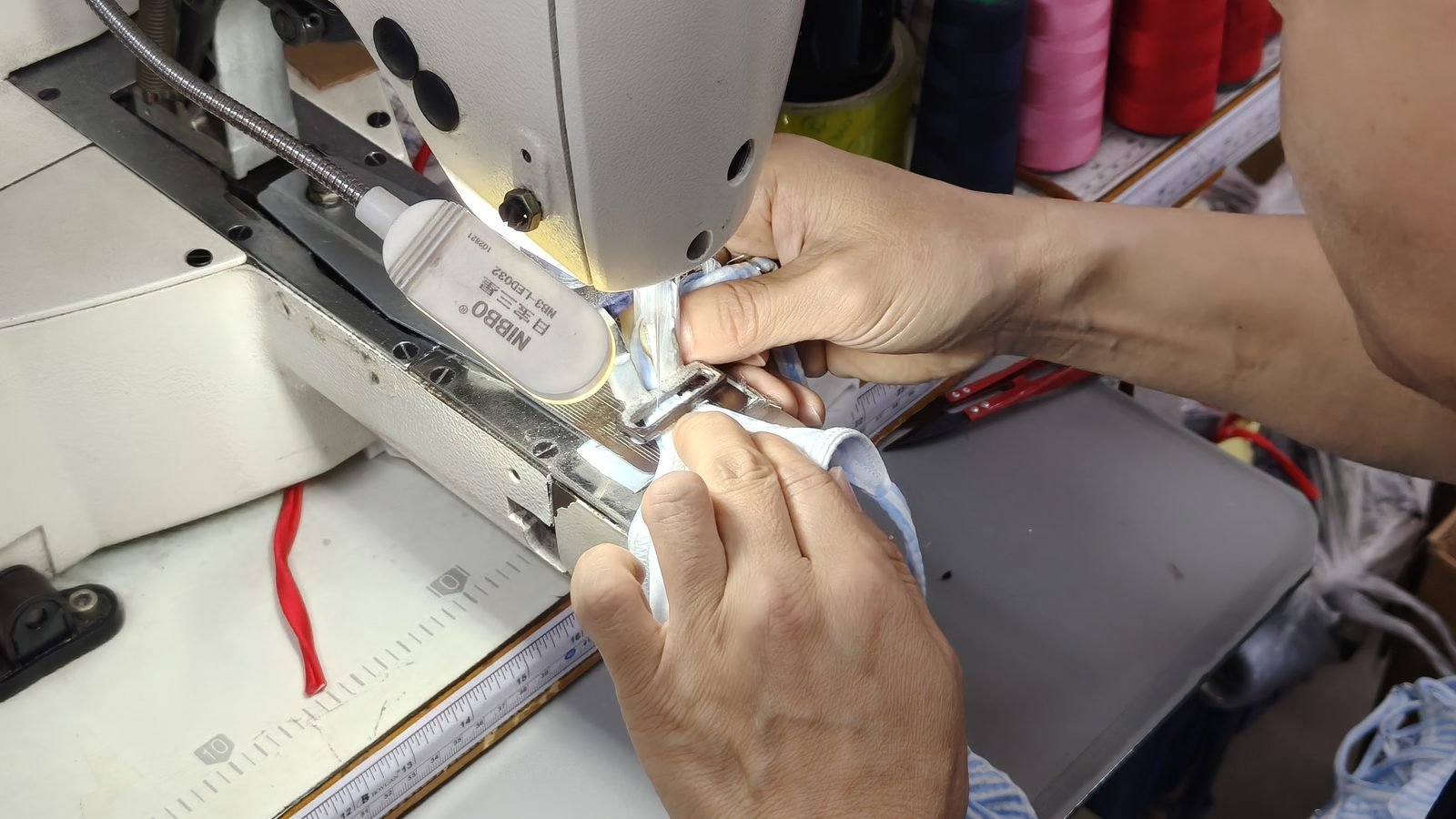
The machines reflect the problem. Structural seams run on four-thread overlock machines that join and trim the edge in one pass, leaving a seam with built-in stretch. Hems that must lie flat against skin are coverstitched, elastic goes in with a zigzag that can stretch and recover, and stress points like the base of a strap get reinforcing bartacks. The close-up below shows an industrial machine at work, the kind of heavy-duty equipment you will find on most serious swimwear floors.

Sewer stitching swimwear fabric on an industrial sewing machine during production
A sewer guiding stretch fabric through an industrial sewing machine on the swimwear line.

Machine badges matter less than what the operator’s hands are doing. Feeding two stretch layers through evenly, keeping elastic tension consistent so a leg opening hugs without digging in, pivoting around a curve with the needle down. Skipped stitches are the classic swimwear defect, usually a sign of a wrong or worn needle, and they are exactly what the finishing check looks for afterward.

The Finishing Touches That Set the Shape

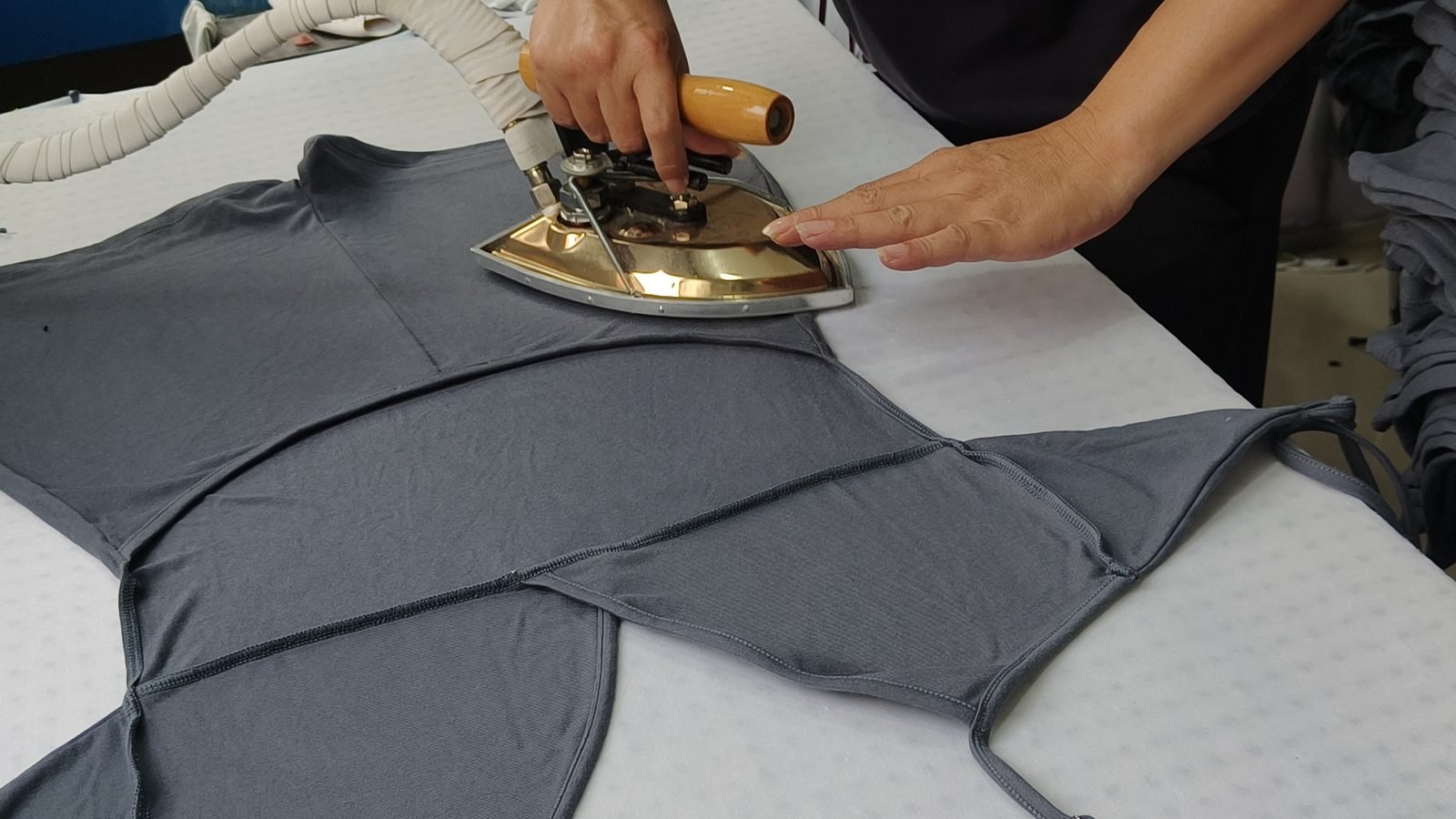
A swimsuit that leaves the sewing line is assembled, not finished. Loose thread ends are snipped by hand, seams get a visual pass, and then the garment meets steam. Pressing swimwear is a lighter discipline than pressing cotton, because spandex degrades under high heat. The goal is a gentle steaming that releases handling creases and sets the intended shape, never a hard iron that would cook the recovery out of the fabric.

Measurements get verified at this station too. Bust, waist, hip and strap length are checked against the specification, first flat and then under light stretch where it matters, because a swimsuit does its job stretched. A suit that measures correctly on the table but not on the body is still a wrong suit, and this is where it gets caught.

Steam-pressing a one-piece swimsuit during garment finishing
Steam-pressing a one-piece swimsuit to release creases and set its final shape.

Packing Is the Last Checkpoint

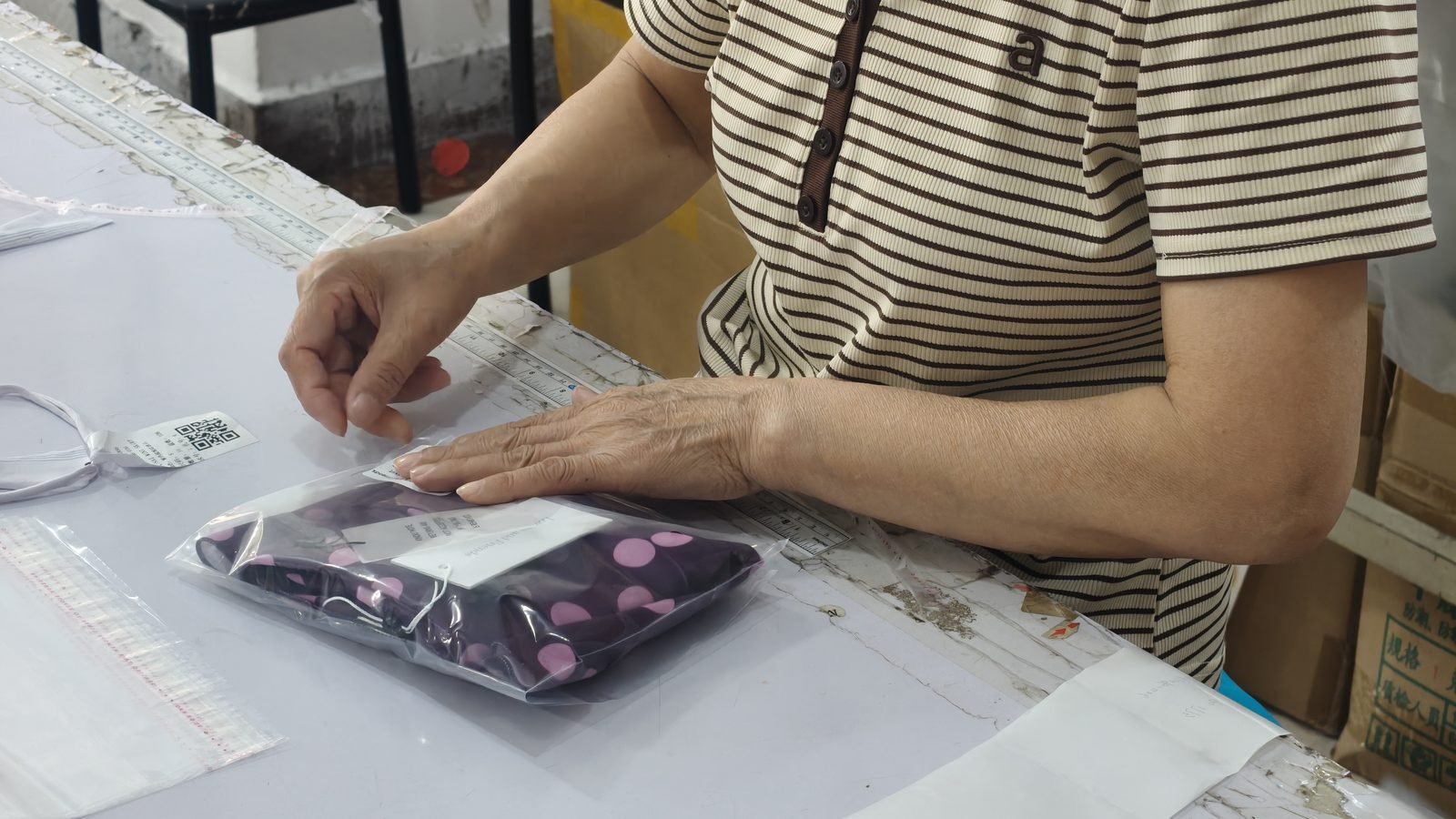
Packing sounds like logistics and behaves like inspection. Each suit is folded, looked over one last time for stains and open seams, matched with its hangtag and care label, then sealed into a polybag with a size sticker. Cartons are packed to your size ratio, their markings are what your warehouse will live by, and quantities are counted twice before the tape goes on.

This is the final moment anyone can still fix a mistake cheaply. A stain missed at sewing, a hangtag paired with the wrong size, a carton count off by a handful. The same checkpoint mindset runs the entire route from the light panel onward, and the same checkpoints are what we walk visiting buyers through, station by station. Buyers who visit in person tend to linger here, because packing is where every upstream shortcut surfaces.

Worker folding and bagging a finished swimsuit at the packing station
Folding and bagging finished swimwear at the packing station before cartons are sealed.

What to Look at in Any Factory You Visit

At Enjoy Apparel, this is the path every order takes, from a first small run to a repeat seasonal program. You can use the same walkthrough as an audit script at any swimwear factory, ours included. Brochures describe intentions; a production floor shows habits. Whether you visit in person or tour by video call, these are the stops that tell you the most.

  • Ask to see where fabric is inspected before cutting, because a factory that skips this station will find its fabric defects inside your finished goods.
  • On the cutting table, check whether the fabric lies relaxed or pulled tight, since tension on the table becomes size drift in the carton.
  • At the sewing line, watch the operators’ hands instead of the machines, because even stretch seams come from easing fabric through rather than tugging it.
  • Turn a finished garment inside out and read the seams, looking for dense, even stitching and thread ends that have actually been trimmed.
  • Ask whether finished garments pass through a needle detector before packing, which matters most when the order includes children’s swimwear.
  • Notice whether you may walk the whole floor or only a prepared route, since open access is the clearest signal a factory can send.

Everything above is the honest version of our own floor, and the same walk works live. If you are comparing factories and want to watch these stations while the line is running, message us on WhatsApp at +852 9641 7199 and we will set up a video tour from the inspection machine to the packing table.

Frequently Asked Questions

Can I visit the factory in person?

Yes, and we encourage it. We host brand founders, designers and QC teams at our factory in Shaxi Town, Zhongshan, part of China’s knitwear manufacturing belt in Guangdong. Reach out a couple of weeks ahead with the styles you care about, and we will plan the visit so the line is running something relevant while you are here.

Do you do live video tours?

Yes. For most overseas buyers a video call is the practical first step before booking flights. We walk the camera through the same route this article follows while the line is working, and you can ask us to stop anywhere, hold a seam up to the lens or show a station twice. Message us on WhatsApp and we will agree on a time that suits your time zone.

How long does it take from fabric confirmation to shipment?

Once your fabric, trims and artwork are locked in, sampling runs 14–21 days. Bulk production starts after you approve the sample and takes a month at minimum, with the schedule set by the style and the season. Transit time then depends on the shipping method and destination you choose.

What is your minimum order quantity?

Minimums begin at 100 pieces per style, and the exact figure depends on the style and fabric you choose. If you are launching a first collection, starting from proven ready styles keeps both the minimum and the development risk low.

Swimwear Quality Control, Step by Step: How an Order Gets Inspected Before It Ships

A padded bikini top comes off a production line with the cup sitting a centimeter off center. On a cutting table, that looks like a small deviation. On a customer in front of a fitting room mirror, it looks like a brand that never checked its own product. She returns the top, leaves a one-star review, and the money you spent acquiring her leaves with it.

If you have ever opened a bulk shipment and found skipped stitches, sizes that fit differently from the approved sample, or loose threads still hanging off the leg openings, you know how that story ends. The direct costs are refunds and replacements. The larger costs are the reviews that stay up after the refund is issued. If you are evaluating factories right now, quality control is the thing you most need to see in action and least want to hear described with the word strict.

Here is how a swimwear order actually gets inspected before it ships, stage by stage, with photos from our own floor in Zhongshan, China. It is written for brand owners who have been burned once and do not intend to repeat the experience.

Quality control starts before the sewing line

Fabric and trims get checked when they arrive, not after they are cut. Incoming fabric is reviewed for weight, stretch and recovery, shade against the approved lab dip, and surface defects such as snags or oil stains. Most serious swimwear factories run some version of this step. What varies is how much of each roll actually gets examined before it goes to the cutting table.

Recovery matters more than most buyers expect. Swimwear fabric is stretched hard in wear and in washing, and if it does not return to its original dimensions, no careful sewing will rescue the fit. Catching a weak roll at the door costs a conversation with the mill. Catching it after cutting costs an order.

Trims get the same treatment. Elastics, rings and sliders, cups, sewing thread, and labels are compared against the approved sample, because a cup molded to the wrong thickness changes the garment as surely as a wrong pattern. For brands selling into markets where chemical safety documentation matters, we can source OEKO-TEX® STANDARD 100 certified fabric for the order, which moves that part of compliance upstream to the fabric itself.

In-line checks while the order is being sewn

Final inspection catches problems. In-line checks keep them from multiplying. When a new style or a new size starts on a line, the first pieces are compared against the approved sample before production continues, which typically catches pattern or tension issues while they have affected a handful of pieces rather than a full size run.

Swimwear adds its own complication. The fabric is sewn under stretch, so seam quality is judged partly by what happens after the stress is released. Inspectors stretch seams by hand to check for popped or skipped stitches on elasticated edges, and they watch for the rippling that shows up when an operator feeds fabric unevenly through the machine.

Sizing also drifts during a shift. Two operators pulling the same fabric with slightly different tension will produce measurably different garments, so in-line checks re-measure pieces against the spec sheet during the run, not only at the start. This is where consistency across an order is really decided.

The goal of all this is boring uniformity. When in-line checks work, final inspection becomes confirmation rather than discovery.

The measurement check

QC inspector measuring a navy swimsuit against a ruler during final inspection
Measuring a finished swimsuit against the spec sheet during final inspection.

Before packing, finished pieces are laid flat and measured against the size spec sheet that was approved at sampling. On swimwear, the critical points are usually bust, waist, hip, body length, and strap length, with bottoms checked at the waist and along the leg. A garment that fails measurement does not go back on the pile.

Knit swimwear keeps moving after it is sewn. A piece measured straight off the machine reads differently once the fabric has relaxed, so garments rest before they are measured for the record. Skipping that rest is how a size that passed at the line ends up fitting small in the fitting room.

No handmade garment measures exactly to spec, which is why tolerance is a conversation rather than a surprise. The agreed tolerance defines what passes. A centimeter of variance at the bust of a medium may sit inside it. A centimeter of offset in cup placement almost never does, because the customer can see it. Tolerances are agreed per style before bulk production begins.

This stage is also where inspection photos come from when a buyer asks for them. We can walk you through these final checks on a call before you commit.

The details your customers actually see

Measurement errors show up in reviews as “runs small.” The next group of checks shows up as photographs in one-star reviews. None of these details affects how a swimsuit performs in the water. All of them tell the customer how much care went into making it, and finishing work is the first casualty when a factory falls behind schedule.

Loose threads get trimmed by hand

Trimming loose threads on striped bikinis during final quality control
Loose threads are trimmed by hand as a separate step before packing.

Every piece passes through a trimming step where workers cut loose threads by hand before packing. It is slow, unglamorous work, and it is the first thing a rushed factory quietly drops. When you ask a factory who trims threads, an answer like “the sewers handle it as they go” usually means nobody owns the job.

Care labels, placed the same way every time

Heat-pressing a care label onto a striped swimsuit with laser-guided alignment
A heat press applies the care label while a laser guide keeps placement consistent.

Tagless care labels are applied with a heat press, and a laser guide on the press keeps placement consistent from the first piece to the last. The label carries your branding, size, and care instructions, so a crooked one is both a cosmetic flaw and a piece of your brand presented badly. Consistency here is a small thing that photographs well.

Hangtags and the last hands on the garment

Attaching hangtags to navy bikinis by hand before packing
Hangtags are attached by hand and matched to the order before garments are bagged.

Hangtags are attached by hand and checked against the order so the right tag lands on the right size. This is the last time a person handles each garment before it is folded and bagged, which makes it a natural moment to catch anything the earlier steps missed.

Packing is part of quality control

Packing swimwear into polybags printed with multilingual suffocation warnings for retail compliance
Polybags carry suffocation warnings in multiple languages to meet retail requirements in destination markets.

The polybag your swimwear ships in is a compliance item, not just protection from dust. Many retailers and marketplaces in the US and Europe require suffocation warnings printed in the languages of the destination market, and a missing warning can get a carton refused or a listing suppressed. It is a few lines of small print that experienced factories handle as routine.

Packing is also the last chance to verify the order itself. Folding, size stickers, assortment per carton, and carton marks are checked against the packing list, so what arrives at your warehouse is ready to be received rather than re-sorted. Re-sorting a shipment at a fulfillment center costs more than the checking would have. Retail-ready is a standard your factory should be able to define in plain language.

What to ask any factory about QC

Whether you end up working with Enjoy Apparel or someone else, a few direct questions will separate factories that inspect from factories that say they inspect. Ask these before you commit:

  • At which stages do you inspect, and who signs off at each stage?
  • How do you check measurements, and what tolerance will we agree on before production?
  • Can I see inspection photos or records from a recent, comparable order?
  • How do you keep sizing consistent across a full size run?
  • What exactly happens when your inspectors find a defect?
  • Do you welcome third-party inspections, and how would we schedule one?
  • How do you handle labeling and packaging compliance for my market?

A factory that answers these without hesitation has done the work. A factory that answers with “we have strict quality control” has given you a slogan.

Frequently Asked Questions

Do you welcome third-party inspections like SGS?

Yes. Third-party inspections are welcome, and the inspection plan is agreed per order so the scope and timing are clear on both sides. Buyers typically book an inspector when goods are packed or close to packing. Tell us your inspection company’s requirements and we will coordinate the schedule with them.

Can I get inspection photos before shipment?

Yes, inspection photos can be arranged per order. Buyers most often ask for measurement records, stitching close-ups, and packing photos. Let us know what you want documented when your order is confirmed, and we will build it into the inspection routine for that order.

What happens if defects are found during inspection?

Defective pieces are pulled from the batch. Depending on the problem, they are reworked and inspected again, or remade if they cannot be brought to standard. The cause is traced back to the line so the rest of the run does not repeat it. Only pieces that pass go into cartons.

How do you control size consistency across a size run?

Every size has its own graded measurements on the spec sheet, so pieces from each size get measured rather than only the sample size. In-line checks during sewing catch drift early, and tolerances are agreed with you before bulk production, which keeps a medium meaning the same thing on every piece in the order.

Everything above comes down to a single idea. Inspection is a sequence of specific, checkable actions, and any factory you work with should be able to walk you through theirs the way we just walked you through ours. If you would like to talk through how your own styles would be inspected, send them to admin@zsenjoyco.com and we will map out an inspection plan for your order. For the bigger picture of how production works here, start with our OEM and ODM services page.