


Most swimwear and activewear brands assume the green marketing headache lives in Europe. If you sell into the United States, a different set of rules applies to every “recycled,” “eco-friendly,” or “sustainable” line on your hangtags and product pages. This guide is for brand owners and sourcing teams, not lawyers. It covers what the FTC Green Guides require of apparel claims, why “recycled” is the word that gets brands into trouble, and how to verify the factory paperwork behind it before your labels go to print.
The US Plays by Its Own Rulebook
The American framework for environmental marketing is the FTC’s Green Guides, codified at 16 CFR Part 260 and last fully revised in 2012. The FTC opened a fresh review in December 2022, collecting public comments on whether the guides need updating, but that review has produced no finalized revision. As of this writing, the 2012 text is still the operative standard, so compliance decisions should be built on what exists today rather than on what might change next year.
One thing worth understanding is how enforcement works. The Green Guides are not a statute by themselves. They are the FTC’s interpretation of Section 5 of the FTC Act, which prohibits deceptive acts and practices in commerce. A claim that contradicts the guides is treated as presumptively deceptive, and that is where the legal exposure comes from.
Apparel brands do not need to imagine what that exposure looks like. In April 2022, the FTC announced actions against Kohl’s and Walmart for marketing dozens of rayon textile products as “bamboo” and touting them as eco-friendly, when turning bamboo into rayon is a chemically intensive process. Kohl’s agreed to pay $2.5 million and Walmart $3 million in civil penalties. The products involved were ordinary soft goods, the same category swimwear lives in, and the claims involved were the same vague green language many brands still use.
What the Current Guides Say About the Claims You Actually Make
Start with recycled content, the claim most relevant to swimwear brands using recycled nylon or recycled polyester. Under 16 CFR 260.13, recycled content must consist of material that was recovered or diverted from the waste stream, either before or after consumer use. An unqualified “made with recycled materials” claim is acceptable only when the entire product, excluding minor components, is made from recycled material. If your bikini is 82% recycled nylon and 18% virgin spandex, the claim needs to be qualified with the actual percentage, stated clearly and prominently.
There is a detail here that catches brands off guard. Factory offcuts collected and fed straight back into the same production line generally do not count as recycled content under the guides, because that material would never have entered the waste stream. If your supplier describes its fabric as recycled, ask whether the content is pre-consumer, post-consumer, and genuinely diverted.
Recyclable claims are a different trap. Under 16 CFR 260.12, an unqualified “recyclable” claim is appropriate only when recycling facilities are available to a substantial majority of consumers where the product is sold, defined as at least 60%. Blended stretch fabrics like nylon/spandex are not accepted by curbside or municipal textile recycling in any meaningful way, which means calling a swimsuit recyclable is very difficult to defend.
Then there are the broad claims. Under 16 CFR 260.4, unqualified general environmental benefit claims like “eco-friendly” or “sustainable” are considered nearly impossible to substantiate, because a reasonable consumer can read a wide range of far-reaching benefits into them. The FTC’s guidance is blunt: do not make them unqualified. The workable version ties the claim to one specific, provable attribute, such as “made with 78% recycled nylon,” and nothing more.
Across all of these sits one underlying rule from 16 CFR 260.2. Marketers must hold a reasonable basis, often competent and reliable scientific evidence, before the claim is made, not after someone challenges it. For a recycled content claim on a garment, that reasonable basis is a paperwork chain, which brings us to the practical core of this article.
The Paper Trail: From the Hangtag Back to the Factory
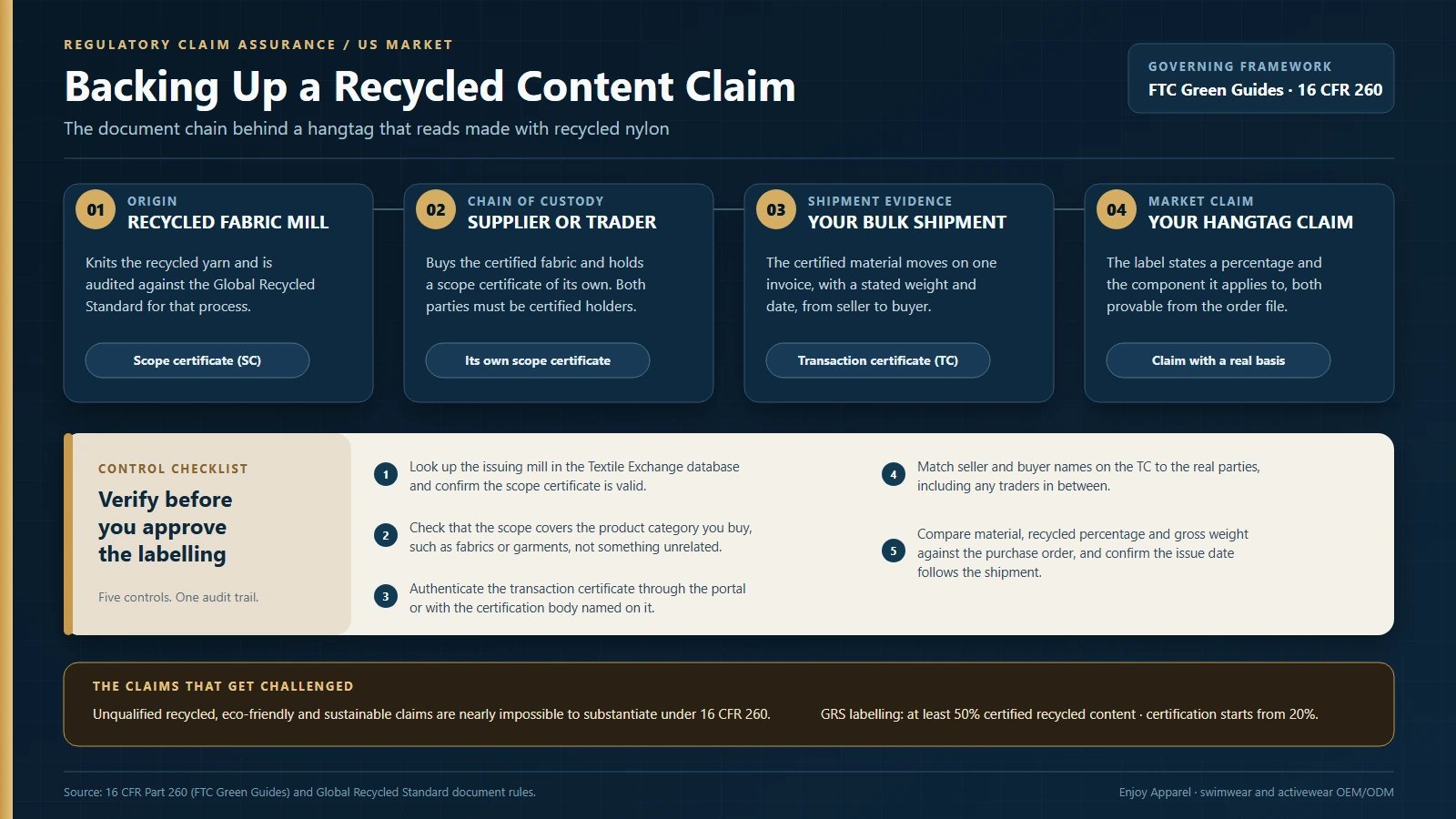
If your brand uses fabric certified to the Global Recycled Standard, you will encounter two documents, and they are not interchangeable. The scope certificate certifies a site. It says a particular factory or mill is audited and approved to handle GRS material for specified products and processes. The transaction certificate, usually called a TC, certifies a shipment. It records that a specific quantity of certified material moved from one certified party to another on a specific date, and it references the scope certificates of both seller and buyer.
This distinction matters because a scope certificate alone proves capability, not content. A mill can hold a valid scope certificate and still ship you conventional fabric on a given order. The FTC’s substantiation standard cares about the batch that became your garments, and the document that speaks to that batch is the TC.
There is also a threshold worth knowing before you plan your labeling. GRS certification applies to products with at least 20% recycled content, but consumer-facing GRS labeling and logo use requires at least 50% certified recycled content in the product. A fabric with 25% recycled content can be certified and traded with TCs, yet it cannot carry the GRS logo on your hangtag.
Neither document should be accepted as a PDF at face value, because PDFs are editable and certificates expire. Textile Exchange, the nonprofit that owns the GRS standard, maintains free public tools for both checks. When a TC lands in your inbox, here is what to verify before you sign off on labeling:
- Look up the issuing factory in Textile Exchange’s “Find a Certified Company” database and confirm the scope certificate is currently valid, not expired.
- Check that the scope covers the product category you are buying, such as fabrics or garments, not something unrelated.
- Authenticate the TC itself through Textile Exchange’s “Authenticate a Transaction” portal, or directly with the certification body named on it.
- Match the TC’s seller and buyer names to the actual parties in your supply chain, including any traders in between.
- Compare the material description, recycled percentage, and gross weight on the TC against your purchase order and shipping documents.
- Confirm the TC’s issue date follows the shipment it covers, since a TC predating the goods cannot certify them.
This verification takes about five minutes per order and requires no cooperation from anyone. A supplier who hesitates to provide a TC number, or whose certificate cannot be found in the official database, is telling you something important before your brand’s name goes on the claim.
How This Differs From the EU Rules
If you also sell into Europe, do not assume one compliance file covers both markets. The US system is a general deception framework applied claim by claim, enforced case by case, while the EU is moving toward prescriptive rules about methodology and substantiation formats. The practical difference for a brand is that the FTC asks “can you prove this specific claim,” whereas the EU increasingly dictates how you must prove it and which claims are off the table entirely.
We covered the European side in detail in a separate piece on EU green claims rules for swimwear brands, including what brands can and cannot say under the current and incoming directives. Read the two together if your collection ships to both markets, because a hangtag that passes in New York can still fail in Amsterdam.
What to Ask Your Factory Before You Print “Recycled”
The safest workflow treats the marketing claim and the sourcing decision as one conversation. Before approving any recycled content claim, ask your manufacturing partner for its scope certificate, confirm which recycled fabrics in its range are covered, and agree in writing that a transaction certificate will be issued for every bulk order that will carry the claim. A factory that works with certified material routinely will not find this unusual.
At Enjoy Apparel, GRS-certified recycled options sit inside a fabric library of over 5,000 materials, alongside virgin nylon/spandex, polyester/spandex, and chlorine-resistant PBT.
When a client builds a collection around a recycled claim, we provide the corresponding transaction certificates as a standard part of the order paperwork, and the fabrics we source include OEKO-TEX® STANDARD 100 certified options. As a BSCI-audited and ISO 9001-certified factory, we are used to having our documentation opened up to client verification, because we would rather you check than trust.
The commercial side stays simple. Sampling runs 14 to 21 days, and bulk production takes at least a month, so the right moment to raise the certification question is at the sampling stage, not after the order is cut.
If you are planning a recycled swimwear or activewear line for the US market and want to see what a real certificate chain looks like, send us a note. We are happy to share a sample GRS transaction certificate, talk through which recycled fabrics fit your styles, or walk through how the documentation maps to the claims you want to print. Reach us on WhatsApp at +852 9641 7199 or by email at admin@zsenjoyco.com.
Preguntas frecuentes
Are the FTC Green Guides legally binding?
Not directly. They are the FTC’s official interpretation of how Section 5 of the FTC Act applies to environmental marketing. Claims that contradict the guides are treated as presumptively deceptive, which gives them real enforcement weight, as the Kohl’s and Walmart penalties showed.
What happens if my brand violates them?
The FTC can pursue civil penalties and consent orders that restrict future claims. Kohl’s paid $2.5 million and Walmart $3 million in 2022 over bamboo and eco-friendly claims. Private lawsuits and state attorneys general can follow the same playbook.
Does GRS certify my brand or my factory?
The factory. Scope certificates are issued to specific sites in the supply chain. Your brand’s protection comes from transaction certificates that trace the certified material from those sites into your specific orders.
Can I ever say “sustainable” on a hangtag?
Not unqualified. The Green Guides say general environmental benefit claims are nearly impossible to substantiate across every reasonable consumer interpretation. Tie the wording to one specific, provable attribute instead, such as a verified recycled content percentage.

