


The email usually arrives on a Tuesday. A California swimwear label opens a message from Landbell USA, the state-approved producer responsibility organization, noting that its registration under SB 707 is overdue. The same week, its French distributor asks for an EPR registration number before the spring order ships. If either scene sounds familiar, this guide is for you. It explains in plain language which textile EPR rules now reach swimwear, what is actually in scope, and which production data to request from your factory before a regulator asks first.
Extended Producer Responsibility in Plain Terms
Extended producer responsibility, EPR for short, moves the cost of dealing with a product after the consumer is done with it from municipalities and taxpayers to the business that first placed that product on the market. That business registers with a scheme, reports what it sold, and pays fees that fund collection, sorting, reuse, and recycling. The model is decades old for packaging, batteries, and electronics.
Textiles joined the list because clothing volumes keep climbing while fiber-to-fiber recycling stays low. Regulators on both sides of the Atlantic decided that apparel brands, rather than local waste budgets, should finance the fix. ملابس سباحة sits squarely inside that logic, since most suits are built from synthetic blends like nylon and spandex that are durable in the water and stubborn in the waste stream.
For a brand owner, the practical shift is simple to state and tedious to execute. EPR turns end-of-life management into a line item on your compliance calendar, with registration numbers your retail partners will ask for and annual declarations your operations team will file.
Two Timelines Worth Putting on Your Calendar
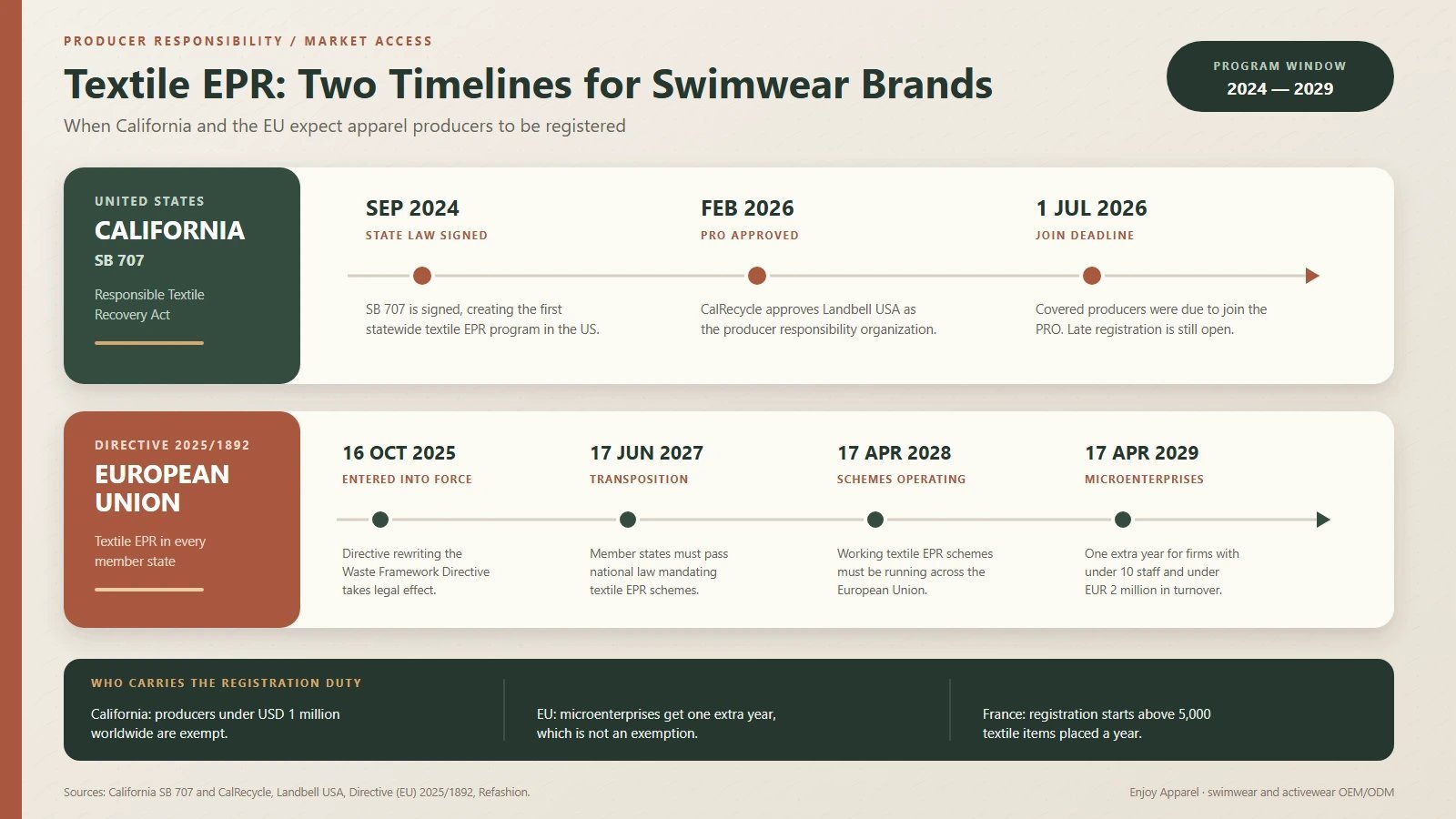
California moved first in the United States. Governor الأخبارom signed SB 707, the Responsible Textile Recovery Act, in late September 2024, creating the country’s first statewide textile EPR program. CalRecycle, the state resources agency, approved Landbell USA as the program’s PRO in February 2026, and covered producers were required to join by July 1, 2026.
That date has passed, but registration remains open, and the state now treats unregistered brands as formally out of compliance, with civil penalties that can reach $50,000 per day. Fee schedules and reporting formats are still being finalized, so a late registrant can still catch up before the program’s machinery fully switches on. Waiting longer only raises the stakes.
Europe runs on a longer fuse with a wider reach. Directive (EU) 2025/1892, which rewrites the Waste Framework Directive to mandate textile EPR in every member state, entered into force on October 16, 2025. National governments must transpose it into domestic law by June 17, 2027, and working EPR schemes for textiles must be operating by April 17, 2028. Microenterprises receive one extra year, until April 17, 2029.
Two national schemes already show what this looks like in practice. France has run textile EPR since 2007 through Refashion, and any company placing more than 5,000 textile items a year on the French market must register and pay per-unit eco-contributions that range from well under a cent to about twelve cents, depending on the category. The Netherlands followed in July 2023 with its UPV Textiel system covering consumer clothing and workwear.
Yes, ملابس سباحة Is in Scope
For California, the answer is unambiguous. The statutory list of covered apparel in SB 707 names swimwear explicitly, alongside athletic wear, leggings, undergarments, and a long roster of other clothing categories. If you sell bikinis, one-pieces, rash guards, or board shorts into the state and your aggregate global revenue tops $1 million a year, the law treats you as a producer with a duty to join the PRO.
The EU directive covers clothing, clothing accessories, footwear, and household textiles, with no carve-out for swim categories. Member states will write their own product lists over the next two years, so national details can still shift, but nothing in the directive or the schemes running today treats swimwear as anything other than apparel. Trims, linings, and hangtags travel with the garment and are not reported as separate items.
Packaging is a different story, and a common source of confusion. Polybags, cartons, and mailers fall under separate packaging EPR regimes, such as California’s SB 54 and the EU’s Packaging and Packaging Waste Regulation, Regulation (EU) 2025/40, which began applying in August 2026. A swimwear brand selling into both markets should budget for two registrations, not one.
What Registration and Reporting Actually Look Like
The mechanics are similar everywhere. You join the designated PRO, sign a participation agreement, and declare what you placed on the market, usually as units or kilograms broken down by product category. The PRO uses those declarations to calculate your fees and to plan collection infrastructure, and it files the program plan with the regulator on behalf of its members.
The fee concept worth understanding early is eco-modulation. The EU directive and mature schemes like France’s tie fees to product design, so garments that are more durable, easier to recycle, or made with documented recycled content cost less to place on the market. A mono-material suit with certified recycled nylon should eventually carry a lower fee than a complex blend with no paperwork behind it. California’s fee schedule is still under construction, and brands there should watch for similar design-linked signals as the PRO publishes details.
Who exactly counts as the producer depends on where your legal entity sits relative to the buyer. Both frameworks cascade through brand owner, importer, and retailer until someone inside the jurisdiction carries the duty. Selling online does not move you out of scope, which is why the الأسئلة الشائعة below spends time on distance selling.
The Compliance Data to Ask Your ملابس سباحة Factory For
Every declaration you file traces back to production data, and most of it originates on the factory floor rather than in your marketing department. Brands that collect this data early can register in days. Brands that chase it retroactively miss deadlines. A standing data pack from your manufacturer should cover the following:
- The exact fiber composition of every component in each style, including shell, lining, cups, elastics, and trims.
- The unit weight of each style and size, so unit-based records can be converted into kilograms when a scheme asks for weight.
- Packaging weights broken down by material, covering polybags, hangtags, and cartons, which feed your separate packaging registrations.
- Production volumes per style per season, which your own sales data then allocates by destination country.
- Recycled content documentation, such as GRS certificates, for any style you intend to claim under eco-modulated fees.
- الأقمشة certifications that support eco-modulation claims, including OEKO-TEX® STANDARD 100 certified fabrics where applicable.
This is where factory choice quietly becomes a compliance decision. At Enjoy Apparel, our fabric library of more than 5,000 materials comes with composition specifications for every option, and we keep the same records across our 1,000-plus ready styles, from nylon-spandex bikinis to recycled rash guards. Because our quality system is ISO 9001-certified and our facility is BSCI-audited, the paperwork behind those fabrics exists before you ask for it.
The cleanest workflow is to attach the data request to every purchase order and refresh it once a year, since most schemes want annual declarations. If your factory cannot produce fiber content by component and unit weights per style, you will end up weighing samples yourself the night before a filing deadline.
Get the Paperwork Before You Need It
Need composition files, fabric certifications, or per-style weights for an EPR registration? Enjoy Apparel supports brand partners with the compliance data behind every style we produce, from fiber content breakdowns to recycled content documentation. Message us on WhatsApp at +852 9641 7199 or email admin@zsenjoyco.com, and tell us which markets you are registering in. We will put together the data pack your PRO expects.
Frequently Asked Questions
Do I have to register if I only sell online?
Yes. SB 707 applies to covered products sold in or into California regardless of sales channel, and online marketplaces must report their higher-volume third-party sellers to the state. The EU directive explicitly covers distance sellers, so a US webstore shipping orders directly into France is treated like any other producer placing goods on the French market.
I am a US brand selling into the EU. Is the obligation mine or my distributor’s?
It depends on who first places the product on each national market. If you sell directly to consumers online, that is usually you. If a European importer or distributor buys your line and resells it, the duty generally sits with them, though contracts and national transpositions differ. Confirm the allocation in writing rather than assuming your partner has it covered.
Are small brands exempt?
Sometimes. California exempts producers with under $1 million in aggregate global annual turnover. The EU grants microenterprises, meaning fewer than ten employees and under €2 million in turnover, one extra year until April 17, 2029, but not an exemption. France’s scheme applies once you place more than 5,000 textile items a year on the French market.
What exactly is a PRO?
A producer responsibility organization is the collective body that runs an EPR scheme day to day. It designs the collection and recycling network, files the program plan with the regulator, collects fees from member brands, and reports results. Landbell USA holds that role for California’s textile program, and Refashion plays it in France.

