


On 10 October 2026, the first big application date of the EU’s PFHxA restriction kicked in, and it covers clothing, accessories and footwear sold to the general public. If you run a swimwear or activewear brand selling into Europe or the US, this article explains what actually changed, why most swimwear was never a PFAS problem in the first place, and where the real risk hides in a typical swim range. It is written for brand owners and sourcing managers, not chemists.
What Changed on 10 October 2026
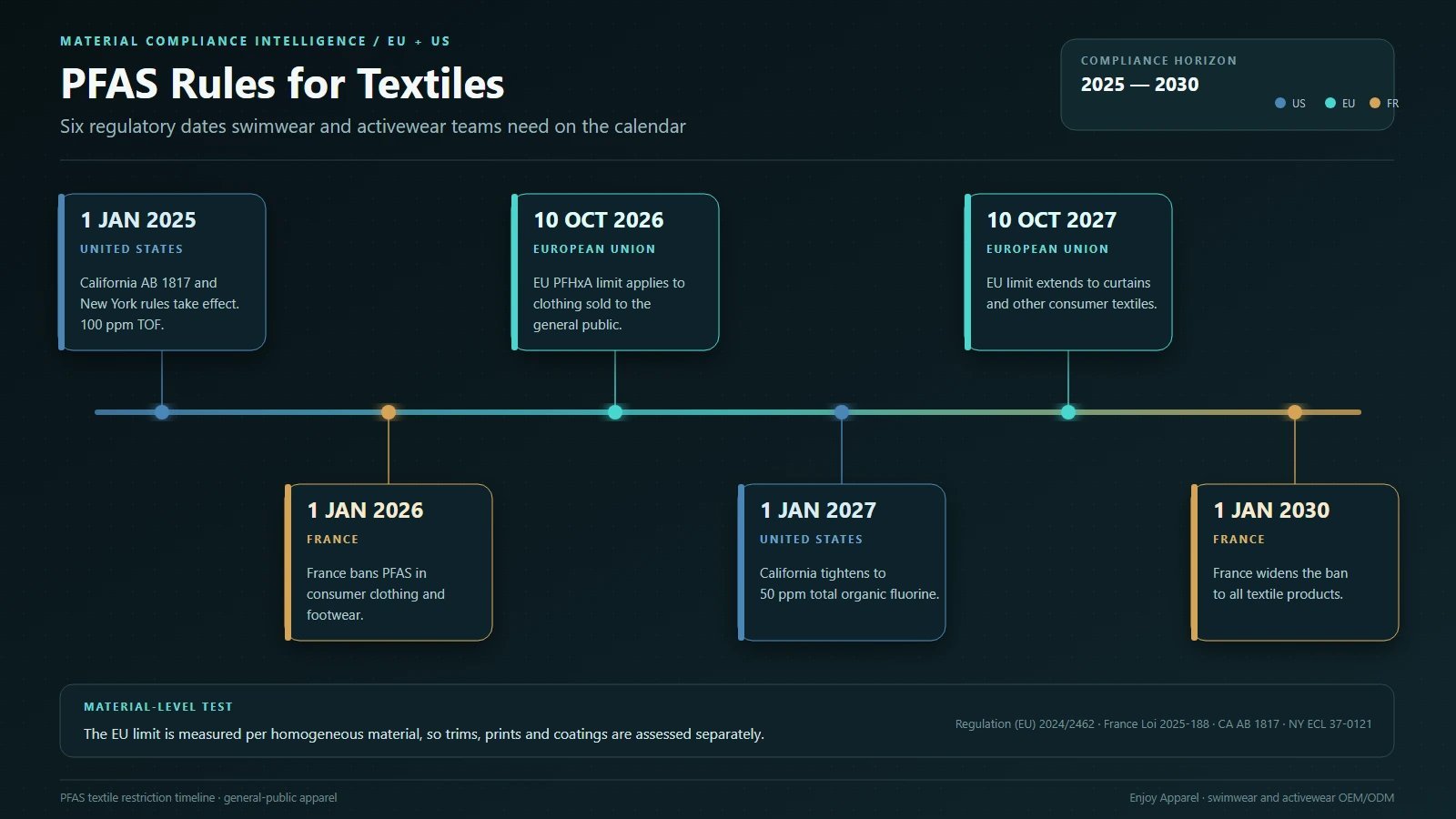
Commission Regulation (EU) 2024/2462 added entry 79 to Annex XVII of REACH, restricting undecafluorohexanoic acid (PFHxA), its salts and PFHxA-related substances. From 10 October 2026, textiles, leather, furs and hides in clothing and related accessories for the general public may not be placed on the EU market at or above 25 ppb for the sum of PFHxA and its salts, or 1,000 ppb for the sum of PFHxA-related substances, measured in homogeneous material. Other consumer textiles such as curtains and upholstery follow on 10 October 2027.
Two details matter for buying teams. First, the limit applies per homogeneous material, so a coated trim or a printed logo is assessed separately from the base fabric. Second, articles already placed on the market before 10 October 2026 are exempt, which protects existing stock but not your next production run. Anything you ship to the EU from now on has to comply.
The EU rule does not arrive in a vacuum. France went further with its own law, Loi n° 2025-188 of 27 February 2025, which has banned PFAS in consumer clothing textiles, footwear and waterproofing agents since 1 January 2026, and extends the prohibition to all textile products from 1 January 2030. Because France bans PFAS as a class rather than one substance group, it is arguably the stricter benchmark for any brand with French distribution.
Across the Atlantic there is no federal apparel ban, so compliance is a state-by-state puzzle. California’s AB 1817 has prohibited new textile articles containing regulated PFAS since 1 January 2025, using a total organic fluorine threshold of 100 ppm that drops to 50 ppm on 1 January 2027. New York’s Environmental Conservation Law section 37-0121 has banned apparel with intentionally added PFAS since 1 January 2025. More states have dated apparel restrictions in the pipeline, so designing for the strictest current rules is the cheapest insurance.
What PFAS Does in Textiles, and Why 泳衣 Is the Exception
PFAS earned their place in apparel for one reason: the carbon-fluorine bond is exceptionally good at repelling water, oil and stains. For decades the chemistry sat inside durable water repellent finishes on rain jackets, stain-resistant treatments on upholstery and school uniforms, and coatings on outdoor gear. That is exactly the product category regulators targeted first, because it is a wide dispersive consumer use where the chemicals wash out and persist in the environment.
泳衣 is built on the opposite premise. A bikini or a pair of swim shorts is designed to get wet, stay wet for a while, and then dry fast. No rational designer applies a water-repellent finish to a garment whose job is to absorb a swim.
Quick-dry performance in swimwear comes from fiber physics, not chemistry. Fine nylon or polyester filaments blended with spandex barely hold water, and the knit structure spreads moisture across a large surface area so it evaporates quickly. Chlorine-resistant PBT achieves its durability through the polymer itself. None of this requires a fluorinated finish.
This is the point most PFAS coverage misses, and it is good news for swim brands. Your core product, the actual swimsuit, is one of the lowest-risk garment types on the market. Brands that build on clean nylon/spandex or polyester/spandex constructions can answer most customer and retailer questionnaires with confidence, because the performance story never depended on the chemicals being banned.
Where PFAS Can Actually Hide in a Swim Range
The risk lives at the edges of the line, in the products that behave less like swimwear and more like outerwear. Men’s boardshorts and surf trunks are the classic case. Buyers often ask for water beading on the fabric surface, and the traditional way to deliver that effect was a C8 or C6 fluorocarbon DWR. If your boardshort spec says “water repellent” without naming the finish chemistry, that is your first audit target. Fluorine-free C0 DWR alternatives exist and are now the default request among EU-facing brands.
Cover-ups, beach ponchos and light resort jackets are a second blind spot. These pieces are frequently sourced with coated or treated fabrics borrowed from outerwear supply chains, where PFAS finishes were routine. Kids’ swim and beachwear deserve extra attention too, because stain-resistant and “easy clean” claims on children’s products historically leaned on fluorinated chemistry, and children’s categories attract the strictest scrutiny from regulators and retailers alike.
Smaller components can also carry risk. Certain prints, coatings and functional trims have involved PFAS-related substances, which is why the EU limit’s homogeneous-material logic matters: a compliant base fabric does not rescue a non-compliant trim. Finally, recycled fabrics add a supply chain wrinkle. GRS-certified recycled polyester or nylon is a strong sustainability story, but recycled feedstock can carry legacy chemistry if the upstream chain is loosely documented, so the certification of the finished fabric matters more than the recycled claim itself.
What to Write on Your Spec Sheet, and What to Ask Your Factory
The fix is mostly paperwork discipline applied at the start of development, not the end. On your tech pack, ban the vague phrase “water repellent finish” and instead specify “fluorine-free (C0) DWR” wherever a repellent effect is genuinely needed, and state explicitly that no intentionally added PFAS are permitted anywhere in the garment, including prints, coatings and trims. One sentence on the spec sheet is cheaper than a failed test or a pulled shipment.
From your manufacturing partner, the documents that close the loop are straightforward.
- A signed PFAS-free declaration covering every component of the garment, not only the shell fabric.
- A current restricted substances list (RSL) that the factory applies to its fabric and trim sourcing.
- Third-party test reports from an accredited lab, ideally covering total organic fluorine as a screening method plus targeted PFAS analysis for high-risk components.
- Certification documents for the finished fabric, such as OEKO-TEX® STANDARD 100, which since 2024 includes a total fluorine limit that acts as a practical PFAS screen.
- A certificate of compliance if you sell into California, where AB 1817 requires manufacturers to provide one on request.
Timing matters as much as paperwork. California’s threshold tightens to 50 ppm total organic fluorine on 1 January 2027, and France’s scope widens to all textiles in 2030. Product you develop this season may still be on shelves when the next rule bites, so spec to the strictest foreseeable threshold rather than today’s minimum.
How We Approach This at Enjoy Apparel
Enjoy Apparel is a swimwear and activewear OEM/ODM factory in Zhongshan, Guangdong, working with brands that sell into both the EU and North America. Our day-to-day answer to PFAS compliance is unglamorous and effective: we build swimwear from constructions that never needed fluorinated finishes in the first place. Quick-dry, chlorine resistance and UPF 50+ performance come from the fiber and the knit, across a library of more than 5,000 fabrics and over 1,000 ready styles.
When a range does call for surface effects, for instance a boardshort with water beading or a cover-up with a protective hand feel, we spec fluorine-free finishes and source from mills supplying OEKO-TEX® STANDARD 100 certified fabrics. Our operation is BSCI-audited and ISO 9001-certified; we maintain the declaration and testing trail that EU and California compliance expects, and we share it per style rather than as a generic PDF.
Send Us Your 面料 Spec for a Compliance Review
If the new PFAS swimwear rules raised questions about your current line, the fastest way to get clarity is a direct technical conversation. Send your fabric list or spec sheet to the Enjoy Apparel team and we will flag which components carry PFAS risk, propose fluorine-free or finish-free alternatives from our fabric library, and tell you what documentation we can support for your target markets.
Sampling runs 14 to 21 days, bulk production takes at least one month, and MOQ starts at 100 pieces per style, so there is time to correct course before your next season. Reach us on WhatsApp at +852 9641 7199 or by email at admin@zsenjoyco.com.
常见问题: PFAS and 泳衣 Compliance
Does quick-dry fabric mean it contains PFAS?
Almost never. Quick-dry swimwear gets its performance from hydrophobic-by-nature fibers such as nylon, polyester or PBT, knitted in open constructions that spread and release moisture fast. That is fiber engineering, not a chemical finish. PFAS-based treatments were designed to stop water entering a fabric, which is the opposite of what a swimsuit needs, so most swimwear contains no PFAS at all unless a separate water-repellent or stain-resistant finish was deliberately specified.
Do recycled fabrics carry PFAS risk?
They can, but the risk is manageable. Recycled polyester or nylon inherits whatever chemistry was present in its feedstock, and recycled streams are harder to trace than virgin ones. The practical safeguard is to certify the finished fabric, not the marketing claim: a GRS certificate verifies recycled content, while an OEKO-TEX® STANDARD 100 certificate with its total fluorine limit screens the actual material your customers will wear. Ask for both, and add targeted testing for high-risk styles.
Which test should I request from my factory?
Start with total organic fluorine (TOF) as a screening test, because it catches any fluorinated chemistry cheaply and maps directly onto California’s 100 ppm and 50 ppm thresholds. Where TOF comes back elevated or a component is high risk, such as a DWR-treated boardshort fabric, follow up with targeted PFAS analysis by an accredited lab. Pair the test reports with a signed PFAS-free declaration and the factory’s RSL so you hold both evidence and accountability.
If I only sell in the US, can I ignore the EU rules?
You can ignore the EU regulation itself, but not the direction of travel. California already bans regulated PFAS in textiles at 100 ppm total organic fluorine, tightening to 50 ppm in 2027, and New York bans intentionally added PFAS in apparel. Several other states have adopted or proposed dated apparel restrictions, and major retailers apply their own PFAS policies nationwide. Building one clean, fluorine-free spec for all markets is simpler than maintaining parallel compliant and non-compliant versions of the same product.

