Swimwear Size Grading, Explained for Brands: Base Sizes, Grade Rules and Fit Samples

Swimwear is widely considered one of the most return-prone categories in apparel, and size uncertainty is usually the reason. A swimsuit that has been tried on typically cannot go back into saleable stock, so every sizing guess turns into inventory you write off. For a young brand, fit inconsistency is not a nuisance. It is margin leaking out of every order.

This guide explains swimwear size grading in the terms a factory actually uses, from base size and grade rules to fit samples and the size-set. It is written for founders and e-commerce sellers who want fewer returns and a size chart they can stand behind.

Why Grading a Swimsuit Is Not Grading a T-Shirt

A T-shirt pattern is graded by adding width and length to a garment that hangs loosely on the body. The ease is positive, meaning the finished shirt measures larger than the person wearing it. A swimsuit works on the opposite principle. It is built with negative ease, so the finished garment measures smaller than the body and stays in place through fabric tension. Grading a swimsuit is therefore not scaling a shape outward. It is redistributing controlled stretch across a size run.

That difference changes the math. Stretch fabric does not recover identically at every size, so the factory must decide how much negative ease each size carries at each measurement. If finished dimensions grow in step with the body, larger sizes end up with less tension and fit looser than the sample size. If they grow less, smaller sizes become unwearably tight. A T-shirt tolerates that drift. A swimsuit does not, because tension is the only thing holding it on.

The shape complicates things further. Bust, waist and hip do not scale at the same rate, and neither do torso length, cup volume and leg opening height. A one-piece that gains an inch at the bust per size may need only a fraction of that through the body loop, and that difference is what separates a suit that sits flat from one that digs into the shoulders or sags at the seat.

Elastic is the quiet variable. Leg openings, straps and underbust bands are all cut shorter than the edge they finish, so they pre-tension the garment against the body. Every size needs that ratio recalculated, because the same elastic percentage pulls differently across a larger opening. Grading software scales pattern pieces easily. Scaling tension still takes a pattern maker who understands swim.

Choosing Your Base Size and Grade Rules

Every size run starts from a base size, the single size on which the pattern is perfected and the fit sample is approved. The default in many factories is a medium, but the right base is the size your core customer actually buys. If your order data clusters around small and medium, grade from one of them. Fit is proven at the base size, so it should sit at the commercial center of your range rather than at a convention.

From that base, grade rules push the pattern outward. A grade rule is the set of per-size increments applied to each measurement, and in US swim sizing the bust and waist typically move in steps of roughly an inch while the hip moves slightly more. Those numbers are yours to tune. Whatever you settle on, the rules belong in your tech pack as agreed values, not as an unexamined factory default.
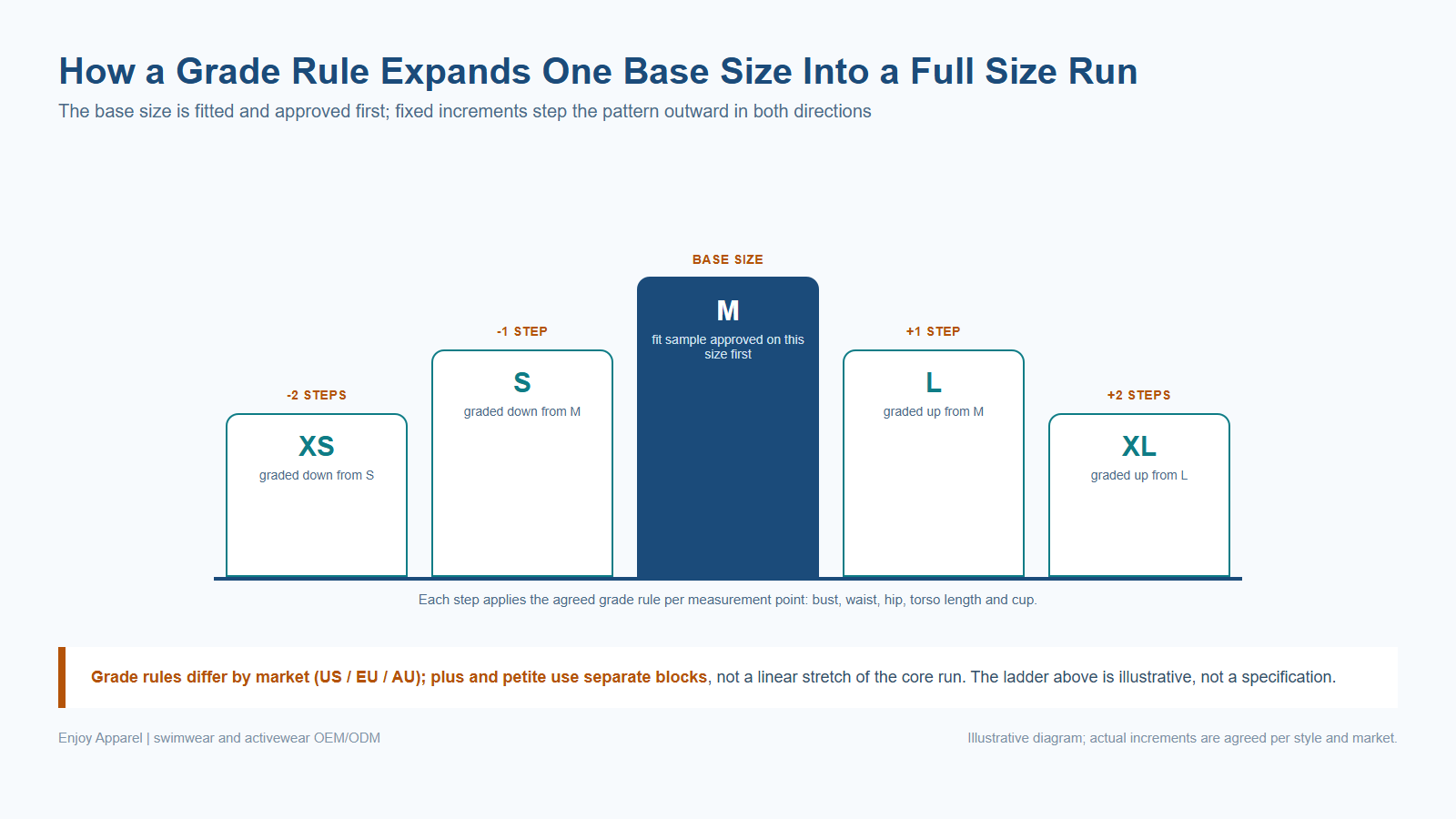
Stepped diagram illustrating how a swimwear grade rule expands a base size pattern across a size run from XS to XL
Grade rules step a base size outward across the full run; the increments shown are illustrative, not a specification.

Geography adds another layer. US, EU and AU systems label the same body differently, and a brand selling across all three needs its conversion table locked before grading begins, not after the first shipment. It helps to work with a factory that already runs multiple sizing systems, since the conversions then feed the grade rules directly instead of being patched on afterward.

Plus and petite ranges deserve special care, because they are not the base pattern stretched or shrunk. A plus-size body differs in proportion, not just scale, so armhole depth, cup spread and rise shift in ways a linear grade will never capture. Petite bodies carry a shorter torso, which changes the entire balance of a one-piece. Each range needs its own block and its own grade rules, validated on its own fit models.

The Swimwear-Specific Checkpoints

Torso length is the measurement that makes or breaks a one-piece. Each size typically gains a small increment through the body loop, and the tolerance is unforgiving. A suit graded too short pulls at the shoulders and rides up, while one graded too long wrinkles through the midsection and sags when wet. Ask how your factory grades torso length, and check it on the size-set rather than only on the base sample.
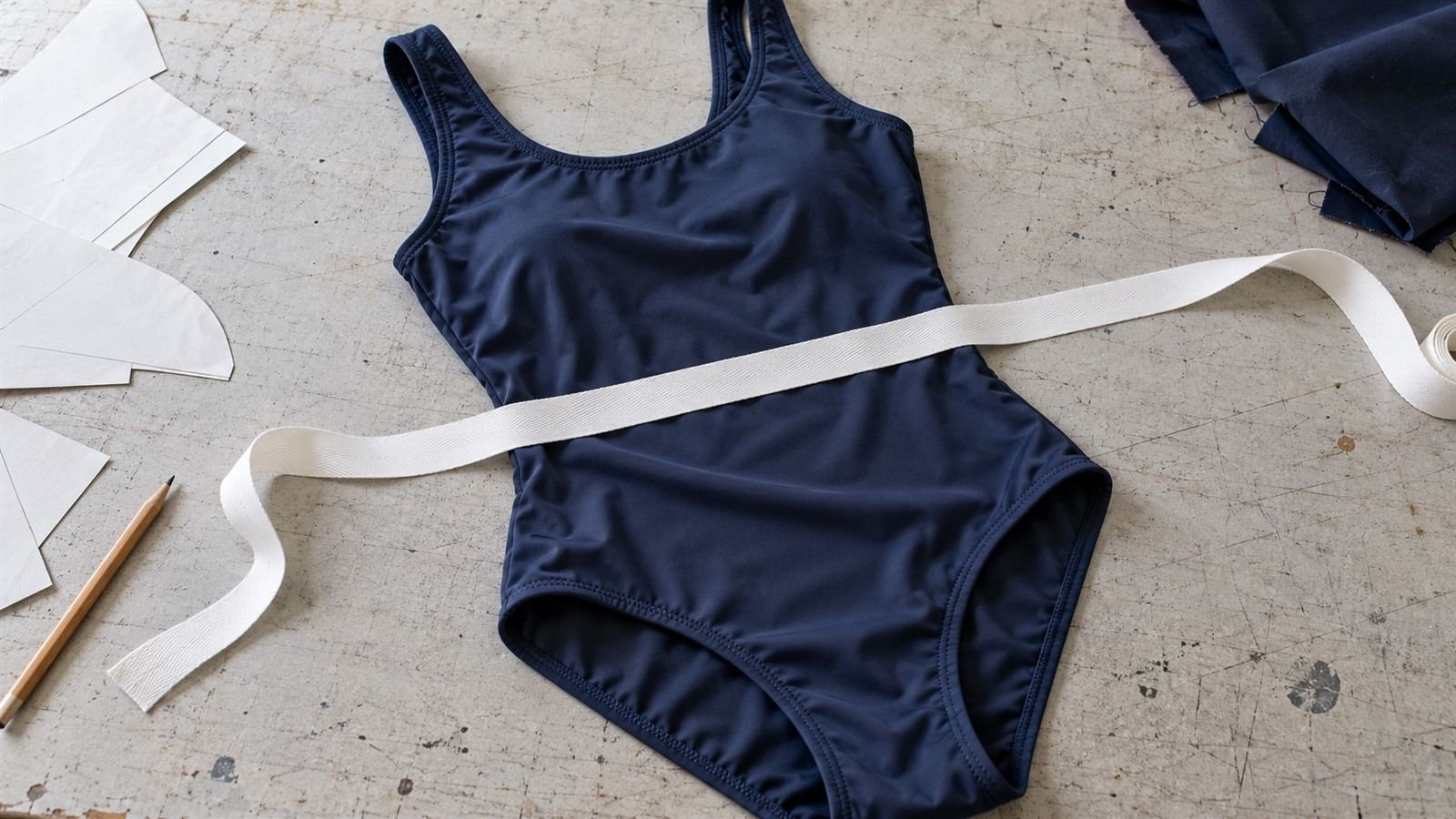
A one-piece swimsuit laid flat with an unmarked measuring tape across the torso during a size-set spec check
A size-set check starts on the table, every graded point measured against the chart.

Cups grade independently of the band. Cup volume grows with cup letter rather than with band size, so a range running from A to DD cannot share a single cup shape across the run. Padding placement and wire length, where the design uses them, shift with each grade. Coverage expectations shift with size too, and the construction standards behind fuller-coverage styles are worth a separate read in our modest swimwear manufacturing guide.

Leg opening height changes how a suit reads across sizes. A high-cut leg rises as the size increases unless the grade rule compensates, which is how a cheeky small becomes a much more revealing XL. Strap length grades as well, and adjustable hardware has a finite range, so the extremes of your size run deserve a specific check rather than an assumption that the base size’s proportions will hold.

There is also a regional question most brands never think to ask. Many factories draft their base blocks on Asian fit forms, where average torso, rise and bust placement differ from Western proportions. A size run that fits beautifully on one block can miss consistently on another. Before you approve any grading, ask which body the base block was built on and how the pattern has been validated for your market.

Fit Samples and the Size-Set

The sample sequence in swim usually runs in three stages. A base-size fit sample proves the pattern on one body. The graded spec then gets reviewed on paper, measurement by measurement, before any more fabric is cut. Finally, a size-set sample run produces the style across the full size range, so the grade can be checked in cloth rather than in theory.
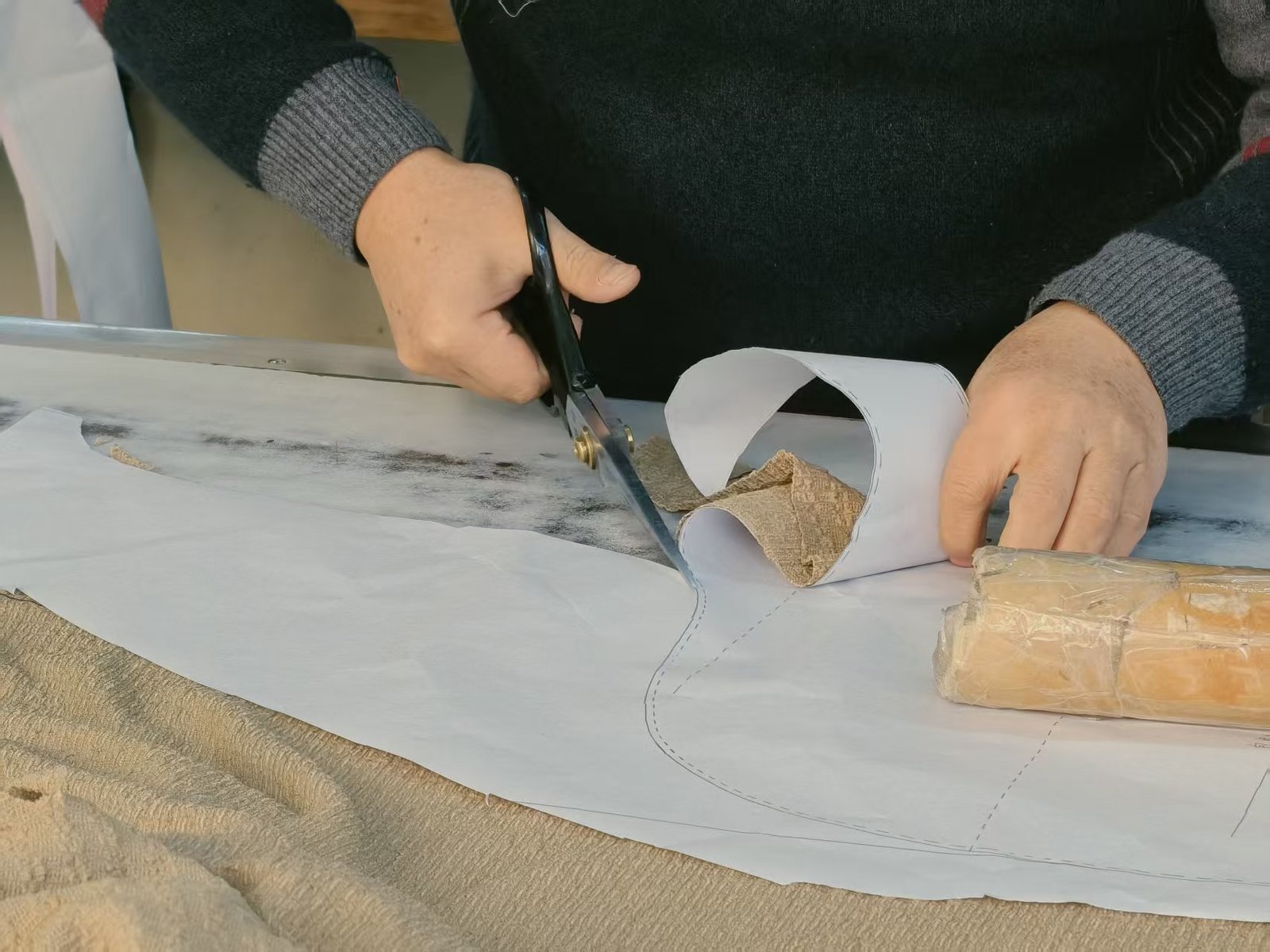
Cutting graded paper pattern pieces for a swimwear style before a size-set sample run is sewn
The graded spec is reviewed on paper, piece by piece, before any more fabric is cut for the size-set.

When the size-set lands on your desk, a short routine catches most problems before bulk:

  • Measure the full spec on every size and compare each point against the graded chart, not just against the base size.
  • Try at least the smallest, the largest and one middle size on real bodies, because stretch fit reads very differently on a table.
  • Check negative ease at bust and hip by comparing garment measurements to the target body, so each size carries the intended tension.
  • Stretch each elastic opening and let it recover, since a size that bags out on a first try-on will not survive a season of wear.
  • Record every deviation in writing and have the factory confirm the corrections before the production sample is cut.

Signing the size-set is signing your size chart. Whatever those garments measure is what your customers will receive, so treat the approval as the moment the chart becomes real. Deviations found after bulk production are no longer fit feedback. They are a claims conversation.

Working with a Factory on Grading

This is the part of the process where a swim-specialist factory earns its keep. At Enjoy Apparel, an OEM and ODM swimwear and activewear manufacturer based in Zhongshan, Guangdong since 2014, grading starts from a base size agreed with the brand rather than a house default. Patterns are developed across US, EU and AU sizing, with plus and petite ranges built on their own blocks instead of stretched from the core run.
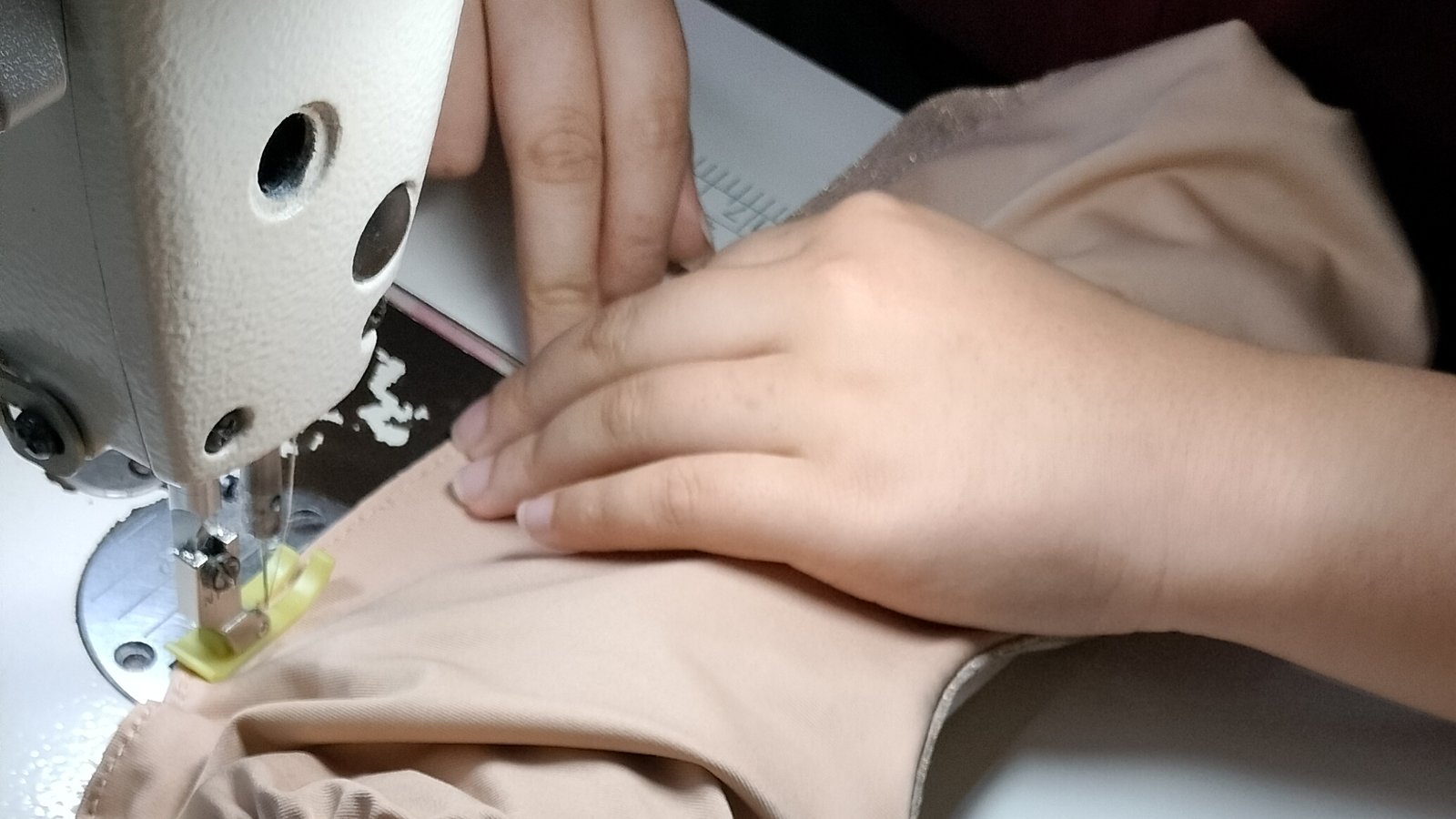
Sewing a beige swimwear style on an industrial machine after the graded size-set has been approved
Once the size-set is signed off, bulk sewing follows the approved grade rule for every size in the run.

Once the grade is approved on paper, the factory produces a size-set for confirmation before bulk cutting begins, across a swim line that runs from bikinis and one-pieces to tankinis, rash guards and kids’ swimwear. The same grading discipline carries into the yoga line of leggings and sports bras. You can see the range on our swimwear product page, and the step from approved spec to size-set sits inside our custom process walkthrough.

The Short Version

Swimwear grading is the management of tension across a size run, which is why it behaves nothing like grading a tee. Choose the base size where your customers actually live. Write your grade rules down and make them yours. Treat plus and petite as separate blocks, check the swim-specific points on the size-set, and approve the graded spec in writing before bulk.

If you are building a swim line and want a factory that treats your size chart as an engineering document, email admin@zsenjoyco.com with your chart, your target sizes or even just your questions. A pattern team that grades swimwear every week will tell you plainly what your range needs.

Frequently Asked Questions

What is a grade rule?

A grade rule is the set of measurement increments applied to a base pattern to create each larger and smaller size. In swimwear it covers not just width and length but also negative ease, torso growth, cup volume and elastic tension, so the rule set is longer and less forgiving than the equivalent for a T-shirt.

Should plus sizes be graded from the same base pattern?

No. Plus-size bodies differ from straight sizes in proportion, not only in scale, so armholes, cup spread, rise and torso balance all shift in ways a linear grade cannot follow. A plus range should be built on its own block with its own grade rules and validated on plus-size fit models, and the same logic applies to petite sizing at the other end of the run.

How many fit samples should I expect before bulk?

A typical sequence is a base-size fit sample, a review of the graded measurements on paper, then a size-set sample covering the full run, with a pre-production sample confirming everything before cutting. The exact count varies with style complexity and how many correction rounds the fit needs, so agree the sequence with your factory at the start rather than discovering it mid-development.
What Textile EPR Means for Swimwear Brands Selling into the US and EU

The email usually arrives on a Tuesday. A California swimwear label opens a message from Landbell USA, the state-approved producer responsibility organization, noting that its registration under SB 707 is overdue. The same week, its French distributor asks for an EPR registration number before the spring order ships. If either scene sounds familiar, this guide is for you. It explains in plain language which textile EPR rules now reach swimwear, what is actually in scope, and which production data to request from your factory before a regulator asks first.

Extended Producer Responsibility in Plain Terms

Extended producer responsibility, EPR for short, moves the cost of dealing with a product after the consumer is done with it from municipalities and taxpayers to the business that first placed that product on the market. That business registers with a scheme, reports what it sold, and pays fees that fund collection, sorting, reuse, and recycling. The model is decades old for packaging, batteries, and electronics.

Textiles joined the list because clothing volumes keep climbing while fiber-to-fiber recycling stays low. Regulators on both sides of the Atlantic decided that apparel brands, rather than local waste budgets, should finance the fix. Swimwear sits squarely inside that logic, since most suits are built from synthetic blends like nylon and spandex that are durable in the water and stubborn in the waste stream.

For a brand owner, the practical shift is simple to state and tedious to execute. EPR turns end-of-life management into a line item on your compliance calendar, with registration numbers your retail partners will ask for and annual declarations your operations team will file.

Two Timelines Worth Putting on Your Calendar

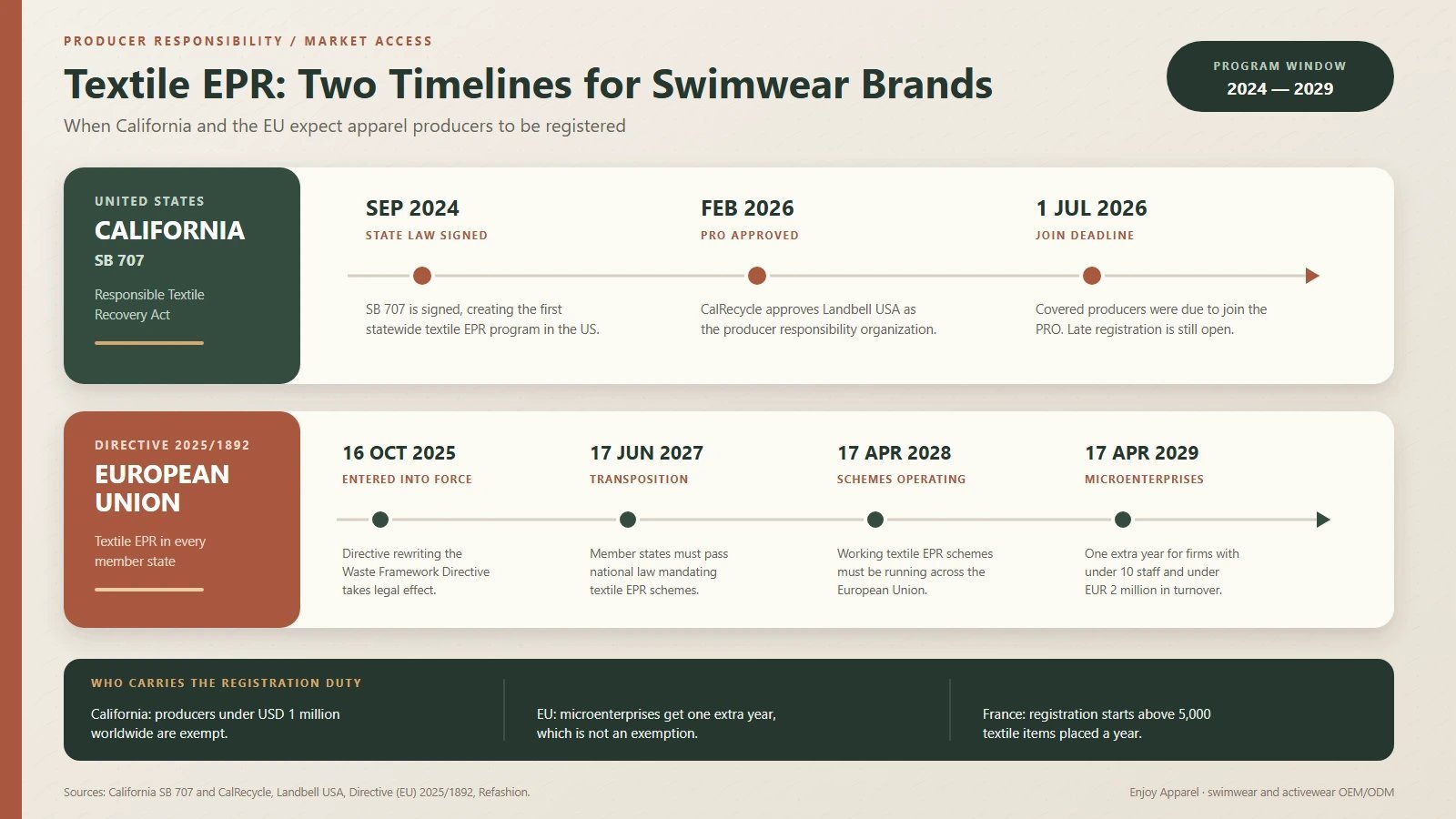
California moved first in the United States. Governor Newsom signed SB 707, the Responsible Textile Recovery Act, in late September 2024, creating the country’s first statewide textile EPR program. CalRecycle, the state resources agency, approved Landbell USA as the program’s PRO in February 2026, and covered producers were required to join by July 1, 2026.

That date has passed, but registration remains open, and the state now treats unregistered brands as formally out of compliance, with civil penalties that can reach $50,000 per day. Fee schedules and reporting formats are still being finalized, so a late registrant can still catch up before the program’s machinery fully switches on. Waiting longer only raises the stakes.

Europe runs on a longer fuse with a wider reach. Directive (EU) 2025/1892, which rewrites the Waste Framework Directive to mandate textile EPR in every member state, entered into force on October 16, 2025. National governments must transpose it into domestic law by June 17, 2027, and working EPR schemes for textiles must be operating by April 17, 2028. Microenterprises receive one extra year, until April 17, 2029.

Two national schemes already show what this looks like in practice. France has run textile EPR since 2007 through Refashion, and any company placing more than 5,000 textile items a year on the French market must register and pay per-unit eco-contributions that range from well under a cent to about twelve cents, depending on the category. The Netherlands followed in July 2023 with its UPV Textiel system covering consumer clothing and workwear.

Comparison of textile EPR registration dates for swimwear brands under California SB 707 and the EU directive
Two registration calendars: California’s SB 707 steps for swimwear producers, and the EU deadlines that follow.

Yes, Swimwear Is in Scope

For California, the answer is unambiguous. The statutory list of covered apparel in SB 707 names swimwear explicitly, alongside athletic wear, leggings, undergarments, and a long roster of other clothing categories. If you sell bikinis, one-pieces, rash guards, or board shorts into the state and your aggregate global revenue tops $1 million a year, the law treats you as a producer with a duty to join the PRO.

The EU directive covers clothing, clothing accessories, footwear, and household textiles, with no carve-out for swim categories. Member states will write their own product lists over the next two years, so national details can still shift, but nothing in the directive or the schemes running today treats swimwear as anything other than apparel. Trims, linings, and hangtags travel with the garment and are not reported as separate items.

Packaging is a different story, and a common source of confusion. Polybags, cartons, and mailers fall under separate packaging EPR regimes, such as California’s SB 54 and the EU’s Packaging and Packaging Waste Regulation, Regulation (EU) 2025/40, which began applying in August 2026. A swimwear brand selling into both markets should budget for two registrations, not one.

What Registration and Reporting Actually Look Like

The mechanics are similar everywhere. You join the designated PRO, sign a participation agreement, and declare what you placed on the market, usually as units or kilograms broken down by product category. The PRO uses those declarations to calculate your fees and to plan collection infrastructure, and it files the program plan with the regulator on behalf of its members.

The fee concept worth understanding early is eco-modulation. The EU directive and mature schemes like France’s tie fees to product design, so garments that are more durable, easier to recycle, or made with documented recycled content cost less to place on the market. A mono-material suit with certified recycled nylon should eventually carry a lower fee than a complex blend with no paperwork behind it. California’s fee schedule is still under construction, and brands there should watch for similar design-linked signals as the PRO publishes details.

Who exactly counts as the producer depends on where your legal entity sits relative to the buyer. Both frameworks cascade through brand owner, importer, and retailer until someone inside the jurisdiction carries the duty. Selling online does not move you out of scope, which is why the FAQ below spends time on distance selling.

The Compliance Data to Ask Your Swimwear Factory For

Every declaration you file traces back to production data, and most of it originates on the factory floor rather than in your marketing department. Brands that collect this data early can register in days. Brands that chase it retroactively miss deadlines. A standing data pack from your manufacturer should cover the following:

  • The exact fiber composition of every component in each style, including shell, lining, cups, elastics, and trims.
  • The unit weight of each style and size, so unit-based records can be converted into kilograms when a scheme asks for weight.
  • Packaging weights broken down by material, covering polybags, hangtags, and cartons, which feed your separate packaging registrations.
  • Production volumes per style per season, which your own sales data then allocates by destination country.
  • Recycled content documentation, such as GRS certificates, for any style you intend to claim under eco-modulated fees.
  • Fabric certifications that support eco-modulation claims, including OEKO-TEX® STANDARD 100 certified fabrics where applicable.

This is where factory choice quietly becomes a compliance decision. At Enjoy Apparel, our fabric library of more than 5,000 materials comes with composition specifications for every option, and we keep the same records across our 1,000-plus ready styles, from nylon-spandex bikinis to recycled rash guards. Because our quality system is ISO 9001-certified and our facility is BSCI-audited, the paperwork behind those fabrics exists before you ask for it.

The cleanest workflow is to attach the data request to every purchase order and refresh it once a year, since most schemes want annual declarations. If your factory cannot produce fiber content by component and unit weights per style, you will end up weighing samples yourself the night before a filing deadline.

Get the Paperwork Before You Need It

Need composition files, fabric certifications, or per-style weights for an EPR registration? Enjoy Apparel supports brand partners with the compliance data behind every style we produce, from fiber content breakdowns to recycled content documentation. Message us on WhatsApp at +852 9641 7199 or email admin@zsenjoyco.com, and tell us which markets you are registering in. We will put together the data pack your PRO expects.

Frequently Asked Questions

Do I have to register if I only sell online?

Yes. SB 707 applies to covered products sold in or into California regardless of sales channel, and online marketplaces must report their higher-volume third-party sellers to the state. The EU directive explicitly covers distance sellers, so a US webstore shipping orders directly into France is treated like any other producer placing goods on the French market.

I am a US brand selling into the EU. Is the obligation mine or my distributor’s?

It depends on who first places the product on each national market. If you sell directly to consumers online, that is usually you. If a European importer or distributor buys your line and resells it, the duty generally sits with them, though contracts and national transpositions differ. Confirm the allocation in writing rather than assuming your partner has it covered.

Are small brands exempt?

Sometimes. California exempts producers with under $1 million in aggregate global annual turnover. The EU grants microenterprises, meaning fewer than ten employees and under €2 million in turnover, one extra year until April 17, 2029, but not an exemption. France’s scheme applies once you place more than 5,000 textile items a year on the French market.

What exactly is a PRO?

A producer responsibility organization is the collective body that runs an EPR scheme day to day. It designs the collection and recycling network, files the program plan with the regulator, collects fees from member brands, and reports results. Landbell USA holds that role for California’s textile program, and Refashion plays it in France.

PFAS in Swimwear: What the EU’s October 2026 Textile Restriction Means for Your Brand

On 10 October 2026, the first big application date of the EU’s PFHxA restriction kicked in, and it covers clothing, accessories and footwear sold to the general public. If you run a swimwear or activewear brand selling into Europe or the US, this article explains what actually changed, why most swimwear was never a PFAS problem in the first place, and where the real risk hides in a typical swim range. It is written for brand owners and sourcing managers, not chemists.

What Changed on 10 October 2026

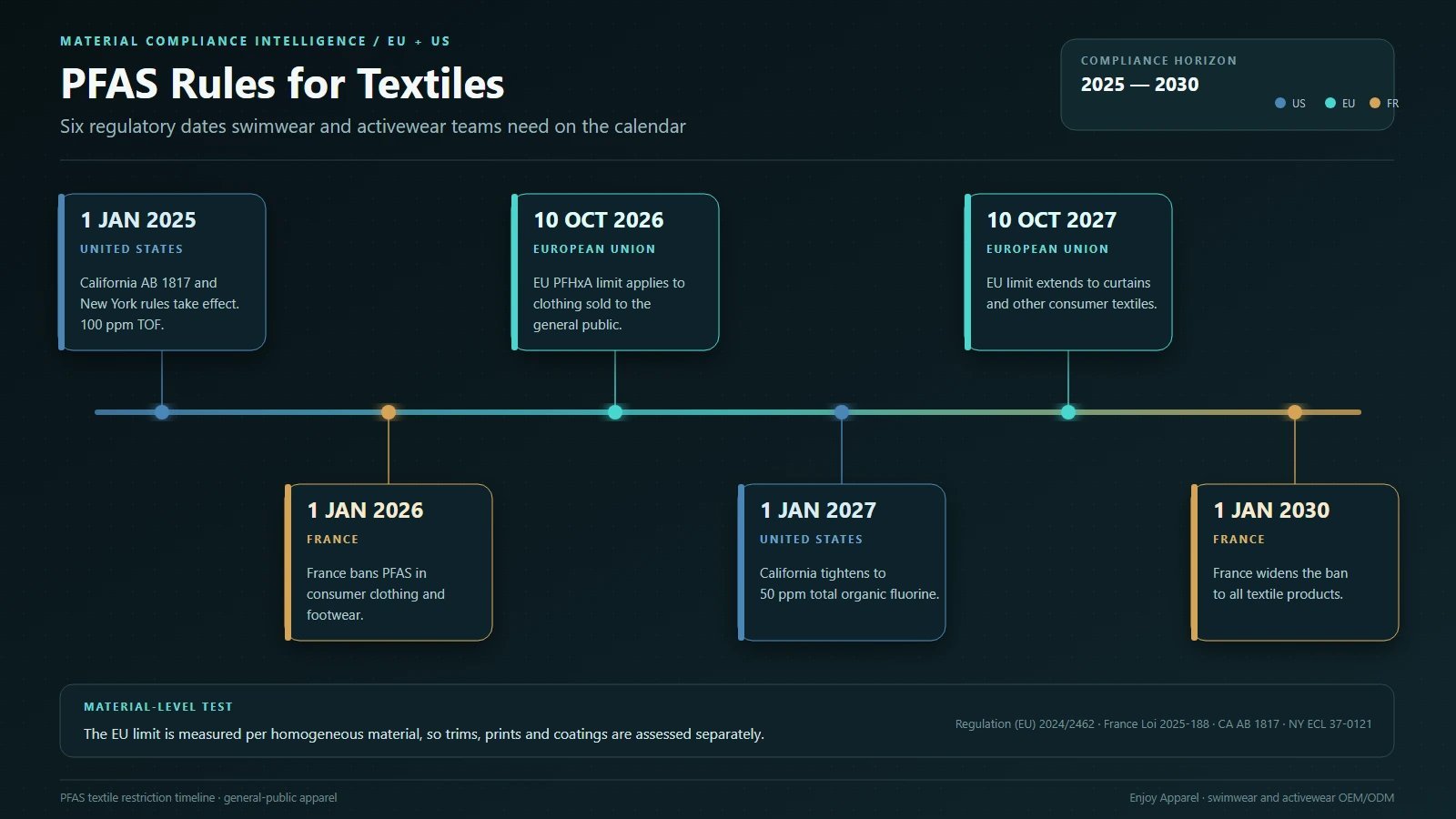
Commission Regulation (EU) 2024/2462 added entry 79 to Annex XVII of REACH, restricting undecafluorohexanoic acid (PFHxA), its salts and PFHxA-related substances. From 10 October 2026, textiles, leather, furs and hides in clothing and related accessories for the general public may not be placed on the EU market at or above 25 ppb for the sum of PFHxA and its salts, or 1,000 ppb for the sum of PFHxA-related substances, measured in homogeneous material. Other consumer textiles such as curtains and upholstery follow on 10 October 2027.

Two details matter for buying teams. First, the limit applies per homogeneous material, so a coated trim or a printed logo is assessed separately from the base fabric. Second, articles already placed on the market before 10 October 2026 are exempt, which protects existing stock but not your next production run. Anything you ship to the EU from now on has to comply.

The EU rule does not arrive in a vacuum. France went further with its own law, Loi n° 2025-188 of 27 February 2025, which has banned PFAS in consumer clothing textiles, footwear and waterproofing agents since 1 January 2026, and extends the prohibition to all textile products from 1 January 2030. Because France bans PFAS as a class rather than one substance group, it is arguably the stricter benchmark for any brand with French distribution.

Across the Atlantic there is no federal apparel ban, so compliance is a state-by-state puzzle. California’s AB 1817 has prohibited new textile articles containing regulated PFAS since 1 January 2025, using a total organic fluorine threshold of 100 ppm that drops to 50 ppm on 1 January 2027. New York’s Environmental Conservation Law section 37-0121 has banned apparel with intentionally added PFAS since 1 January 2025. More states have dated apparel restrictions in the pipeline, so designing for the strictest current rules is the cheapest insurance.

Timeline of PFAS textile restriction dates for swimwear brands, from California and New York in 2025 to the EU PFHxA limit in October 2026
Six dates that decide when a swimwear or activewear range has to be free of fluorinated finishes.

What PFAS Does in Textiles, and Why Swimwear Is the Exception

PFAS earned their place in apparel for one reason: the carbon-fluorine bond is exceptionally good at repelling water, oil and stains. For decades the chemistry sat inside durable water repellent finishes on rain jackets, stain-resistant treatments on upholstery and school uniforms, and coatings on outdoor gear. That is exactly the product category regulators targeted first, because it is a wide dispersive consumer use where the chemicals wash out and persist in the environment.

Swimwear is built on the opposite premise. A bikini or a pair of swim shorts is designed to get wet, stay wet for a while, and then dry fast. No rational designer applies a water-repellent finish to a garment whose job is to absorb a swim.

Quick-dry performance in swimwear comes from fiber physics, not chemistry. Fine nylon or polyester filaments blended with spandex barely hold water, and the knit structure spreads moisture across a large surface area so it evaporates quickly. Chlorine-resistant PBT achieves its durability through the polymer itself. None of this requires a fluorinated finish.

This is the point most PFAS coverage misses, and it is good news for swim brands. Your core product, the actual swimsuit, is one of the lowest-risk garment types on the market. Brands that build on clean nylon/spandex or polyester/spandex constructions can answer most customer and retailer questionnaires with confidence, because the performance story never depended on the chemicals being banned.

Where PFAS Can Actually Hide in a Swim Range

The risk lives at the edges of the line, in the products that behave less like swimwear and more like outerwear. Men’s boardshorts and surf trunks are the classic case. Buyers often ask for water beading on the fabric surface, and the traditional way to deliver that effect was a C8 or C6 fluorocarbon DWR. If your boardshort spec says “water repellent” without naming the finish chemistry, that is your first audit target. Fluorine-free C0 DWR alternatives exist and are now the default request among EU-facing brands.

Cover-ups, beach ponchos and light resort jackets are a second blind spot. These pieces are frequently sourced with coated or treated fabrics borrowed from outerwear supply chains, where PFAS finishes were routine. Kids’ swim and beachwear deserve extra attention too, because stain-resistant and “easy clean” claims on children’s products historically leaned on fluorinated chemistry, and children’s categories attract the strictest scrutiny from regulators and retailers alike.

Smaller components can also carry risk. Certain prints, coatings and functional trims have involved PFAS-related substances, which is why the EU limit’s homogeneous-material logic matters: a compliant base fabric does not rescue a non-compliant trim. Finally, recycled fabrics add a supply chain wrinkle. GRS-certified recycled polyester or nylon is a strong sustainability story, but recycled feedstock can carry legacy chemistry if the upstream chain is loosely documented, so the certification of the finished fabric matters more than the recycled claim itself.

What to Write on Your Spec Sheet, and What to Ask Your Factory

The fix is mostly paperwork discipline applied at the start of development, not the end. On your tech pack, ban the vague phrase “water repellent finish” and instead specify “fluorine-free (C0) DWR” wherever a repellent effect is genuinely needed, and state explicitly that no intentionally added PFAS are permitted anywhere in the garment, including prints, coatings and trims. One sentence on the spec sheet is cheaper than a failed test or a pulled shipment.

From your manufacturing partner, the documents that close the loop are straightforward.

  • A signed PFAS-free declaration covering every component of the garment, not only the shell fabric.
  • A current restricted substances list (RSL) that the factory applies to its fabric and trim sourcing.
  • Third-party test reports from an accredited lab, ideally covering total organic fluorine as a screening method plus targeted PFAS analysis for high-risk components.
  • Certification documents for the finished fabric, such as OEKO-TEX® STANDARD 100, which since 2024 includes a total fluorine limit that acts as a practical PFAS screen.
  • A certificate of compliance if you sell into California, where AB 1817 requires manufacturers to provide one on request.

Timing matters as much as paperwork. California’s threshold tightens to 50 ppm total organic fluorine on 1 January 2027, and France’s scope widens to all textiles in 2030. Product you develop this season may still be on shelves when the next rule bites, so spec to the strictest foreseeable threshold rather than today’s minimum.

How We Approach This at Enjoy Apparel

Enjoy Apparel is a swimwear and activewear OEM/ODM factory in Zhongshan, Guangdong, working with brands that sell into both the EU and North America. Our day-to-day answer to PFAS compliance is unglamorous and effective: we build swimwear from constructions that never needed fluorinated finishes in the first place. Quick-dry, chlorine resistance and UPF 50+ performance come from the fiber and the knit, across a library of more than 5,000 fabrics and over 1,000 ready styles.

When a range does call for surface effects, for instance a boardshort with water beading or a cover-up with a protective hand feel, we spec fluorine-free finishes and source from mills supplying OEKO-TEX® STANDARD 100 certified fabrics. Our operation is BSCI-audited and ISO 9001-certified; we maintain the declaration and testing trail that EU and California compliance expects, and we share it per style rather than as a generic PDF.

Send Us Your Fabric Spec for a Compliance Review

If the new PFAS swimwear rules raised questions about your current line, the fastest way to get clarity is a direct technical conversation. Send your fabric list or spec sheet to the Enjoy Apparel team and we will flag which components carry PFAS risk, propose fluorine-free or finish-free alternatives from our fabric library, and tell you what documentation we can support for your target markets.

Sampling runs 14 to 21 days, bulk production takes at least one month, and MOQ starts at 100 pieces per style, so there is time to correct course before your next season. Reach us on WhatsApp at +852 9641 7199 or by email at admin@zsenjoyco.com.

FAQ: PFAS and Swimwear Compliance

Does quick-dry fabric mean it contains PFAS?

Almost never. Quick-dry swimwear gets its performance from hydrophobic-by-nature fibers such as nylon, polyester or PBT, knitted in open constructions that spread and release moisture fast. That is fiber engineering, not a chemical finish. PFAS-based treatments were designed to stop water entering a fabric, which is the opposite of what a swimsuit needs, so most swimwear contains no PFAS at all unless a separate water-repellent or stain-resistant finish was deliberately specified.

Do recycled fabrics carry PFAS risk?

They can, but the risk is manageable. Recycled polyester or nylon inherits whatever chemistry was present in its feedstock, and recycled streams are harder to trace than virgin ones. The practical safeguard is to certify the finished fabric, not the marketing claim: a GRS certificate verifies recycled content, while an OEKO-TEX® STANDARD 100 certificate with its total fluorine limit screens the actual material your customers will wear. Ask for both, and add targeted testing for high-risk styles.

Which test should I request from my factory?

Start with total organic fluorine (TOF) as a screening test, because it catches any fluorinated chemistry cheaply and maps directly onto California’s 100 ppm and 50 ppm thresholds. Where TOF comes back elevated or a component is high risk, such as a DWR-treated boardshort fabric, follow up with targeted PFAS analysis by an accredited lab. Pair the test reports with a signed PFAS-free declaration and the factory’s RSL so you hold both evidence and accountability.

If I only sell in the US, can I ignore the EU rules?

You can ignore the EU regulation itself, but not the direction of travel. California already bans regulated PFAS in textiles at 100 ppm total organic fluorine, tightening to 50 ppm in 2027, and New York bans intentionally added PFAS in apparel. Several other states have adopted or proposed dated apparel restrictions, and major retailers apply their own PFAS policies nationwide. Building one clean, fluorine-free spec for all markets is simpler than maintaining parallel compliant and non-compliant versions of the same product.

FTC Green Guides for Apparel: How US Swimwear Brands Can Back Up Recycled Content Claims

Most swimwear and activewear brands assume the green marketing headache lives in Europe. If you sell into the United States, a different set of rules applies to every “recycled,” “eco-friendly,” or “sustainable” line on your hangtags and product pages. This guide is for brand owners and sourcing teams, not lawyers. It covers what the FTC Green Guides require of apparel claims, why “recycled” is the word that gets brands into trouble, and how to verify the factory paperwork behind it before your labels go to print.

The US Plays by Its Own Rulebook

The American framework for environmental marketing is the FTC’s Green Guides, codified at 16 CFR Part 260 and last fully revised in 2012. The FTC opened a fresh review in December 2022, collecting public comments on whether the guides need updating, but that review has produced no finalized revision. As of this writing, the 2012 text is still the operative standard, so compliance decisions should be built on what exists today rather than on what might change next year.

One thing worth understanding is how enforcement works. The Green Guides are not a statute by themselves. They are the FTC’s interpretation of Section 5 of the FTC Act, which prohibits deceptive acts and practices in commerce. A claim that contradicts the guides is treated as presumptively deceptive, and that is where the legal exposure comes from.

Apparel brands do not need to imagine what that exposure looks like. In April 2022, the FTC announced actions against Kohl’s and Walmart for marketing dozens of rayon textile products as “bamboo” and touting them as eco-friendly, when turning bamboo into rayon is a chemically intensive process. Kohl’s agreed to pay $2.5 million and Walmart $3 million in civil penalties. The products involved were ordinary soft goods, the same category swimwear lives in, and the claims involved were the same vague green language many brands still use.

What the Current Guides Say About the Claims You Actually Make

Start with recycled content, the claim most relevant to swimwear brands using recycled nylon or recycled polyester. Under 16 CFR 260.13, recycled content must consist of material that was recovered or diverted from the waste stream, either before or after consumer use. An unqualified “made with recycled materials” claim is acceptable only when the entire product, excluding minor components, is made from recycled material. If your bikini is 82% recycled nylon and 18% virgin spandex, the claim needs to be qualified with the actual percentage, stated clearly and prominently.

There is a detail here that catches brands off guard. Factory offcuts collected and fed straight back into the same production line generally do not count as recycled content under the guides, because that material would never have entered the waste stream. If your supplier describes its fabric as recycled, ask whether the content is pre-consumer, post-consumer, and genuinely diverted.

Recyclable claims are a different trap. Under 16 CFR 260.12, an unqualified “recyclable” claim is appropriate only when recycling facilities are available to a substantial majority of consumers where the product is sold, defined as at least 60%. Blended stretch fabrics like nylon/spandex are not accepted by curbside or municipal textile recycling in any meaningful way, which means calling a swimsuit recyclable is very difficult to defend.

Then there are the broad claims. Under 16 CFR 260.4, unqualified general environmental benefit claims like “eco-friendly” or “sustainable” are considered nearly impossible to substantiate, because a reasonable consumer can read a wide range of far-reaching benefits into them. The FTC’s guidance is blunt: do not make them unqualified. The workable version ties the claim to one specific, provable attribute, such as “made with 78% recycled nylon,” and nothing more.

Across all of these sits one underlying rule from 16 CFR 260.2. Marketers must hold a reasonable basis, often competent and reliable scientific evidence, before the claim is made, not after someone challenges it. For a recycled content claim on a garment, that reasonable basis is a paperwork chain, which brings us to the practical core of this article.

The Paper Trail: From the Hangtag Back to the Factory

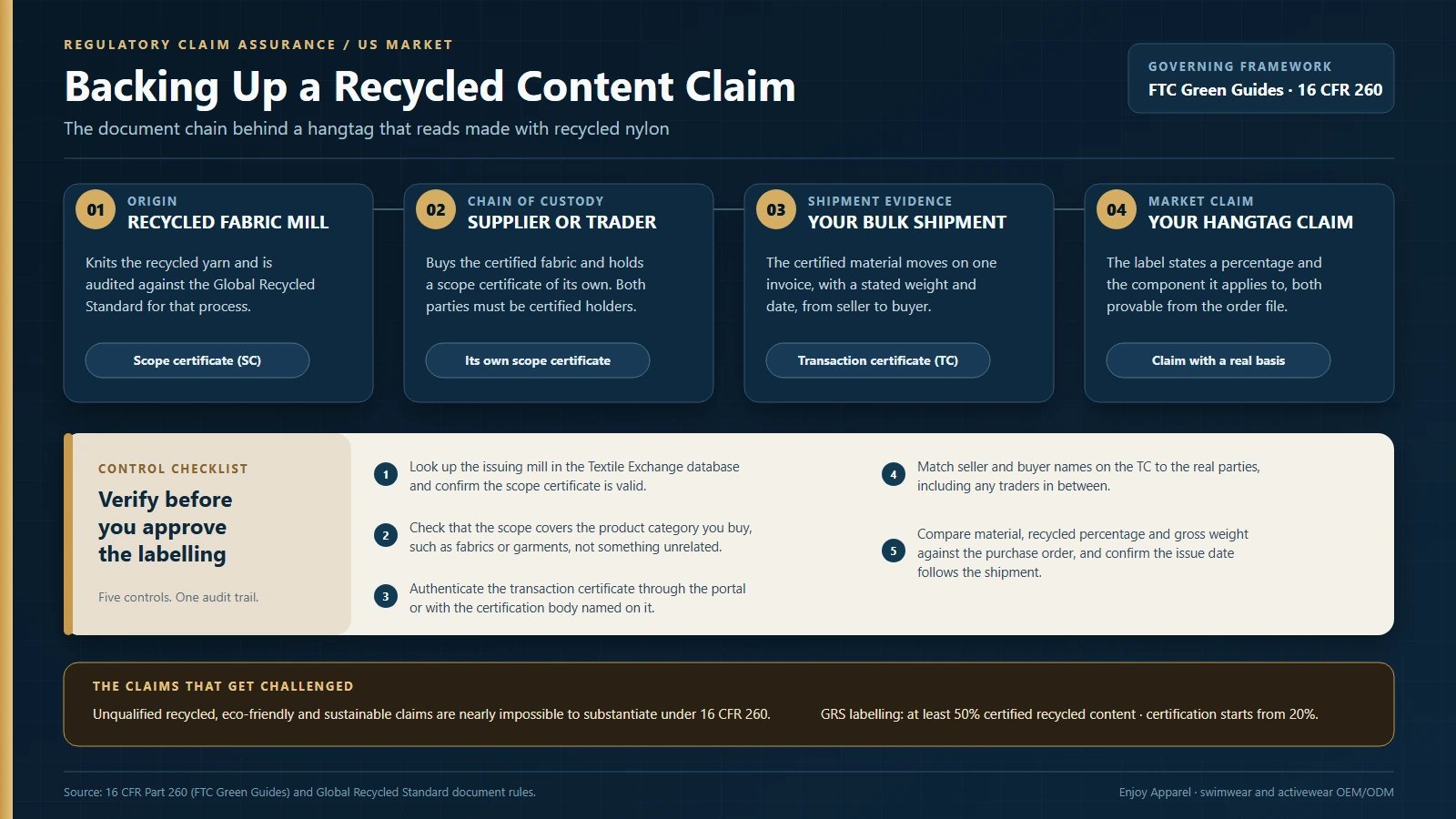
If your brand uses fabric certified to the Global Recycled Standard, you will encounter two documents, and they are not interchangeable. The scope certificate certifies a site. It says a particular factory or mill is audited and approved to handle GRS material for specified products and processes. The transaction certificate, usually called a TC, certifies a shipment. It records that a specific quantity of certified material moved from one certified party to another on a specific date, and it references the scope certificates of both seller and buyer.

This distinction matters because a scope certificate alone proves capability, not content. A mill can hold a valid scope certificate and still ship you conventional fabric on a given order. The FTC’s substantiation standard cares about the batch that became your garments, and the document that speaks to that batch is the TC.

There is also a threshold worth knowing before you plan your labeling. GRS certification applies to products with at least 20% recycled content, but consumer-facing GRS labeling and logo use requires at least 50% certified recycled content in the product. A fabric with 25% recycled content can be certified and traded with TCs, yet it cannot carry the GRS logo on your hangtag.

Neither document should be accepted as a PDF at face value, because PDFs are editable and certificates expire. Textile Exchange, the nonprofit that owns the GRS standard, maintains free public tools for both checks. When a TC lands in your inbox, here is what to verify before you sign off on labeling:

  • Look up the issuing factory in Textile Exchange’s “Find a Certified Company” database and confirm the scope certificate is currently valid, not expired.
  • Check that the scope covers the product category you are buying, such as fabrics or garments, not something unrelated.
  • Authenticate the TC itself through Textile Exchange’s “Authenticate a Transaction” portal, or directly with the certification body named on it.
  • Match the TC’s seller and buyer names to the actual parties in your supply chain, including any traders in between.
  • Compare the material description, recycled percentage, and gross weight on the TC against your purchase order and shipping documents.
  • Confirm the TC’s issue date follows the shipment it covers, since a TC predating the goods cannot certify them.

This verification takes about five minutes per order and requires no cooperation from anyone. A supplier who hesitates to provide a TC number, or whose certificate cannot be found in the official database, is telling you something important before your brand’s name goes on the claim.

Document chain behind a recycled content claim for swimwear brands, from a mill scope certificate to the hangtag
How a recycled nylon claim travels, from the mill’s scope certificate to the hangtag in your retailer’s hands.

How This Differs From the EU Rules

If you also sell into Europe, do not assume one compliance file covers both markets. The US system is a general deception framework applied claim by claim, enforced case by case, while the EU is moving toward prescriptive rules about methodology and substantiation formats. The practical difference for a brand is that the FTC asks “can you prove this specific claim,” whereas the EU increasingly dictates how you must prove it and which claims are off the table entirely.

We covered the European side in detail in a separate piece on EU green claims rules for swimwear brands, including what brands can and cannot say under the current and incoming directives. Read the two together if your collection ships to both markets, because a hangtag that passes in New York can still fail in Amsterdam.

What to Ask Your Factory Before You Print “Recycled”

The safest workflow treats the marketing claim and the sourcing decision as one conversation. Before approving any recycled content claim, ask your manufacturing partner for its scope certificate, confirm which recycled fabrics in its range are covered, and agree in writing that a transaction certificate will be issued for every bulk order that will carry the claim. A factory that works with certified material routinely will not find this unusual.

At Enjoy Apparel, GRS-certified recycled options sit inside a fabric library of over 5,000 materials, alongside virgin nylon/spandex, polyester/spandex, and chlorine-resistant PBT.

When a client builds a collection around a recycled claim, we provide the corresponding transaction certificates as a standard part of the order paperwork, and the fabrics we source include OEKO-TEX® STANDARD 100 certified options. As a BSCI-audited and ISO 9001-certified factory, we are used to having our documentation opened up to client verification, because we would rather you check than trust.

The commercial side stays simple. Sampling runs 14 to 21 days, and bulk production takes at least a month, so the right moment to raise the certification question is at the sampling stage, not after the order is cut.

If you are planning a recycled swimwear or activewear line for the US market and want to see what a real certificate chain looks like, send us a note. We are happy to share a sample GRS transaction certificate, talk through which recycled fabrics fit your styles, or walk through how the documentation maps to the claims you want to print. Reach us on WhatsApp at +852 9641 7199 or by email at admin@zsenjoyco.com.

FAQ

Are the FTC Green Guides legally binding?

Not directly. They are the FTC’s official interpretation of how Section 5 of the FTC Act applies to environmental marketing. Claims that contradict the guides are treated as presumptively deceptive, which gives them real enforcement weight, as the Kohl’s and Walmart penalties showed.

What happens if my brand violates them?

The FTC can pursue civil penalties and consent orders that restrict future claims. Kohl’s paid $2.5 million and Walmart $3 million in 2022 over bamboo and eco-friendly claims. Private lawsuits and state attorneys general can follow the same playbook.

Does GRS certify my brand or my factory?

The factory. Scope certificates are issued to specific sites in the supply chain. Your brand’s protection comes from transaction certificates that trace the certified material from those sites into your specific orders.

Can I ever say “sustainable” on a hangtag?

Not unqualified. The Green Guides say general environmental benefit claims are nearly impossible to substantiate across every reasonable consumer interpretation. Tie the wording to one specific, provable attribute instead, such as a verified recycled content percentage.

Private Label Activewear and Swimwear: Logos, Labels, Hangtags and Packaging Explained

Your customer’s first physical contact with your brand is not the leggings or the bikini. It is the mailer on the doorstep, the sticker sealing the tissue, the hangtag turning between finger and thumb, the woven label at the back of the neck. For a brand that lives online, those first seconds of unboxing carry the entire weight of everything you have built on a screen. Get the trims right and an ordinary product feels considered. Get them wrong and premium fabric reads as generic.

This guide is written for founders and Amazon sellers preparing a first OEM order with a manufacturer. It walks through every branding element that goes beyond the garment itself, from logo application methods to custom clothing labels, hangtags and packaging, and it explains the compliance basics and the budget effects most suppliers never volunteer. By the end you will know exactly what to send a factory before sampling begins.

What Private Label Actually Covers

Private label sounds like a small thing, a logo sewn onto a ready product. In practice it is a bundle of decisions made at the same time as the garment itself. The logo on the fabric, the woven brand label, the printed care label, the hangtag, the size sticker, the hygiene liner inside a bikini bottom and the bag it all ships in are each sourced from different trim suppliers, and each one needs artwork, content and a decision from you.

These items run on their own production schedules in parallel with your fabric and cutting, which is why a serious factory asks for them up front. A hangtag finalized late holds up packing, and packing holds up shipment. When you brief a manufacturer on a private label swimwear or activewear order, treat the trims as part of the product rather than an afterthought. Our private label service shows how the whole bundle comes together in a single quotation.

Logo Application Methods and Where Each Works

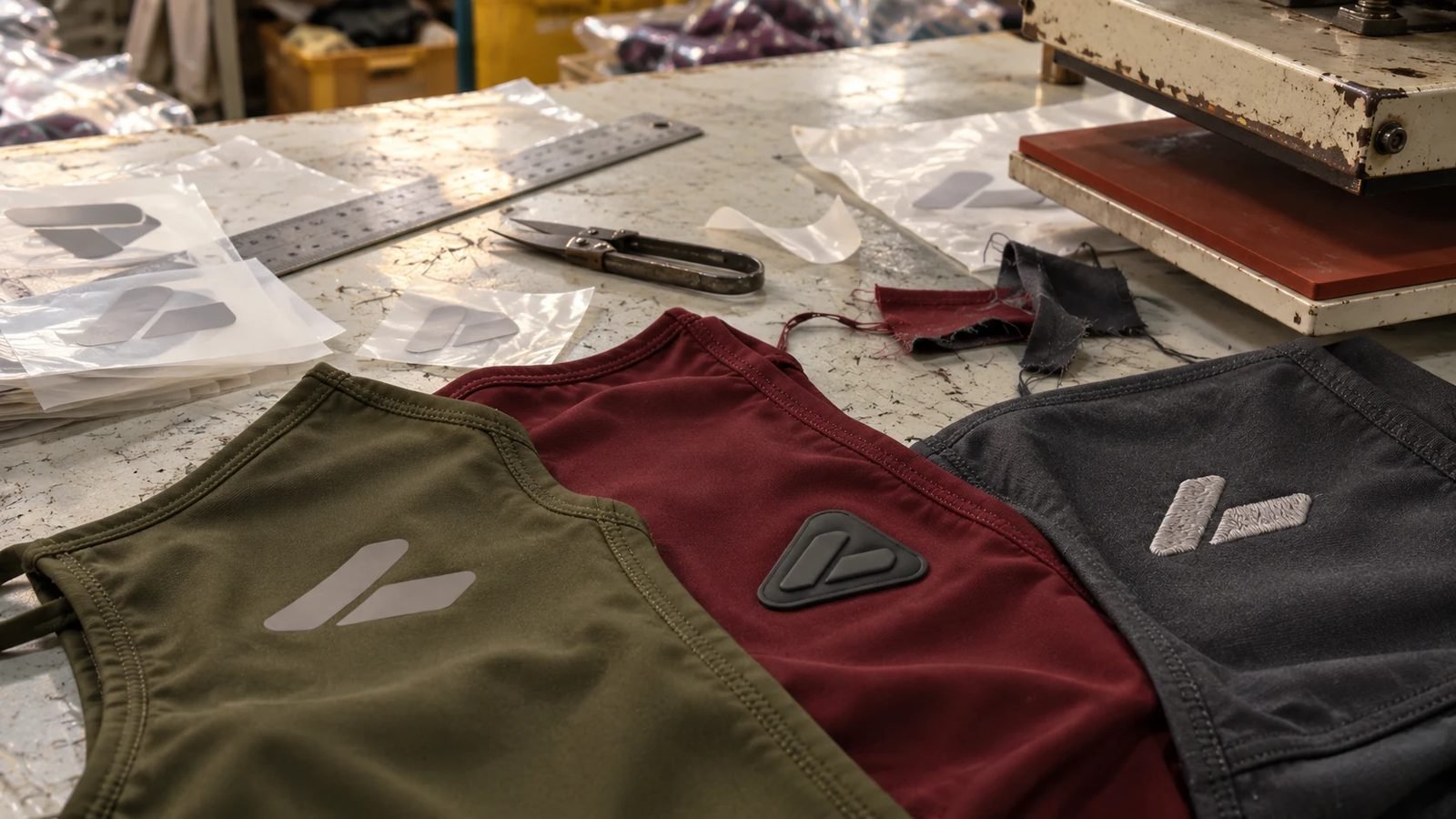
Heat transfer is the workhorse of swim and stretch categories. The logo sits flat, moves with four-way stretch fabric and survives pool water when the film is specified correctly, and the same process prints tagless care information directly onto the garment, removing the itchy sewn patch entirely. Silk screen suits bolder artwork such as chest and back graphics on tees, hoodies and cover-ups, where a slightly raised ink layer is part of the look.

Silicone logos are molded and raised, with a soft rubbery feel that reads premium on a leggings waistband or the chest of a sports bra. Embossing and debossing press the mark into or out of thicker materials for a tonal, understated effect that suits minimal brands. Reflective application earns its place on running and outdoor pieces, where low-light visibility is a selling point rather than decoration.

Flock gives a velvety, retro texture that surf and varsity-inspired brands use well, though it belongs on casual layers more than on swim. Embroidery is the oldest method and still the strongest signal of quality, but on four-way stretch swimwear fabric the stitching gathers and puckers the knit, so save it for jackets, cover-ups, caps and tote bags.

Whatever you choose, the base matters as much as the mark. We apply logos onto OEKO-TEX® STANDARD 100 certified fabrics, so the material sitting against skin all day has already passed independent testing for harmful substances.

Heat transfer, raised silicone and embroidery applications on colorful activewear fabrics
Each logo method creates a different surface, weight and stretch response.

Labels and Compliance Basics for Swim and Activewear

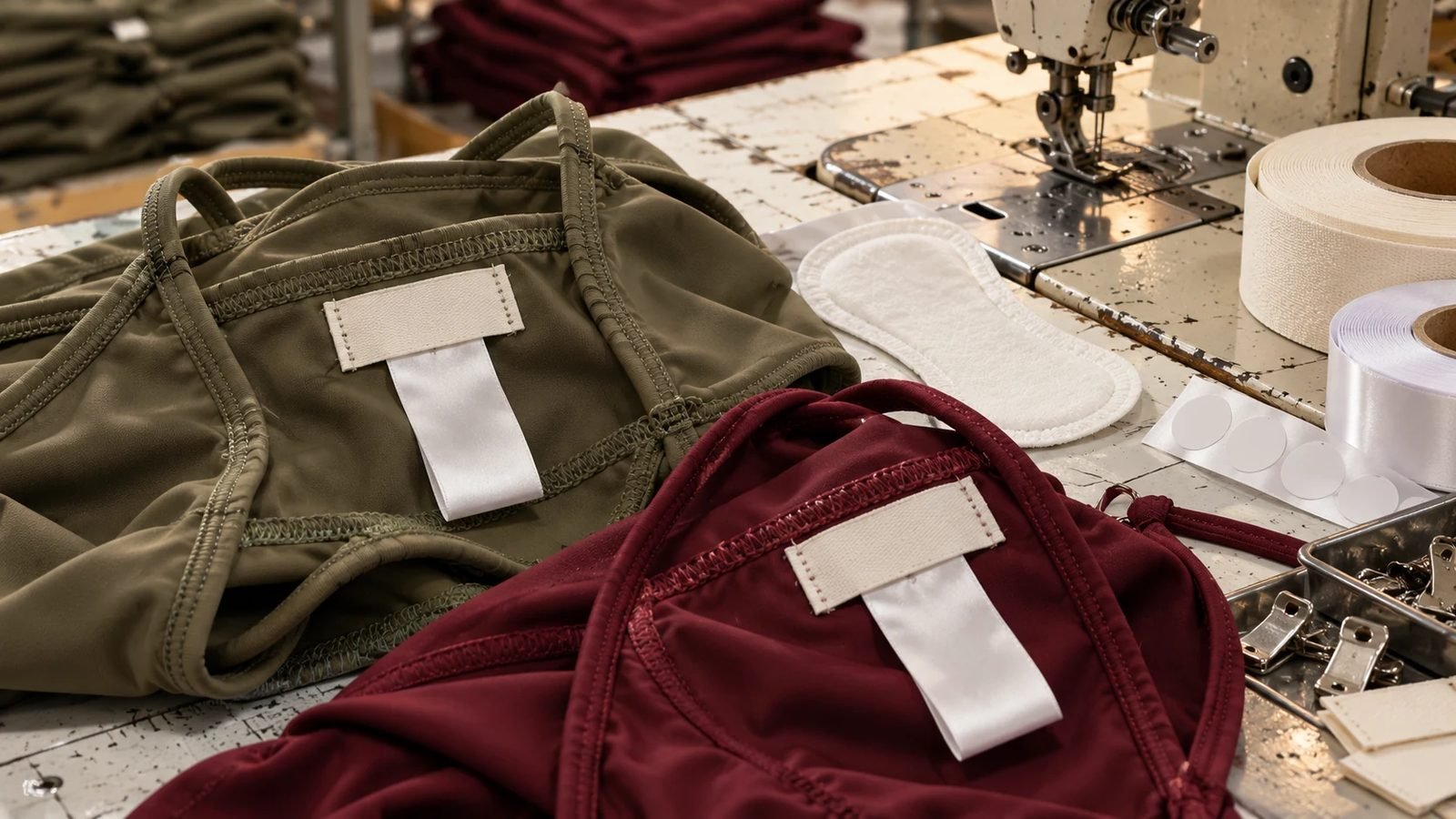
A private label garment carries two labels that do different jobs. The woven brand label is identity, usually damask or satin, sewn at the neck of a top or the back waistband of leggings, and it should outlive the garment. The care label is the legal one, typically printed on soft satin or taffeta, carrying the information regulators require. Cheap care labels crack and fade within a few washes, and on swimwear the print must also survive chlorine, salt and sunscreen without dissolving into a smudge.

In the United States, the Federal Trade Commission requires most apparel to state fiber content, country of origin and care instructions, and it expects a responsible party such as your brand or importer to be identified on the product. Marketplaces and retail buyers enforce the same checklist before they list you, so treat compliance as a design input rather than paperwork at the end. Selling into Europe adds its own language and fiber-naming rules. Your target market decides the content, which is why factories ask where you sell.

Write the care instructions for the garment you actually made. A nylon-spandex bikini and a cotton-blend hoodie need different symbols, and copying a competitor’s label is how brands end up promising machine washable on a hand wash fabric. Chlorine-resistant print on swimwear care labels costs very little and prevents the most common complaint in the category, a label that goes blank while the suit is still new.

Blank woven brand labels and care labels sewn into swimwear and activewear samples
Brand labels communicate identity, while care labels carry product and compliance information.

Hangtags, Stickers and Retail-Ready Details

The hangtag is your smallest billboard and your last salesperson. It carries price, size and barcode, but it also carries the brand story a shopper reads in the fitting room or photographs for a friend. Recycled kraft stock sends one message, thick coated card with a foil logo sends another, and the choice of string, safety pin or plastic fastener changes how the garment hangs on the rail.

Stickers do quiet operational work. Size stickers on the outside of a polybag let a warehouse pick orders without opening the product. Hygiene liners inside swimwear bottoms reassure the customer and protect you on returns. If you sell through Amazon, the bag itself needs a suffocation warning once it crosses a certain size, and marketplaces reject stock that arrives without it. None of this is glamorous, and all of it is cheaper to get right at the factory than to fix inside a fulfillment center.

Packaging Options for Activewear and Swimwear

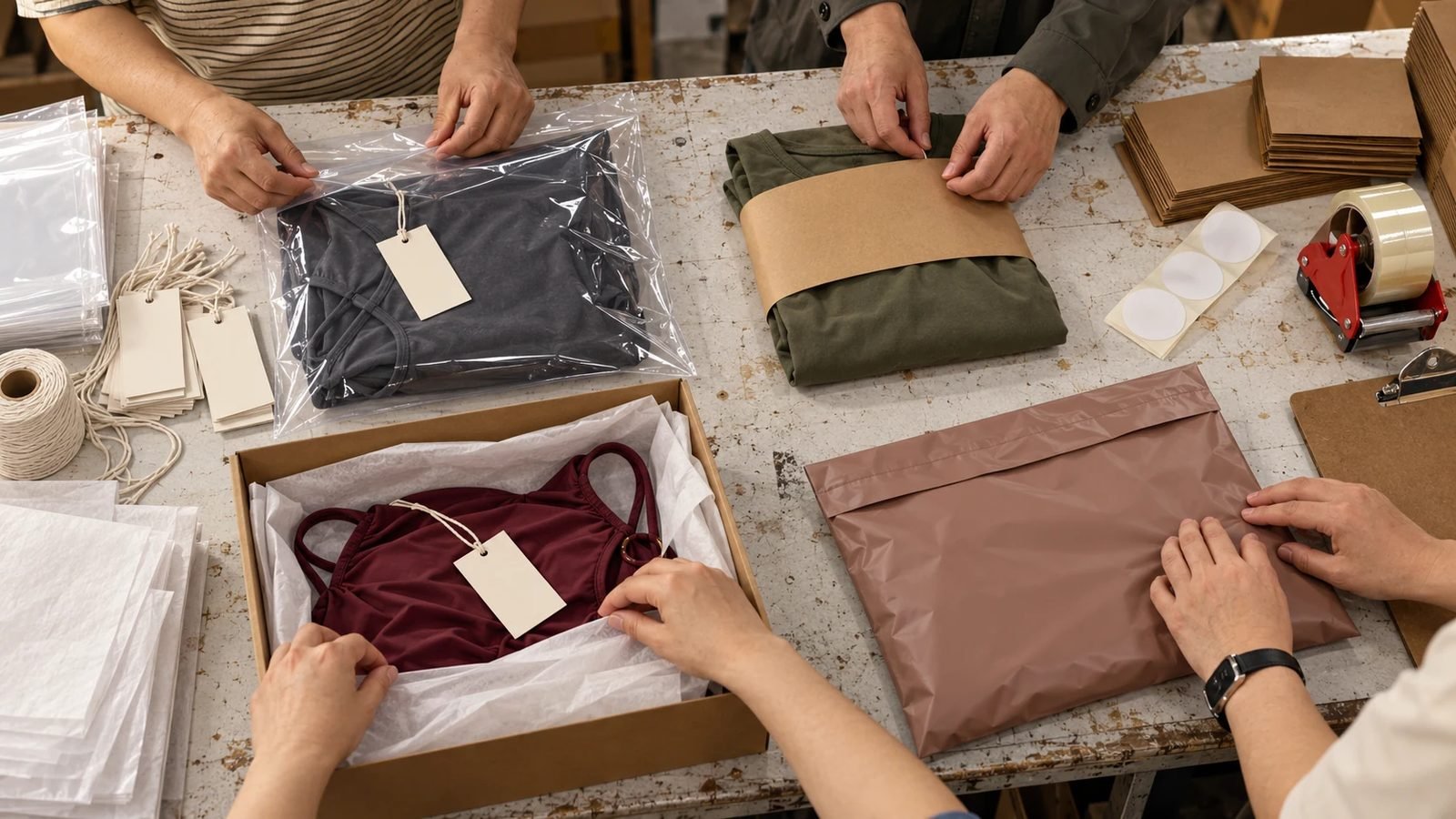
The standard for a first order is a self-seal PE bag, one per garment, sometimes carrying a printed logo. It protects the product, keeps sizes separated and costs very little. Brands positioning higher move to boxes, belly bands or printed mailers, which photograph well in unboxing content but add cost, volume and shipping weight. Direct-to-consumer brands often skip the inner bag entirely and let a branded mailer do both jobs.

Compostable and recycled-content bags exist and we can source them, but two cautions apply. They cost more and often carry their own minimums. More importantly, any environmental claim printed on packaging is a legal claim, not a mood. Regulators in the EU are tightening the rules around green marketing, as we covered in our guide to EU green claims for swimwear brands, and vague words like eco-friendly can now create real liability. Print only what you can document.

Activewear packaging options with clear garment bag, belly band, kraft box and mailer
Packaging choices change cost, protection, shipping volume and the unboxing experience.

How Labels and Packaging Affect Your MOQ and Budget

Every trim has its own upstream minimum that rarely matches your garment quantity. A woven label mill, a hangtag printer and a polybag factory each start their machines at their own floors, so a first order often produces more labels and tags than garments. The extras are not waste. A good factory stores them for your reorder, and your second order suddenly carries almost no trim cost.

Garment minimums work the same way, set by fabric and dyeing rather than by the sewing floor, which our piece on custom swimwear MOQ and fabric walks through in detail. At Enjoy Apparel, a private label run begins at a minimum of 100 pieces for each style, and we cost the full trim package into the same quotation, so the number you approve already includes labels, tags and bags.

Standardizing saves the most money. One label design, one hangtag layout and one bag size shared across a whole range spread every setup cost thin, which is how established brands keep trims invisible in their margins. We have run private label programs this way for clients that include Free People and Monday Swimwear, and the same discipline works at first-order scale.

What to Send Your Manufacturer

The fastest sampling rounds start with a complete brief. Before you ask for pricing, have these ready.

  • Your logo as a vector file, meaning AI, EPS or PDF, because a screenshot cannot be separated for printing.
  • Pantone codes for your brand colors, since dusty rose means something different at every print house.
  • Logo placement with measurements, ideally inside a tech pack, so the print lands exactly where you pictured it.
  • Care label content for each fabric you use, covering fiber composition, country of origin and care instructions.
  • A packaging specification covering bag or box, dimensions and printing, plus whether you want hangtags and stickers.
  • Your target markets, because the compliance content for the United States differs from Europe and the Middle East.

Pull these six items together and a manufacturer can quote accurately in days instead of weeks of back-and-forth. If you are mapping out a first private label order in swimwear or activewear, email your artwork and tech pack to admin@zsenjoyco.com, or reach the team through our contact page. You will hear back with logo method recommendations, label and packaging options, swatches from a fabric library that runs past 5,000 qualities, and a realistic timeline for your launch.

Frequently Asked Questions

What is private label activewear?

Private label activewear is product made by a manufacturer and sold under your brand, carrying your logo, labels, hangtags and packaging instead of the factory’s. It sits between buying blank wholesale stock and developing fully custom ODM designs, and for most startup brands it is the fastest credible route to market.

What is the best logo method for swimwear?

Heat transfer is the category standard because it lies flat, stretches with the fabric and can double as a tagless care label. Silicone works well for a raised premium mark on waistbands. Avoid embroidery on four-way stretch swim fabric, since the stitching puckers the knit; save it for jackets and cover-ups.

What labels are legally required on swimwear sold in the United States?

Most apparel sold in the US must show fiber content, country of origin and care instructions, with the brand or importer identified as the responsible party. Marketplaces apply the same checklist before listing your product, so build these elements into your label artwork from the start rather than retrofitting after production.

Can I market my packaging as eco-friendly?

Only with evidence. Regulators, especially in the EU, now expect environmental claims to be specific, substantiated and verifiable. Compostable or recycled-content packaging backed by supplier documentation is a defensible claim. A green leaf icon next to the word sustainable is not.

Custom Tennis Skirts and Skorts: Fabric, Built-In Shorts and Fit Specs for Your Order

Racquet sports are having a long moment. Tennis participation keeps climbing, pickleball courts are appearing inside retired big-box stores, and golf is drawing a younger crowd that dresses differently than the one before it. For activewear brands, the interesting part is not the sports themselves but the garment they share. The skort, a skirt with a short built underneath, is the common silhouette across all three, and it has become one of the most requested expansion categories we hear about from brands that already sell leggings and sports bras.

This guide is written for founders and product developers planning a custom tennis skirts order, whether the hangtag says tennis, golf or pickleball. It covers the fabric choices that decide how a skort feels and performs, the construction details that belong in your spec sheet, and what a factory needs from you before the first sample gets cut.

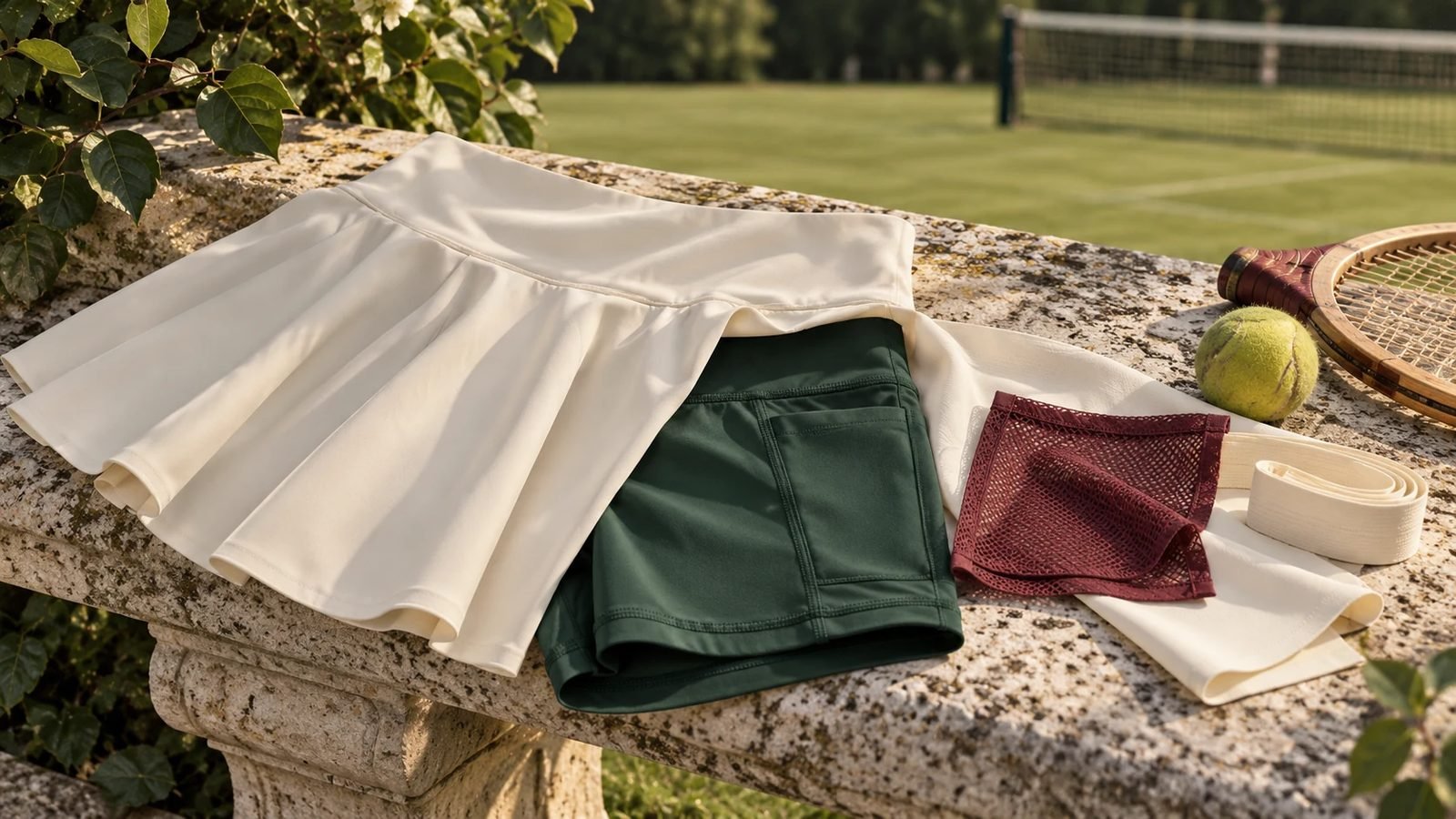
Two women wearing custom tennis skorts and dresses walking beside a grass tennis court

Why Activewear Brands Are Adding Racquet-Sport Styles

The expansion logic is unusually clean. Your customer already plays. The woman who buys your high-waisted leggings is, in large numbers, the same woman booking a court on Saturday morning, and she wants her activewear brand to dress her there too. You are not acquiring a new audience. You are following an existing one into an adjacent category.

The production logic is just as friendly. A skort is built from the same stretch knit family as yoga bottoms, so a tennis skirt manufacturer is typically a factory already fluent in nylon-spandex and polyester-spandex, flat seams and elastic waistbands. Pattern work and fit intent differ, but the machinery, the fabric suppliers and the sewing skill all carry over from a leggings line.

Retail timing adds pressure. Courtwear has crossed into everyday fashion, which means a golf skort sells to customers who have never held a club. Brands that wait for the trend to peak before developing will land after it, because sampling, fitting and production take a full season to do properly.

Fabric Specs for Skorts

The nylon-spandex route gives you the soft, matte, brushed hand feel that premium activewear customers associate with high-end yoga wear. It drapes beautifully in the overskirt and photographs well, which matters for a category that lives on social media. The polyester-spandex route runs slightly crisper and slicker, holds vivid prints with better color saturation, and generally costs less at comparable quality levels. Price-led lines and print-heavy collections usually land on polyester, while boutique and studio-positioned brands lean nylon.

Whichever base fiber you choose, the functional finishes are what make a skort court-ready rather than studio-only. Moisture-wicking and quick-dry treatment handle a three-set match in July. UPF 50+ sun protection covers outdoor play, and it is a claim customers increasingly look for on the hangtag. Cooling finishes have moved from novelty to expectation in warm-weather markets. All four are standard options in our fabric library, and any serious supplier should offer them without drama.

Here is the decision most first-time skort specs miss: the overskirt and the built-in short want different fabrics, and you should spec them separately. The overskirt wants a lighter, drapier knit with enough flow to move well, since stiffness reads as cheap the moment she walks. The short wants more substance and snap, a higher spandex share with genuine compression and recovery, because it does the garment’s actual work. Cutting both components from one fabric to save a step is a false economy that surfaces in reviews.

Draped coral overskirt fabric beside firm teal compression shorts fabric for a tennis skort
A successful skort pairs a fluid outer layer with a supportive built-in short.

Construction Decisions That Belong in Your Spec

Factories build what you write down, and skorts have more writable decisions than most categories. The built-in short comes first. Inseam length sets the personality of the garment: a shorter inseam reads sporty and shows more leg, a longer one suits modest markets and older customers, and the wrong choice for your audience will sink an otherwise good product. Leg openings need a stay-put solution, most often a soft silicone gripper tape or a compressive folded hem, because a short that rides up during a serve gets the skort returned.

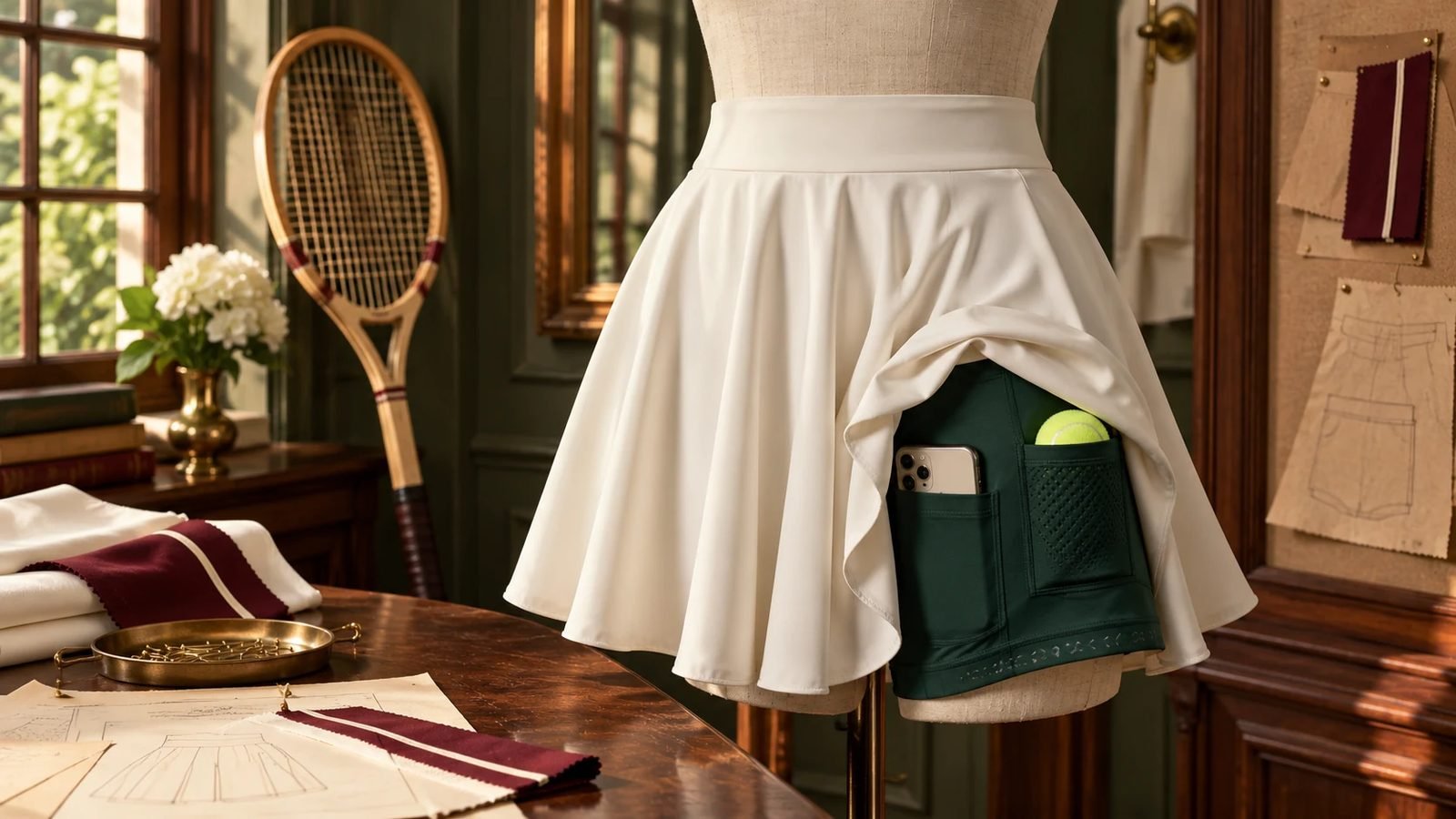
Pockets are now table stakes rather than a bonus. A ball pocket on the short, sized and angled so a tennis ball sits securely upside down, is the detail players check first. A phone pocket, usually a second sleeve on the opposite leg, serves the much larger crowd who will never carry a ball. Both belong in the spec with placement sketches, because retrofitting them after sampling wastes a development round.

Custom tennis skort anatomy showing built-in shorts, ball pocket, phone pocket and leg gripper
Built-in shorts, secure pockets and a stay-put hem should be specified before sampling.

Silhouette and waistband choices define the range. An A-line cut flatters broadly and sells steadily, a swing or circle cut moves dramatically and photographs well, and pleats carry the classic tennis association but add sewing cost and pressing labor. Waistband height should match your existing bottoms so customers can buy on habit, and a wide, double-layer band holds the garment up through lunges. Skirt length typically runs from micro and flirty to just above the knee, and most launch ranges cover two lengths rather than one.

Sizing is a commercial decision disguised as a technical one. We grade to US, EU and AU conventions including plus and petite, and the grading question belongs in your first conversation, not the third. A plus-size skort is not a graded-up size small, because the short needs its own rise and thigh adjustments, so flag the size range early if you plan to serve it properly.

When you send an inquiry, the details below are the ones that turn a vague request into a quotable order:

  • State the sport and the customer first, because tennis, golf and pickleball buyers weight length and pockets differently.
  • Name your fabric direction and the functional finishes you need, such as UPF 50+ or cooling.
  • Give the short inseam, the skirt length and the leg-opening solution you want tested.
  • Describe pockets by what they must hold, a ball or a phone, and where.
  • Attach reference photos for silhouette, since “A-line” and “pleated” mean slightly different things to every pattern maker.
  • List your size conventions and any plus or petite range up front.

Decoration and Branding on Skorts

Skorts offer less branding real estate than a hoodie, so placement earns real thought. Heat transfer logos are the workhorse here because they sit flat, stretch with the knit and add no weight, which suits the left hip of the overskirt or the back of the waistband. Embroidery reads more premium and fits the country-club end of the golf market, but it needs a stabilized placement, and a waistband or a pleat base handles it better than a stretchy panel.

Woven labels, care labels, hangtags and packaging carry the rest of the private label story. That topic deserves its own guide rather than a rushed paragraph, so we will leave the full branding checklist for a dedicated piece on private label execution.

From Inquiry to First Sample

A factory can start from two kinds of input, and both work. A tech pack with flat sketches, measurements and fabric callouts is the gold standard because it removes guesswork. A physical reference sample, the skort your designer loves and wants modified, is almost as good and sometimes faster, because the pattern team can measure it directly and you can mark changes on the garment itself.

Either way, expect the first questions to be about fabric direction, target price and size range rather than styling. At Enjoy Apparel, our sportswear line includes tennis skirts in active production, and because we develop in the same stretch knits as our yoga wear, the fabric conversation usually shortens to pulling cards from our library of more than 5,000 options. Club shops and brand clients who ask about social compliance get a straight answer: we are a BSCI-audited factory, and audit paperwork goes out with the development file on request.

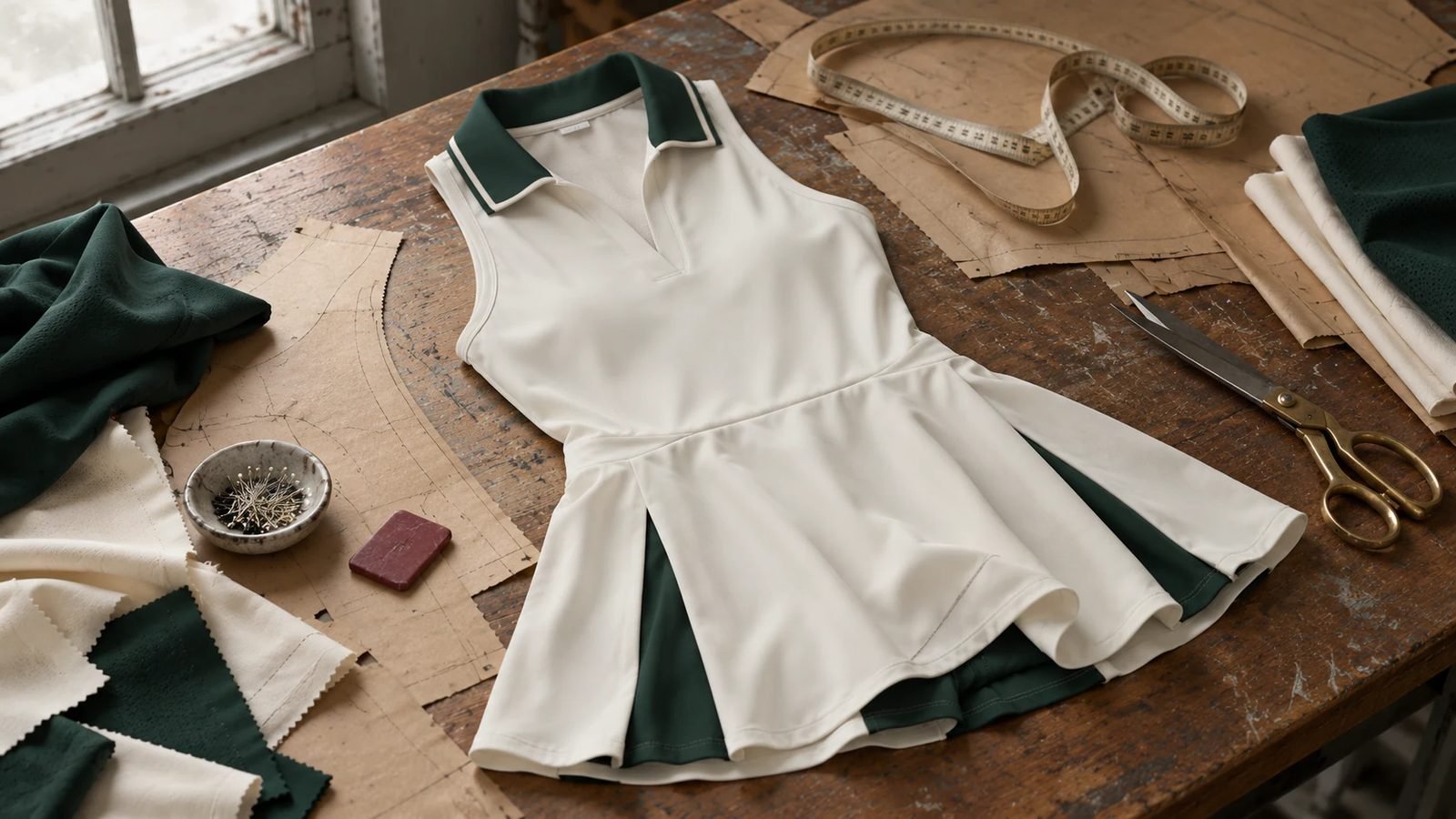
Once fabric, colors and the spec sheet are locked, a first sample takes 14 to 21 days in our sampling room, with fit revisions moving faster after that because the pattern already exists. The full journey from first email to bulk production follows the same stages as any custom order with us, and our custom process page maps each one.

Custom tennis skort first sample with patterns, measuring tape and colorful fabric swatches
The first sample brings fabric, proportion and construction decisions together for review.

The short version is this. Spec the overskirt and the short as two fabrics, write down the inseam, pockets and silhouette decisions, flag your size range early, and start from a reference garment if you have one. If a racquet-sport capsule is on your roadmap, message us on WhatsApp at +852 9641 7199 and we will send fabric cards for both routes, nylon and polyester, so you can feel both before committing to a sample. Or reach the team through our contact page if email suits you better.

Frequently Asked Questions

What is the difference between a tennis skirt and a skort?

A tennis skirt traditionally means a skirt with a separate or attached brief underneath, while a skort has a fitted knit short built in. In current activewear the terms blur, and most products sold as tennis skirts today are technically skorts. For manufacturing purposes, the built-in short is the standard construction, and your spec should state the short’s inseam and fabric regardless of which word goes on the hangtag.

Can one skort pattern serve tennis, golf and pickleball?

Mostly yes, because the silhouette is shared across the three sports. The adjustments are in length, pockets and fabric positioning rather than the base pattern. Tennis buyers expect a ball pocket, golf-leaning ranges run longer and more tailored, and pickleball sits between them. Many brands launch one base pattern with two lengths and let colorways and marketing do the sport-specific work.

What size ranges can you produce for custom tennis skirts?

We grade to US, EU and AU size conventions, including plus and petite ranges. Extended sizes need their own fit work on the built-in short rather than simple grading, so the earlier you flag the range, the better the first sample fits. Size charts and grading rules are part of the development conversation, not an afterthought.

Custom Sports Bras: Support Levels, Padding and Sizing Specs for OEM Orders

Ask any activewear brand what drives its returns and one answer keeps surfacing. The bra sold as high support shows up in reviews as “fine for yoga,” and the one marketed as light and easy gets sent back for doing nothing at all. The gap rarely comes from bad sewing. It starts much earlier, in a spec sheet that says “medium support” and leaves the factory to guess what that means in fabric, elastic and construction.

This guide is written for brand founders, product developers and sourcing buyers planning a custom sports bra line with an OEM partner. It translates the marketing language of support into specifications a factory can execute, then works through fabric, padding, sizing and testing, and closes with the information that makes a first inquiry answerable in one round instead of five.

What “Support Level” Actually Means on a Spec Sheet

Support is not a single feature. It is the sum of three systems working together, and a factory can only hit your target if you say which system carries the load. The first is compression, where stretch fabric presses breast tissue toward the chest wall and limits movement through tension alone. The second is encapsulation, where each breast sits in its own shaped cup or panel, controlling motion by containment rather than pressure.

Most commercial bras blend the two. A light yoga bra leans on compression by itself. A true high support sports bra usually pairs encapsulation cups with a compressive outer layer, because pressure alone cannot control larger cup volumes at running speed. Writing “high impact” in an email tells the factory almost nothing. Writing “encapsulated cups, compressive outer, built for running” tells it exactly where to start.

Compression, encapsulation and combined high-support sports bra constructions in a sampling studio
Compression, encapsulation and combined construction control movement in different ways.

The underband does more work than any other component, typically anchoring the majority of the bra’s support. Its width, elastic tension and the way it is enclosed all belong in your spec rather than in the factory’s assumption. A band that rides up on a fit model is a band that will generate returns at scale.

Straps finish the system. Racerback and cross-back constructions pull support from the shoulders and upper back and suit high-impact training, while straight or adjustable straps read as lifestyle and fit low to medium impact. Convertible designs add hardware decisions and cost. Name the strap construction and the intended activity in your brief, and the factory can match elastic widths and stitch types without a guessing round.

Fabric Choices by Support Level

Fabric does the quiet half of the support work, and the blend decision follows the impact level you are targeting. Low and medium support styles can run on softer, lower-tension knits. High support styles need high compression fabric, where the knit is engineered to hold tension through repeated stretch cycles without relaxing.

On fiber, nylon-spandex gives the softer, more matte hand feel that premium activewear brands prefer, and it is the default for studio and lifestyle positioning. Polyester-spandex costs a little less, manages moisture aggressively and holds sublimation prints far better, which makes it the practical base for print-led or volume-priced ranges. Either blend can carry a moisture-wicking finish, but the claim belongs on your hangtag only if the mill data backs it.

Weight and recovery each deserve a line in your spec. Sports bra fabrics typically run heavier than swim fabrics, and high support styles typically sit at the top of that range, because weight buys stability. Recovery, meaning the fabric’s ability to snap back after stretch, matters even more. A bra that stretches beautifully and stays stretched has failed your customer by the tenth wear. Ask for stretch-and-recovery test data rather than trusting a hand-feel judgment.

If you want swatches in hand before committing, Enjoy Apparel pulls sports bra qualities from a fabric library running past 5,000 options across its sportswear and swim lines, including recycled alternatives. Development briefs ship with the relevant weight and compression options side by side, so the decision happens on fabric rather than on a spreadsheet.

Colorful nylon-spandex, polyester-spandex, mesh and lining swatches for custom sports bras
Fabric weight, recovery and surface character all contribute to the final support level.

Padding and Underwire Options

Padding is a positioning decision as much as a functional one. Removable cups dominate the mid-market because they let the wearer choose and they simplify care instructions, but they generate a known complaint, cups that fold or migrate in the wash. Molded cups solve that by building shape into the bra itself, at the cost of more pattern and tooling work. Unlined compression styles keep cost and care simple and read as athletic rather than shaped.

Underwire sports bras occupy a different niche. They serve larger cup sizes, where encapsulation plus wire support delivers what compression alone cannot, and they answer a demand that much of the category still underserves. Sports bras for large breasts rank among the most consistent unmet needs shoppers voice, and brands that spec them properly tend to keep those customers for years.

Underwire in a garment that flexes through a workout is an engineering problem rather than a styling one. The wire channel, casing fabric and bar-tacked ends all need specification, and the wire gauge must match the intended impact level. Our swimwear line has produced underwire and padded styles for years, and that wire-channel and cup-construction experience transfers directly into sports bra development, which shortens the sampling loop on structured styles.

Sizing Systems That Survive a Size Run

Sizing is where good bras lose their reviews, because the system you choose decides how many ways the fit can drift. S-through-XL alpha sizing is cheaper to grade, easier to stock and simpler for customers, and it works for low and medium support styles where fit tolerance is generous. High support and larger cups outgrow it. Band-plus-cup dual sizing, the 34C logic borrowed from lingerie, fits far more bodies accurately but multiplies your SKU count and grading work.

Sister sizing complicates the picture further. A 34C, a 36B and a 32D share cup volume but not band length, and customers who know this will size across when their own size sells out. If your range uses dual sizing, the size chart needs to acknowledge sister sizes openly, or customer service will answer the same email forever.

Geography adds another layer. US, EU and AU sizing systems label the same body differently, and a brand selling across all three needs conversion tables locked before grading begins rather than after the first shipment. Plus size and petite ranges deserve their own grade rules instead of a straight extension of the core size run.

Whatever system you choose, consistency across the size run is the thing to lock before ordering. Grade rules decide how much each measurement grows per size, and an inconsistent grade shows up as a five-star medium and a one-star XL of the very same bra. Approve the graded spec, not just the sample size, and confirm it in writing before bulk production starts.

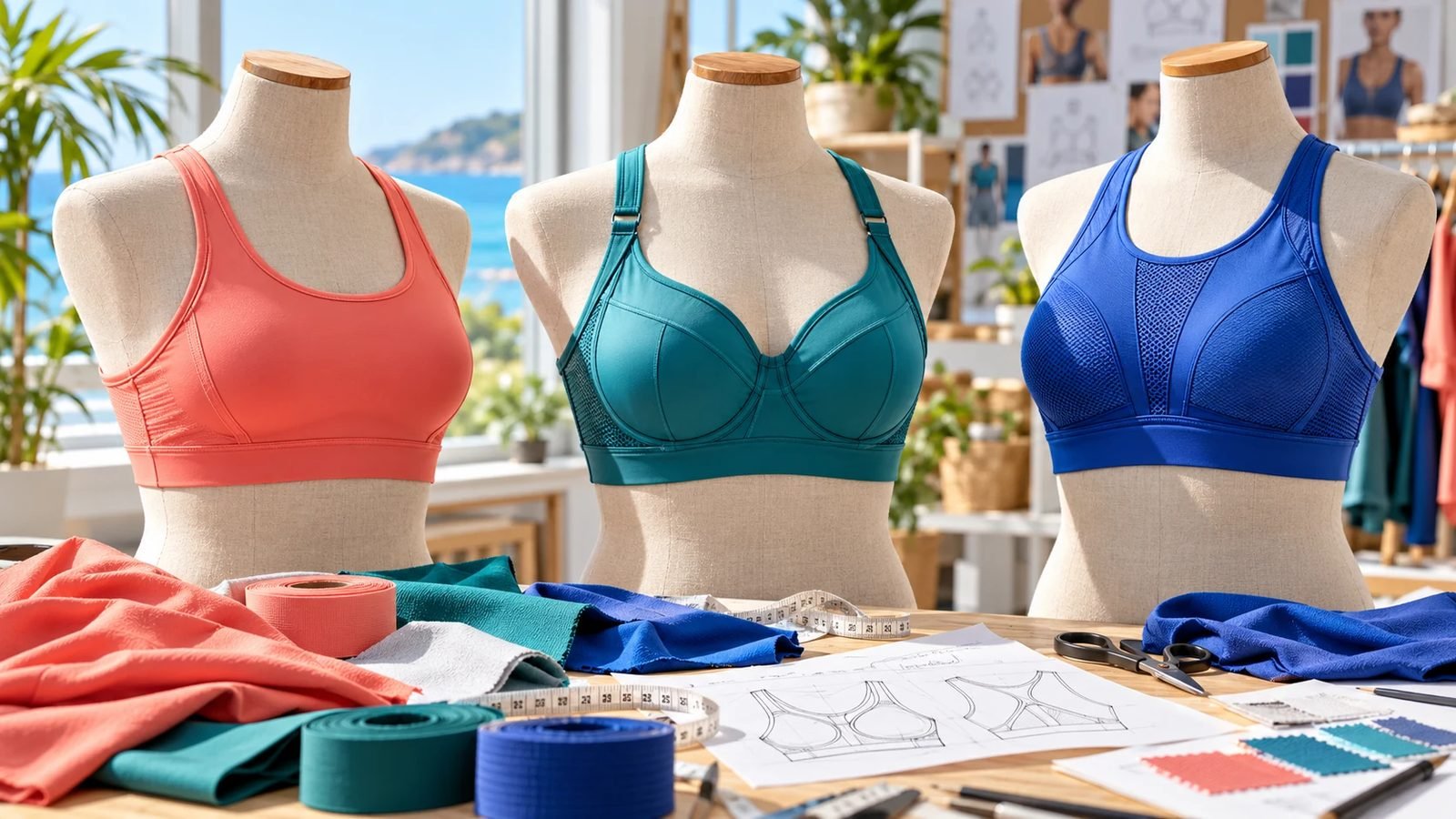
Graded sports bra size run with pattern pieces and measuring tools on a sampling table
A complete size run reveals changes in both cup volume and band proportion.

Testing Before Bulk Production

A sports bra cannot be validated on a table. Fit and bounce testing on real wearers, moving at the impact level you claim, is the only test that predicts reviews. Run it on more than one body and more than one size, because a bra that controls bounce on a B-cup sample tells you nothing about your DD customer.

Wash testing catches the second failure mode. Removable cups that fold, elastics that relax and prints that crack all surface within a handful of wash and dry cycles, and it is far cheaper to learn that in sampling than in a returns report. Specify the care conditions you intend to print on the label, then test to exactly those conditions.

Process discipline is what makes these tests repeatable across an order. As an ISO 9001-certified factory, we run inspection as a documented sequence from fabric intake through final packing rather than a single check at the end, and the same framework covers bras as well as swim. The logic mirrors the checkpoints in our swimwear quality control process, where each stage is defined, recorded and held to standard before the next one begins.

What to Include in Your OEM Inquiry

The fastest first replies go to inquiries that arrive decision-ready. A complete brief lets the factory price, plan and sample against real numbers instead of assumptions, and it signals that you will be a straightforward partner through production. Cover these points and the conversation starts at solutions rather than questions:

  • State the support level you are targeting and the activity behind it, since “high support for distance running” specifies far more than “high support” alone.
  • Send reference samples or detailed photos of bras whose fit and construction you want to match or beat.
  • Name your sizing system, alpha or band-and-cup, and attach the size chart with grade rules for the full size run.
  • Specify padding and underwire preferences, including whether cups should be removable, molded or omitted entirely.
  • Note your fabric preferences, such as nylon-spandex versus polyester-spandex, along with any weight or compression targets.
  • Give your target quantity per style and colorway so pricing and material planning reflect the real order.
  • Share your target retail price if you have one, because it lets the factory steer fabric and construction toward your margin instead of away from it.

If your line starts from a sketch rather than a reference sample, our ODM team develops original sports bra styles from concept through Pantone-matched colorways, and an exclusive design agreement can keep the resulting designs yours alone. Either route converges on the same next step, which is a conversation with people who build these garments every day.

When a sports bra line moves from idea to roadmap, send the brief or the reference samples through our contact page. Expect a reply with fabric options, a realistic development path and a candid view of the right place to begin.

Frequently Asked Questions

How do compression and encapsulation sports bras differ?

Compression bras hold breast tissue against the chest wall through fabric tension, which suits smaller cups and lower impact. Encapsulation bras give each breast its own shaped cup, controlling movement through structure. High support styles typically combine both, pairing encapsulation cups with a compressive outer layer, and your spec should say which mechanism you expect to do the work.

How long does custom sports bra production take?

Allow at least a month for bulk production once the final sample is approved, with the exact timeline set by style complexity, fabric availability and order volume. Structured styles with molded cups or underwire sit at the longer end, so build that buffer into your launch calendar rather than discovering it mid-season.

Can you make sports bras for large cup sizes?

Yes. Larger cup sizes call for band-and-cup dual sizing, encapsulation construction and, where the design needs it, underwire support carried over from our swimwear wire-channel experience. The size chart should acknowledge sister sizing so customers can find their fit when a size sells through, and the grade rules should be approved across the full run before production begins.